Loading Search...


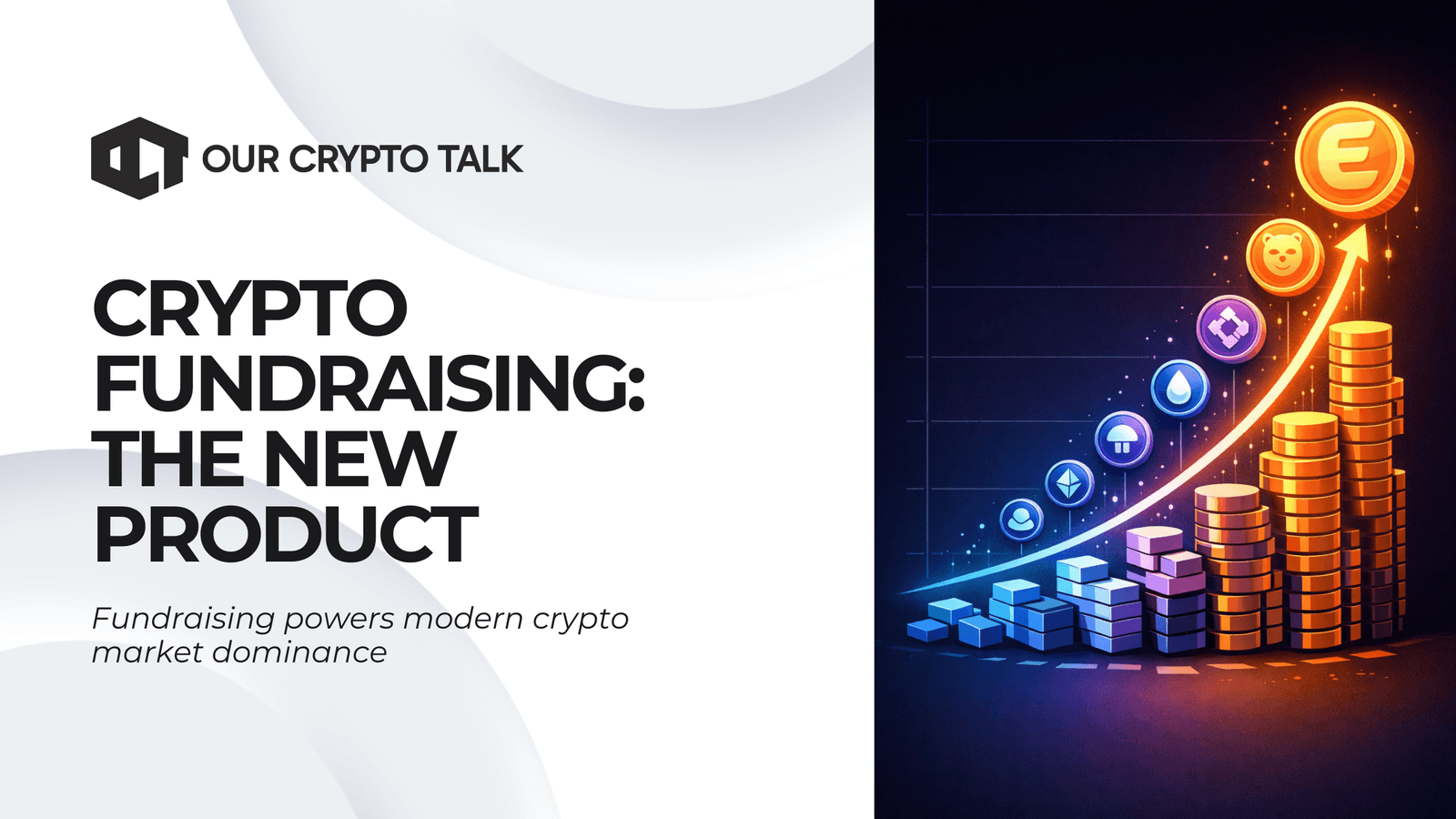
Crypto fundraising now drives project valuation, adoption, and market momentum, reshaping how crypto projects sustain long-term relevance.

Author: Kritika Gupta
The crypto industry has entered a new structural phase. Crypto fundraising itself has become one of the most powerful drivers of project growth, valuation, and market dominance. In previous cycles, projects like Ethereum, Chainlink, and Uniswap grew because they delivered real utility first. Adoption followed functionality, and capital flowed in response to proven demand.
In contrast, the 2024–2025 cycle has seen projects such as Ethena, Worldcoin, Berachain, and EigenLayer achieve multi-billion-dollar valuations shortly after raising hundreds of millions in funding. Ethena raised over $100 million and rapidly became one of the largest stablecoin ecosystems. Worldcoin raised over $240 million and reached multi-billion valuations despite ongoing debates about its utility model. Berachain achieved a $1.5 billion valuation before full mainnet maturity. EigenLayer raised over $164 million and became one of the fastest-growing infrastructure protocols by total value locked.
Projects raise capital through venture funding, token sales, and ecosystem programs. They then deploy that capital into liquidity incentives, exchange listings, ecosystem grants, and marketing campaigns. This creates rapid visibility, accelerates adoption metrics, and drives valuation expansion.
The crypto market operates differently from traditional startup ecosystems. In traditional markets, companies build products, generate revenue, and eventually achieve valuation through financial performance. Crypto reverses this order. Tokens provide instant liquidity, meaning valuation becomes liquid immediately, regardless of revenue or maturity. This structural characteristic allows crypto fundraising to directly influence adoption, valuation, and ecosystem expansion.
This structural characteristic allows capital itself to become a growth mechanism.When a project raises large amounts of funding, it can deploy that capital strategically to create the appearance and momentum of adoption. Liquidity can be subsidized, incentives can be funded, marketing can be amplified, and ecosystems can be expanded. This creates a reflexive loop where capital sustains growth.
Crypto fundraising provides liquidity and it increases market cap. Higher market cap strengthens narrative. Strong narrative attracts more users and investors. This attracts more capital, reinforcing the cycle.
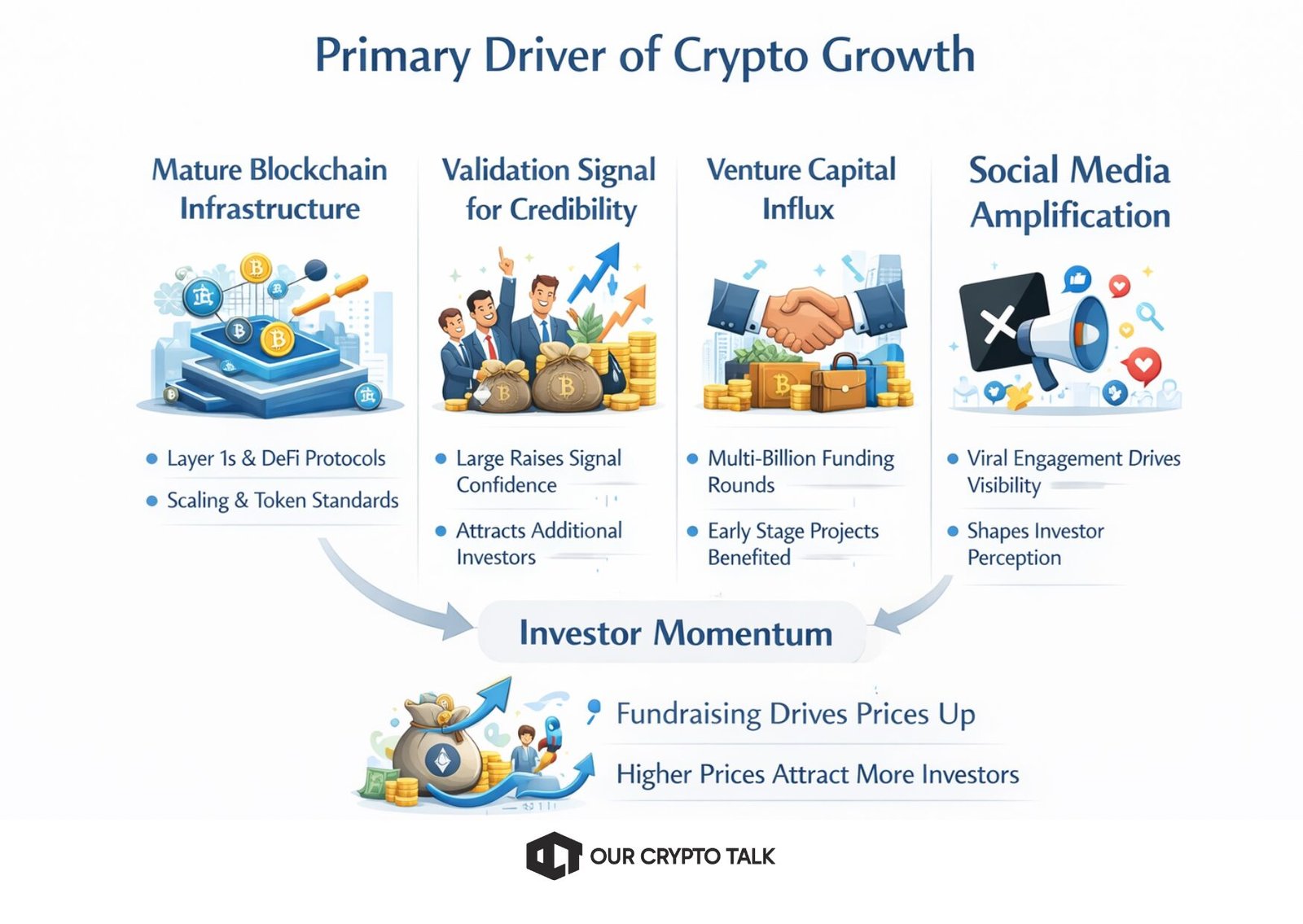
Several structural changes have reshaped crypto markets and elevated fundraising into a central role.
First, blockchain infrastructure has matured significantly. Layer 1 networks, decentralized finance protocols, scaling solutions, and token standards have become widely available. As a result, new projects struggle to differentiate themselves based purely on technical innovation. Investors now rely more heavily on signals such as funding size, investor participation, and early momentum to assess project credibility.
Fundraising serves as a powerful validation signal. When a project raises significant capital, the market interprets that as institutional confidence. This perception attracts additional investors and accelerates valuation growth.
Second, venture capital has played a major role in reinforcing this model. Crypto venture funding expanded dramatically during 2024 and 2025, with billions of dollars flowing into early stage projects. This influx allowed projects to secure large capital reserves before delivering fully mature products. With these funds, projects invested heavily in marketing, influencer campaigns, ecosystem grants, and user incentives to drive rapid awareness and participation.
Investor psychology has also reinforced the fundraising driven model. Crypto markets operate with strong momentum dynamics. Investors often interpret large raises, rapid exchange listings, and aggressive marketing campaigns as signals of opportunity. This behavior creates a feedback loop in which capital raises drive price increases, which attract more investors, which further increases valuation.
dogwifhat illustrates how fundraising and marketing can drive rapid valuation expansion. The project gained popularity through community driven liquidity and viral marketing. Social media campaigns, influencer promotion, and exchange listings increased visibility rapidly.
This attention pushed the market cap above $4.8 billion at peak valuation. However, the project offered no core infrastructure utility or revenue generating functionality.
When market momentum slowed, trading volume declined and investor attention shifted elsewhere. As a result, valuation dropped significantly. This demonstrated how narrative driven growth depends heavily on sustained attention and capital inflows.
PEPE achieved massive valuation growth through aggressive marketing and meme driven momentum. Viral campaigns increased engagement, attracted traders, and accelerated price appreciation.
However, the project lacked fundamental infrastructure utility or long term revenue mechanisms. As market conditions weakened and hype declined, investor participation decreased.
This led to significant price correction and valuation stabilization at lower levels. The project demonstrated how marketing driven growth can achieve rapid expansion but struggles to sustain long term stability without underlying utility.
The TRUMP token leveraged political attention and media coverage to generate rapid market momentum. Marketing campaigns, social engagement, and narrative positioning accelerated early adoption.
This pushed valuation above $1 billion within a short period. However, the project did not provide infrastructure services, protocol functionality, or sustained economic activity.
When market attention shifted and sentiment weakened, valuation declined sharply. This case demonstrated how narrative based tokens face structural volatility.
Arbitrum represents a fundamentally strong infrastructure project with real utility. The network provides Ethereum scaling and supports decentralized applications.
However, fundraising and incentive programs played a major role in accelerating early growth. Ecosystem incentives attracted users, increased liquidity, and supported valuation expansion.
When incentives decreased and token unlocks increased supply, price momentum slowed. This demonstrated that even fundamentally strong projects rely on funding driven incentives to maintain growth.
Ethena demonstrates how crypto fundraising can rapidly accelerate ecosystem growth and valuation.Ethena raised over $100 million from major institutional investors including Franklin Templeton, Dragonfly, and Binance Labs, providing significant capital to bootstrap its synthetic stablecoin ecosystem. The funding was deployed into liquidity incentives, yield programs, and exchange integrations, which accelerated stablecoin adoption and ecosystem participation.
These incentives attracted large inflows of capital, rapidly increasing trading volume and total value locked. As a result, Ethena achieved a multi-billion-dollar fully diluted valuation within months of launch.
However, much of this early growth was driven by capital-funded incentives rather than organic demand, demonstrating how strategic fundraising can accelerate ecosystem expansion and valuation before long-term utility fully matures.
Worldcoin raised over $240 million from leading venture firms including Andreessen Horowitz and Bain Capital Crypto, enabling the project to deploy biometric identity infrastructure globally. The capital funded hardware manufacturing, operational expansion, and aggressive user acquisition campaigns across multiple regions.
This allowed Worldcoin to onboard millions of users and rapidly expand its ecosystem footprint. The project achieved multi-billion-dollar valuation shortly after expansion, driven largely by infrastructure deployment and narrative strength.
However, much of this growth depended on capital-funded expansion rather than proven economic demand, highlighting how large fundraising rounds can accelerate adoption, visibility, and valuation ahead of long-term utility validation and sustainable ecosystem revenue generation. This scale of expansion was made possible primarily through aggressive crypto fundraising.
Berachain raised $69 million in seed funding from major institutional investors, providing the capital needed to bootstrap its ecosystem and infrastructure development. The funding supported developer grants, liquidity programs, and ecosystem incentives, which attracted early builders and participants.
This strong capital backing created investor confidence and accelerated ecosystem growth prior to full network maturity. As a result, Berachain achieved a valuation exceeding $1.5 billion shortly after early funding rounds.
Much of this valuation expansion was driven by investor backing and capital deployment rather than mature adoption, demonstrating how fundraising itself can create credibility, accelerate ecosystem formation, and significantly increase valuation during early project stages.
EigenLayer raised over $164 million from investors including Andreessen Horowitz, Blockchain Capital, and Polychain Capital to build its restaking infrastructure on Ethereum. This funding supported validator incentives, ecosystem integrations, and infrastructure expansion, accelerating adoption across the Ethereum ecosystem.
Capital deployment enabled rapid growth in total value locked, with billions of dollars flowing into the protocol shortly after launch. This positioned EigenLayer as one of the fastest-growing infrastructure protocols in crypto.
However, much of this early expansion was driven by incentive-based participation and capital deployment, demonstrating how large fundraising rounds can rapidly bootstrap adoption, ecosystem participation, and valuation ahead of fully mature economic sustainability.
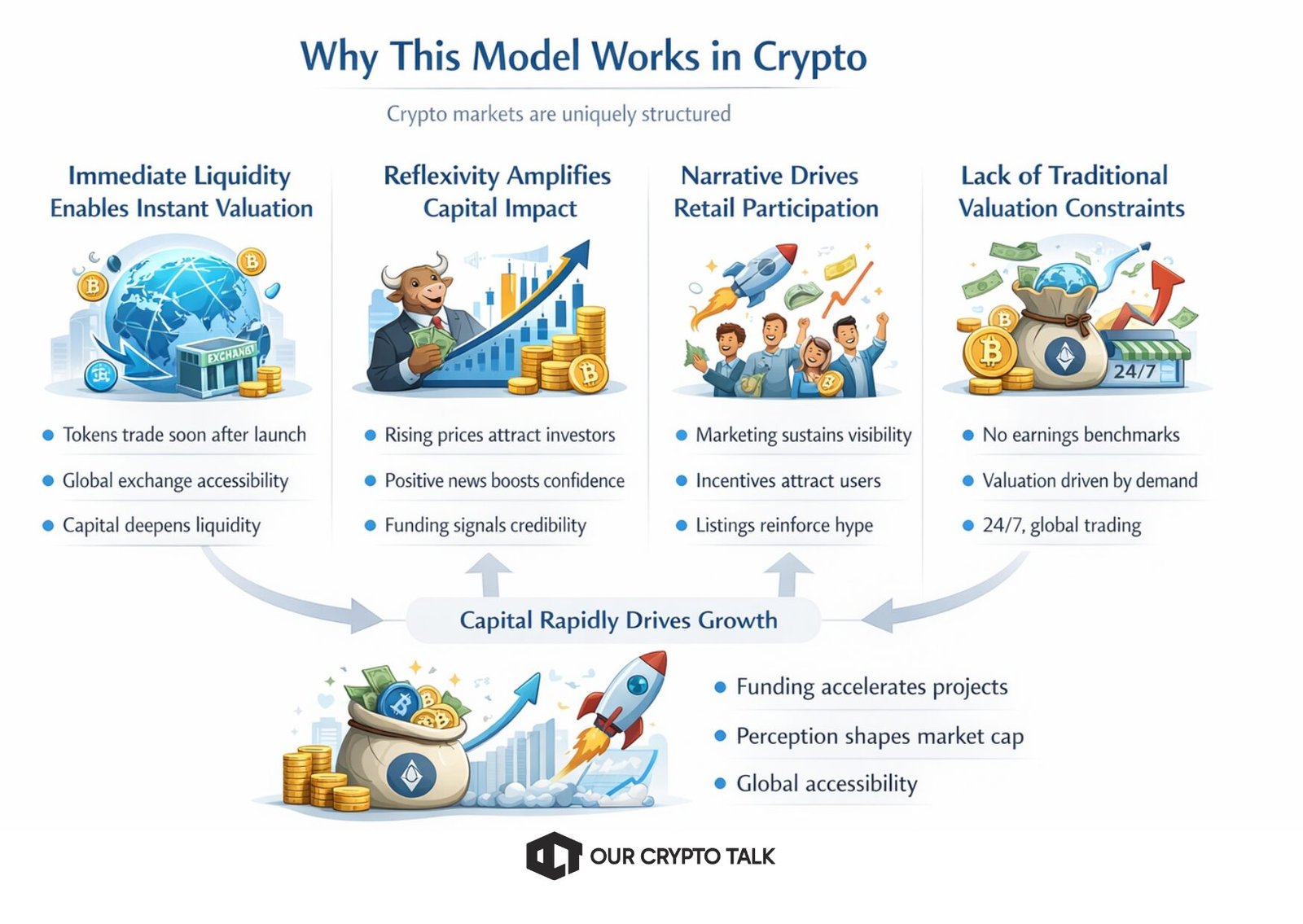
Crypto markets are uniquely structured to allow capital to directly drive growth, valuation, and adoption. Unlike traditional startups, where funding supports long-term product development before valuation is realized, crypto allows capital to influence market cap almost immediately. This structural difference enables fundraising itself to become a powerful growth engine.
Immediate Liquidity Enables Instant Valuation
One of the most important factors is immediate liquidity. Crypto tokens typically begin trading shortly after launch, often across multiple global exchanges. This means valuation becomes liquid and visible instantly, rather than remaining theoretical as in private startup funding rounds. When projects raise capital, they can deploy it into liquidity provisioning, market making, and exchange integrations. This creates deeper order books, reduces volatility, and makes the token appear more stable and mature. As a result, capital can translate directly into higher market cap and stronger investor confidence.
Reflexivity Amplifies Capital Impact
Crypto markets are highly reflexive, meaning price and perception reinforce each other. When a token’s price rises, it attracts attention from traders, influencers, and media. This increased visibility brings in new investors, which further drives price growth. Funding announcements themselves act as strong credibility signals, indicating institutional confidence. This attracts additional capital, creating a self-reinforcing cycle where capital drives price, and price attracts more capital.
Narrative Drives Retail Participation
Retail investors play a major role in crypto markets and often rely on narrative strength rather than financial metrics. Since most early-stage crypto projects do not generate significant revenue, investors evaluate future potential instead of current earnings. Capital allows projects to fund marketing campaigns, partnerships, ecosystem incentives, and exchange listings. These activities sustain visibility and reinforce growth narratives, which attract new users and investors.
Lack of Traditional Valuation Constraints
Unlike stocks, crypto lacks valuation anchors such as earnings, profit, or cash flow requirements. Token valuation is driven primarily by supply, demand, liquidity, and expectations of future growth. This allows perception and capital inflow to directly shape market cap. Combined with global accessibility and 24/7 trading, crypto enables capital to rapidly influence valuation, adoption, and ecosystem expansion.
This is why fundraising has evolved beyond a support function. In crypto, capital itself has become a primary driver of growth.
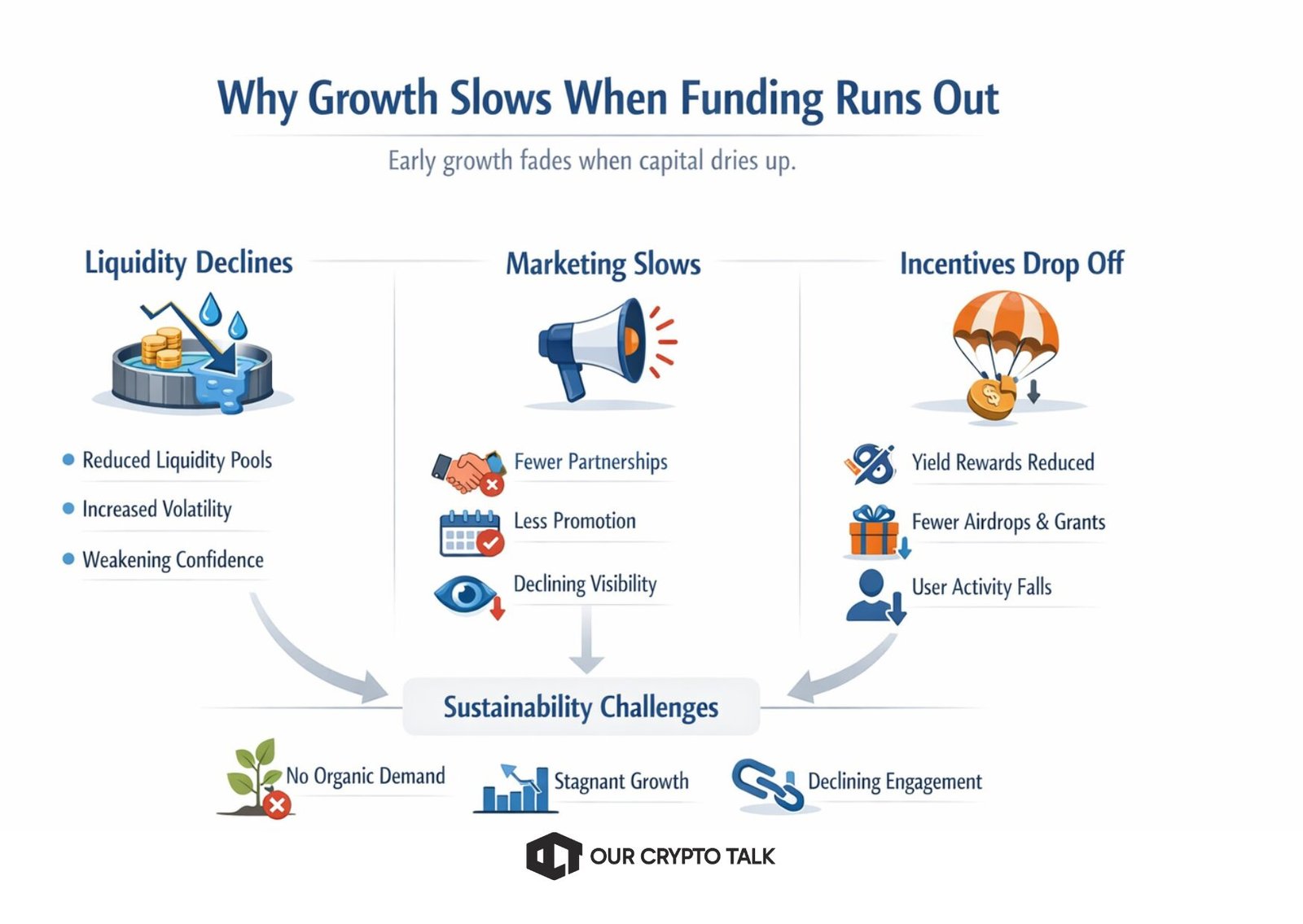
Capital plays a critical role in accelerating early growth, but its impact is often temporary. During expansion phases, projects use funding to support liquidity, incentives, and marketing. These mechanisms create strong trading activity, attract users, and sustain market attention. However, once funding begins to run out, these growth drivers weaken quickly.
Liquidity is usually the first to decline. Projects often rely on funded market makers and liquidity incentives to maintain stable trading conditions. When these supports are reduced, order books become thinner, volatility increases, and investor confidence weakens. This makes the asset less attractive to both traders and institutions.
At the same time, marketing and ecosystem activity slow down. Without funding, partnerships, announcements, and promotional campaigns become less frequent, causing the project to lose visibility. In crypto’s attention-driven environment, reduced visibility often leads to declining interest and capital outflows.
Incentives such as yield rewards, grants, and airdrops also decrease. Since much of the early adoption was driven by these rewards, user activity often drops once incentives disappear.
At this stage, only genuine utility can sustain growth. Projects without strong organic demand typically stagnate or decline after capital support fades.
Crypto fundraising will remain a core component of crypto project growth. However, long term success will depend on delivering real utility, infrastructure, and sustainable economic activity.Projects that rely solely on marketing and capital raises will struggle to maintain valuation once momentum declines.
Investors have become more sophisticated. They increasingly evaluate tokenomics, unlock schedules, adoption metrics, and ecosystem growth rather than relying solely on narrative strength.
Market cycles will continue reinforcing this pattern. During bullish periods, fundraising driven projects experience rapid growth. During bearish periods, fundamentally strong projects demonstrate greater resilience.
Crypto fundraising has become one of the most powerful drivers of crypto project success. Fundraising has become one of the most powerful drivers of crypto project success. It accelerates adoption, increases visibility, and enables rapid valuation growth. However, fundraising alone cannot sustain long term value.
Projects must deliver real infrastructure, adoption, and economic utility to maintain relevance. Fundraising creates momentum, but utility determines long term survival.
This shift reflects the evolving structure of crypto markets. Capital, narrative, and marketing now play central roles in early stage growth. However, long term success still depends on building systems that deliver real and sustained value.