Loading Search...


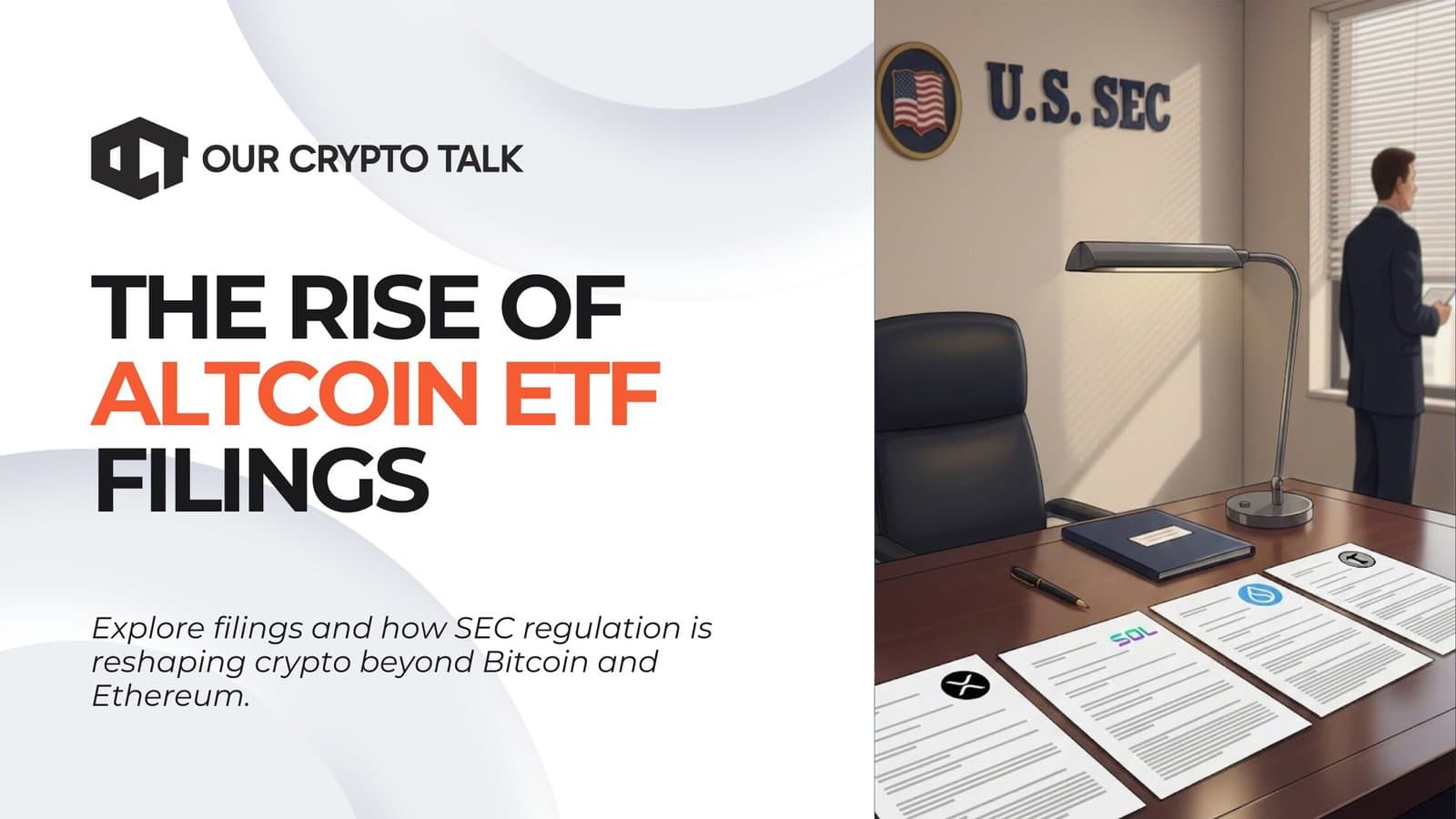
The Altcoin ETF era has begun. Explore filings, approvals, risks, and how SEC regulation is reshaping crypto beyond Bitcoin and Ethereum.

Author: Chirag Sharma
For years, the exchange-traded fund narrative revolved around Bitcoin and, to a lesser extent, Ethereum. That changed when the first spot Bitcoin ETFs were approved in January 2024, followed by Ethereum in July 2024. Those approvals validated crypto as a regulated asset class inside traditional finance. Now, the spotlight has moved. The conversation is no longer about whether an Altcoin ETF will exist. It is about how many will exist, how large they will become, and what their presence means for the future of digital assets.
With more than 130 crypto ETF filings submitted to the U.S. Securities and Exchange Commission, the Altcoin ETF has transitioned from speculation to inevitability. Solana and XRP products are already trading in U.S. markets. Dozens more are waiting in regulatory queues. This is not a minor expansion of the ETF universe. It is the beginning of a structural bridge between traditional capital markets and the broader crypto ecosystem.
But before assuming this is purely bullish, it is worth understanding how we got here and what is truly at stake.
The Altcoin ETF idea did not appear overnight. It emerged from the success of Bitcoin and Ethereum ETFs.
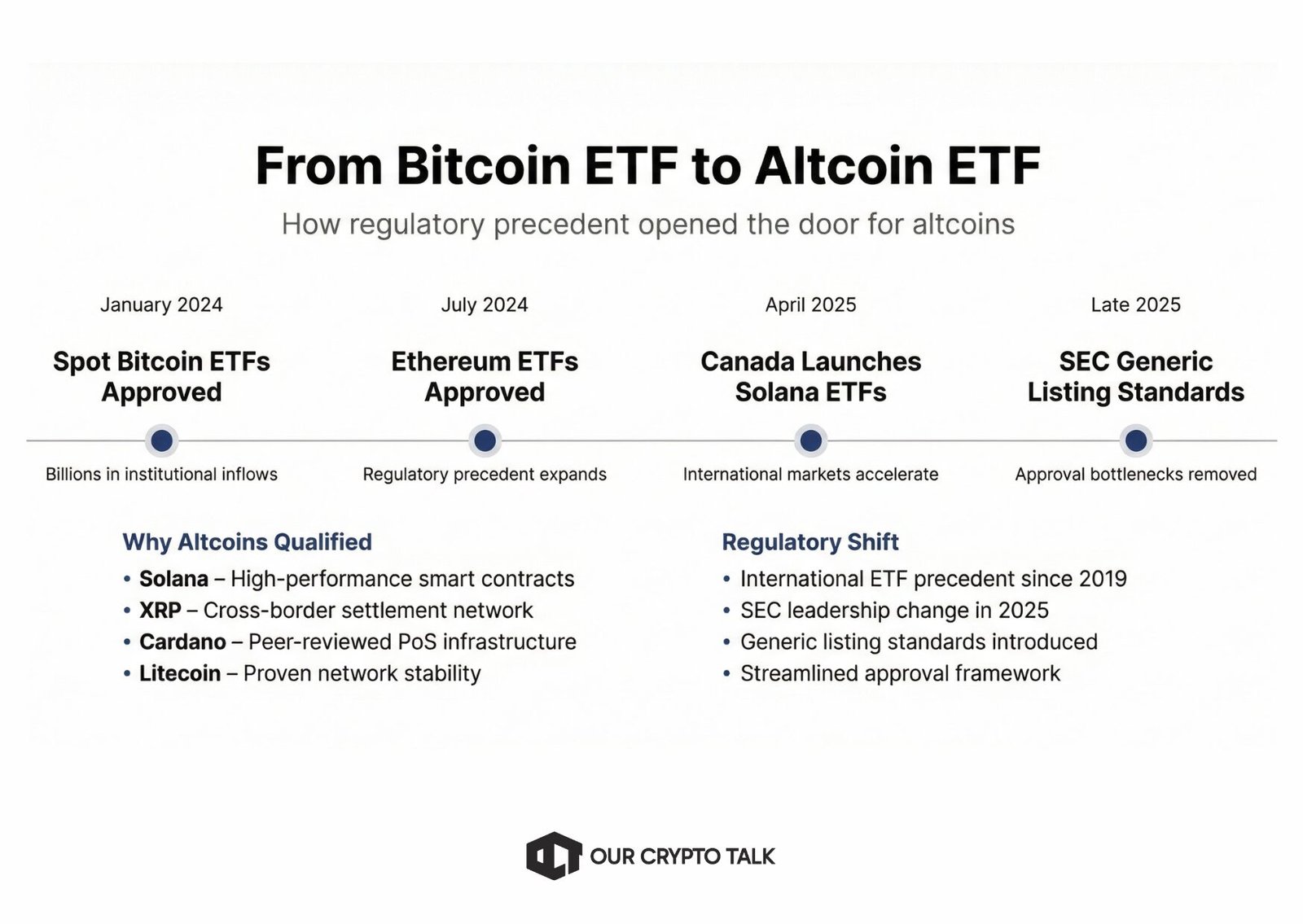
When the SEC approved spot Bitcoin ETFs in January 2024, products like BlackRock’s iShares Bitcoin Trust absorbed billions in institutional inflows within months. Capital that had previously avoided crypto due to custody and compliance concerns suddenly had a regulated access point.
Ethereum followed in mid-2024, though with more modest inflows. Still, the regulatory precedent had been set. If Bitcoin and Ethereum qualified for ETF treatment, why not other mature blockchain networks?
The logic was compelling:
Meanwhile, international markets were moving faster.
Canada launched Solana ETFs on the Toronto Stock Exchange in April 2025, including products from 3iQ and Purpose that incorporated staking rewards. Europe and Asia had already been offering crypto exchange-traded products since 2019. These international precedents weakened the argument that altcoins were too risky or immature for regulated vehicles.
The regulatory shift in the United States accelerated the trend.
The departure of SEC Chair Gary Gensler and the introduction of generic listing standards in late 2025 streamlined approvals. Qualified funds could list automatically if predefined criteria were met. Approval bottlenecks eased. Issuers gained clarity.
The Altcoin ETF was no longer hypothetical. It became a race.
The Altcoin ETF race is not being led by crypto-native startups alone. It is being driven by traditional asset management giants.
Bitwise Asset Management
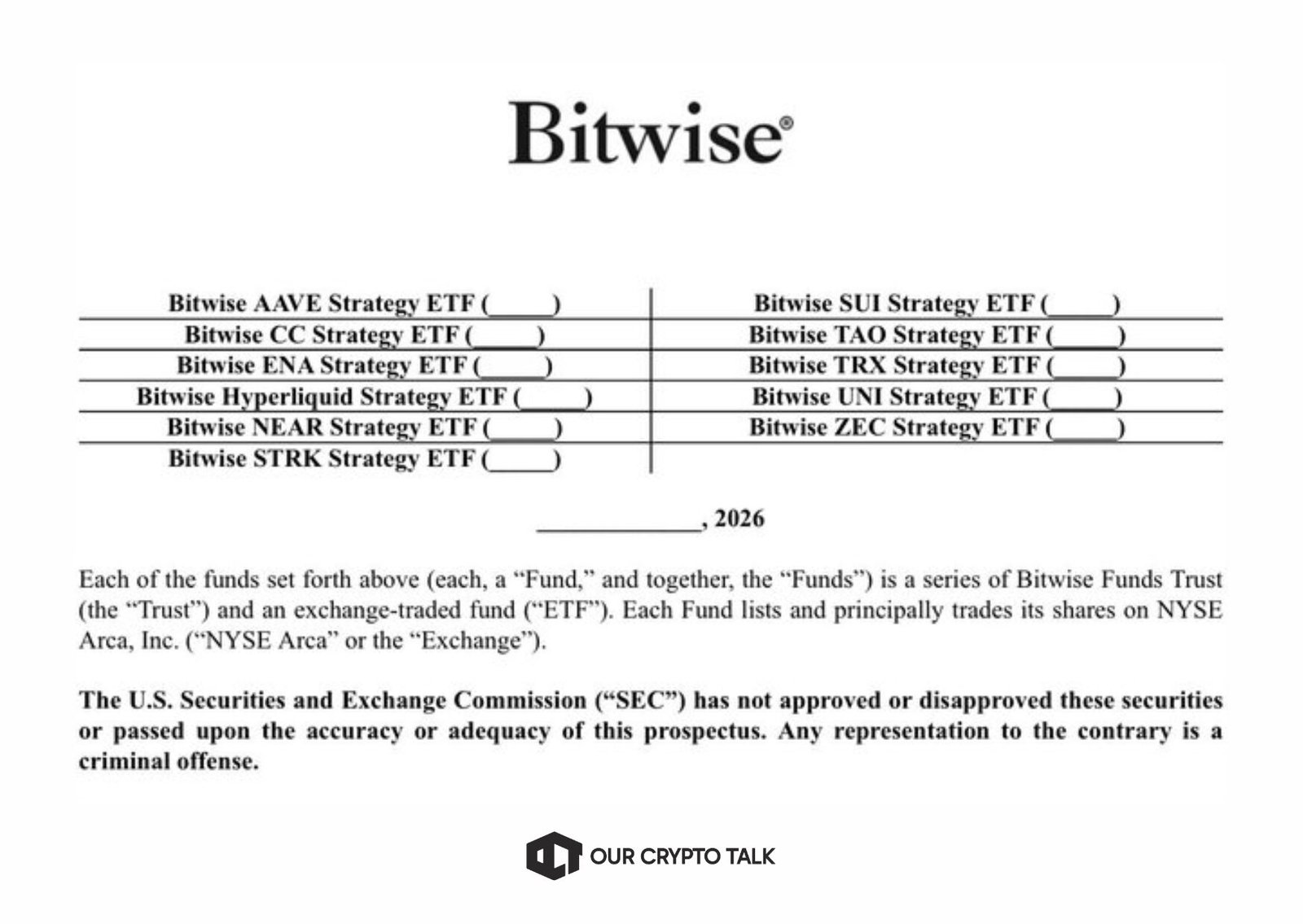
Bitwise positioned itself as one of the most aggressive filers, submitting 11 Altcoin ETF applications in a single day. The proposed funds span DeFi leaders like Aave and Uniswap, privacy coin Zcash, AI-focused Bittensor, and newer networks such as Sui and NEAR. If approved, these ETFs could unlock regulated exposure for assets that institutional investors previously could not touch.
Grayscale Investments
Grayscale has leveraged its existing trust infrastructure to convert products into ETFs. Having managed billions in digital assets for over a decade, the firm filed for spot Solana, XRP, Cardano, and Litecoin ETFs. Its experience navigating regulatory frameworks gives it an edge in this environment.
Franklin Templeton
With $1.5 trillion in assets under management, Franklin Templeton’s entry into the Altcoin ETF space signals institutional seriousness. Filing for Solana and XRP ETFs, the firm reinforces that this trend is not fringe speculation.
21Shares
A leader in European crypto ETPs, 21Shares expanded aggressively into U.S. filings for Dogecoin, XRP, SUI, and SEI ETFs. Their strategy focuses on being early while leveraging operational experience built since 2019.
VanEck
VanEck, an early Bitcoin ETF pioneer, filed spot ETFs for Solana and Avalanche, extending its crypto ETF footprint.
This is not a niche experiment.
It is a coordinated push by institutions that manage trillions in assets. Their participation transforms the Altcoin ETF from a crypto industry development into a broader capital markets event.
As of early 2026, Solana and XRP represent the clearest case studies for the Altcoin ETF model in the United States.
Solana’s ETF debut in 2025 marked a milestone. Spot products began trading on major exchanges, and within months, U.S. Solana ETFs accumulated over $600 million in net inflows. Some products incorporated staking rewards, offering investors yield alongside price exposure.
This proved a key point: regulated altcoin exposure could attract sustained capital beyond initial hype.
XRP followed closely behind.
Multiple XRP ETFs launched in late 2025, with early inflows reportedly reaching hundreds of millions of dollars. Collectively, XRP ETFs now custody a measurable portion of circulating supply, introducing new supply-demand dynamics.
These launches demonstrated three important realities:
The Altcoin ETF is no longer theoretical. It is actively reshaping market structure.
The arguments in favor of the Altcoin ETF are straightforward and compelling.
Many institutional investors cannot directly hold crypto due to compliance mandates. ETFs solve this problem by providing regulated exposure within brokerage accounts.
Pension funds, endowments, and registered investment advisors can allocate to an Altcoin ETF without managing wallets or private keys. Custody is handled by regulated providers such as Coinbase Custody.
This dramatically expands the addressable market for altcoins.
For retail investors, an Altcoin ETF eliminates operational friction:
Exposure becomes as simple as buying shares of a stock.
ETFs also fit inside retirement accounts like IRAs and 401(k)s, enabling long-term crypto allocations within traditional financial planning frameworks.
The Bitcoin ETF precedent demonstrated how sustained ETF inflows can outpace asset issuance.
If an Altcoin ETF attracts similar flows, it reduces circulating exchange supply and strengthens price floors. Improved liquidity also reduces volatility over time.
Crypto is not monolithic.
Bitcoin functions as digital gold. Ethereum operates as programmable infrastructure. Solana focuses on high throughput. XRP emphasizes cross-border payments.
An Altcoin ETF allows investors to allocate based on specific network theses rather than a generic crypto basket.
From a portfolio construction perspective, that flexibility matters.
Despite clear benefits, the Altcoin ETF introduces structural trade-offs.
When large ETF issuers custody billions in tokens, supply centralizes.
This raises concerns about governance influence, especially in proof-of-stake networks. Centralized custody creates potential systemic risks if a major custodian faces operational or legal issues.
ETF approval can channel capital toward narratives rather than utility.
Some altcoins have limited real-world usage relative to market valuation. An Altcoin ETF may amplify hype cycles if investors focus on ticker symbols rather than network activity.
ETF shares are not on-chain assets.
Investors cannot:
This creates a two-tier ecosystem: native crypto users and ETF-based investors.
As more supply locks inside ETFs, on-chain activity could face liquidity constraints.
Crypto’s foundational ethos centers on decentralization and permissionless access.
By integrating altcoins into SEC-regulated products managed by Wall Street firms, the industry introduces regulatory oversight into asset custody and distribution.
While this increases legitimacy, it also increases regulatory exposure.
The Altcoin ETF strengthens the bridge to traditional finance. But bridges run both ways.
The pipeline remains extensive.
Bloomberg analysts estimate high approval probabilities for additional large-cap assets such as Litecoin and Avalanche. More speculative filings, including meme tokens and thematic products, face lower approval odds.
Several scenarios may unfold in 2026:
Historical ETF markets suggest not every thematic fund succeeds. Many attract early inflows but struggle to maintain long-term traction.
The Altcoin ETF landscape may evolve similarly. A handful of products could dominate, while others remain niche.
The defining factor will be sustained demand, not launch-day headlines.
The Altcoin ETF represents both progress and tension. It unlocks institutional capital, legitimizes altcoin networks, and simplifies retail access. At the same time, it concentrates custody, fragments composability, and risks amplifying speculative cycles.
The market has already voted. With over 130 filings and multiple live products, the Altcoin ETF is not a debate. It is a structural reality.
The critical question is whether the crypto industry can absorb this capital influx without compromising its foundational principles. Decentralization, permissionlessness, and user sovereignty remain core to crypto’s identity. If Altcoin ETFs strengthen networks through liquidity and adoption, they will mark a new chapter of maturity. If they hollow out on-chain participation while concentrating power in traditional intermediaries, they may represent a strategic trade-off.
Either way, the Altcoin ETF revolution is underway. By the end of 2026, dozens of altcoin funds could be trading across U.S. exchanges. This is no longer about Bitcoin alone. It is about whether the broader crypto ecosystem is ready to operate inside the world of traditional finance without losing what made it different.