Loading Search...


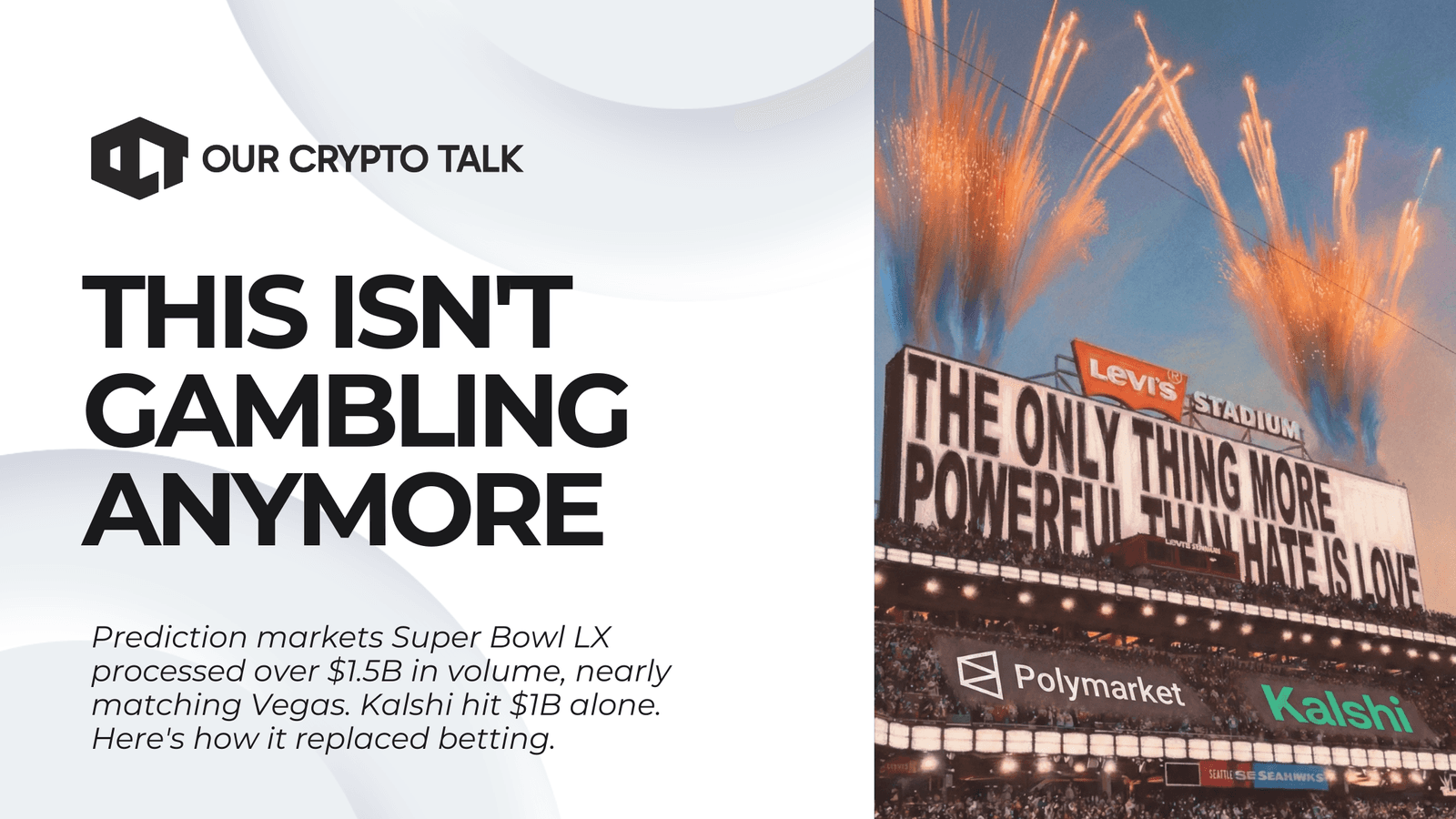
Prediction markets Super Bowl LX processed over $1.5B in volume, nearly matching Vegas. Kalshi hit $1B alone. Here's how it replaced betting.

Author: Tanishq Bodh
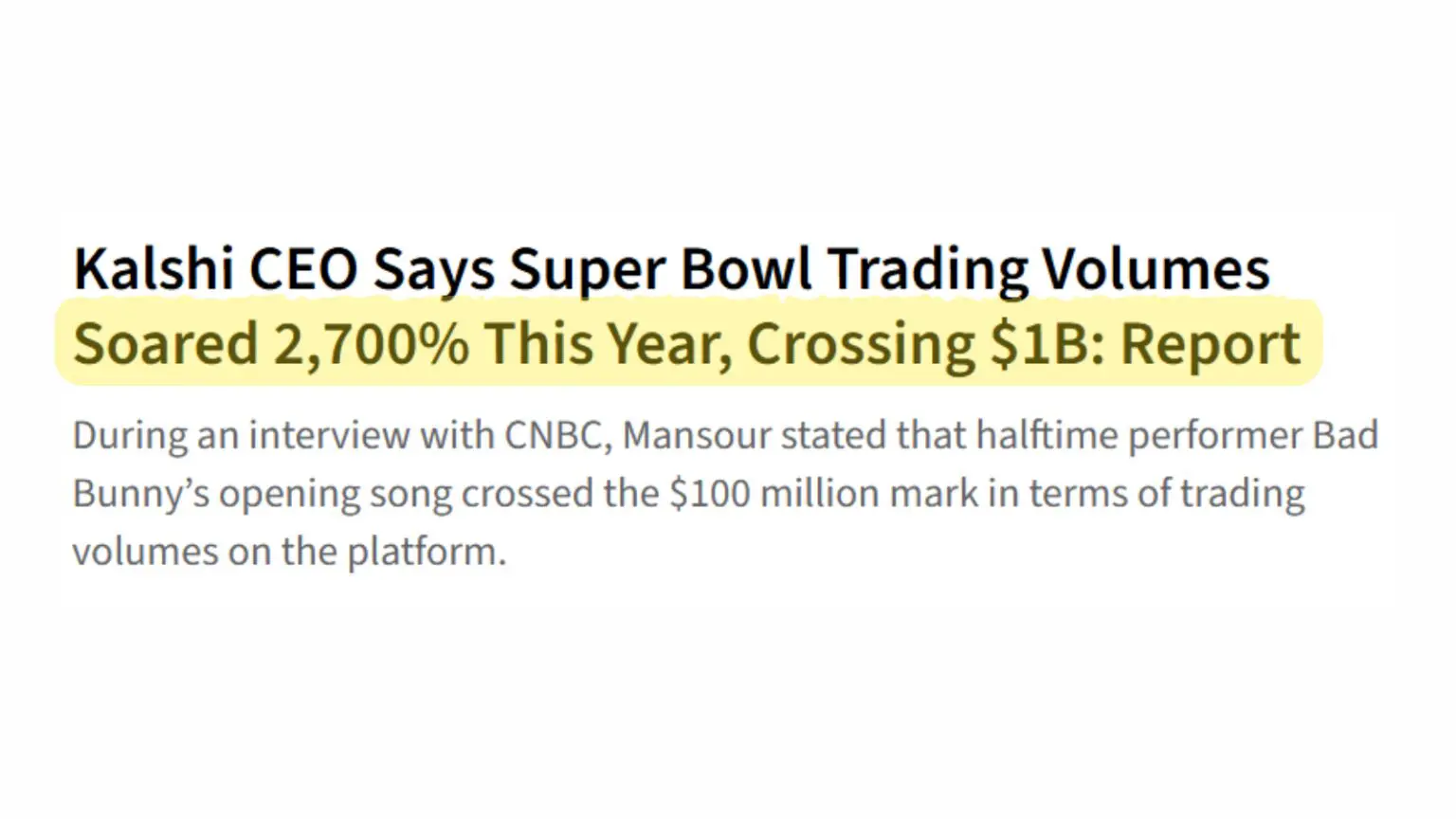
The loudest roar on Super Bowl Sunday didn’t come from Levi’s Stadium. It came from trading desks, dorm rooms, and dive bars across America, where nearly 2 million people weren’t just watching the Seattle Seahawks demolish the New England Patriots 29-13. They were trading the outcome in real time, second by second, like day traders on the world’s most chaotic stock exchange. Kalshi alone processed over $1 billion in trading volume on Super Bowl Sunday. One platform. One day. Up 2,700 percent from last year’s Super Bowl. When you add Polymarket’s nearly $700 million championship market, smaller platforms, and futures bets placed months in advance, the total prediction markets Super Bowl volume crossed $1.5 billion. For context, traditional sportsbooks saw $1.78 billion wagered on the game.
Prediction markets, a category that barely existed three years ago, nearly matched the entire regulated sports betting industry on its biggest night. This isn’t a trend. It’s a takeover.
Let’s start with the growth curve, because it reads like fiction. In 2024, the entire prediction markets industry processed roughly $9 billion in volume. In 2025, that number exploded to over $44 billion. That’s nearly 400 percent year-over-year growth, a pace that took early crypto exchanges half a decade to achieve.
Kalshi alone processed $22.88 billion in trading volume in 2025, generating roughly $260 million in fee revenue, with 89 percent of that coming from sports. December 2025 was the company’s best month, pulling in $63.5 million in fees. The final week of the year alone did $20 million, more than the company’s entire first four months of 2025 combined.
Polymarket processed about $6 billion in just the first half of 2025 and kept accelerating. Monthly volumes topped $4.1 billion in October 2025. The platform went from 4,000 monthly active traders in January 2024 to over 314,000 by December. Then there’s Robinhood, the new player everyone is sleeping on. Vlad Tenev’s brokerage processed 12 billion event contracts in 2025, its first full year. It has already done 4 billion more in January 2026 alone.
Citizens Financial Group forecasts prediction market firm revenues will balloon to more than $10 billion by 2030. Some analysts believe the industry could reach a trillion dollars in annual trading volume by the end of this decade. These aren’t crypto Twitter pipe dreams. These are Wall Street projections.
The prediction markets war is being fought on two fronts, and both sides are winning.
Kalshi bet everything on being the first CFTC-regulated prediction market exchange. That bet has paid off beyond anyone’s imagination. The company’s valuation trajectory reads like a fever dream. In October 2025, Kalshi closed a $300 million Series D at a $5 billion valuation. Less than two months later, in December, it raised a $1 billion Series E at $11 billion. Led by Paradigm, with Sequoia, Andreessen Horowitz, ARK Invest, and Y Combinator all on the cap table.
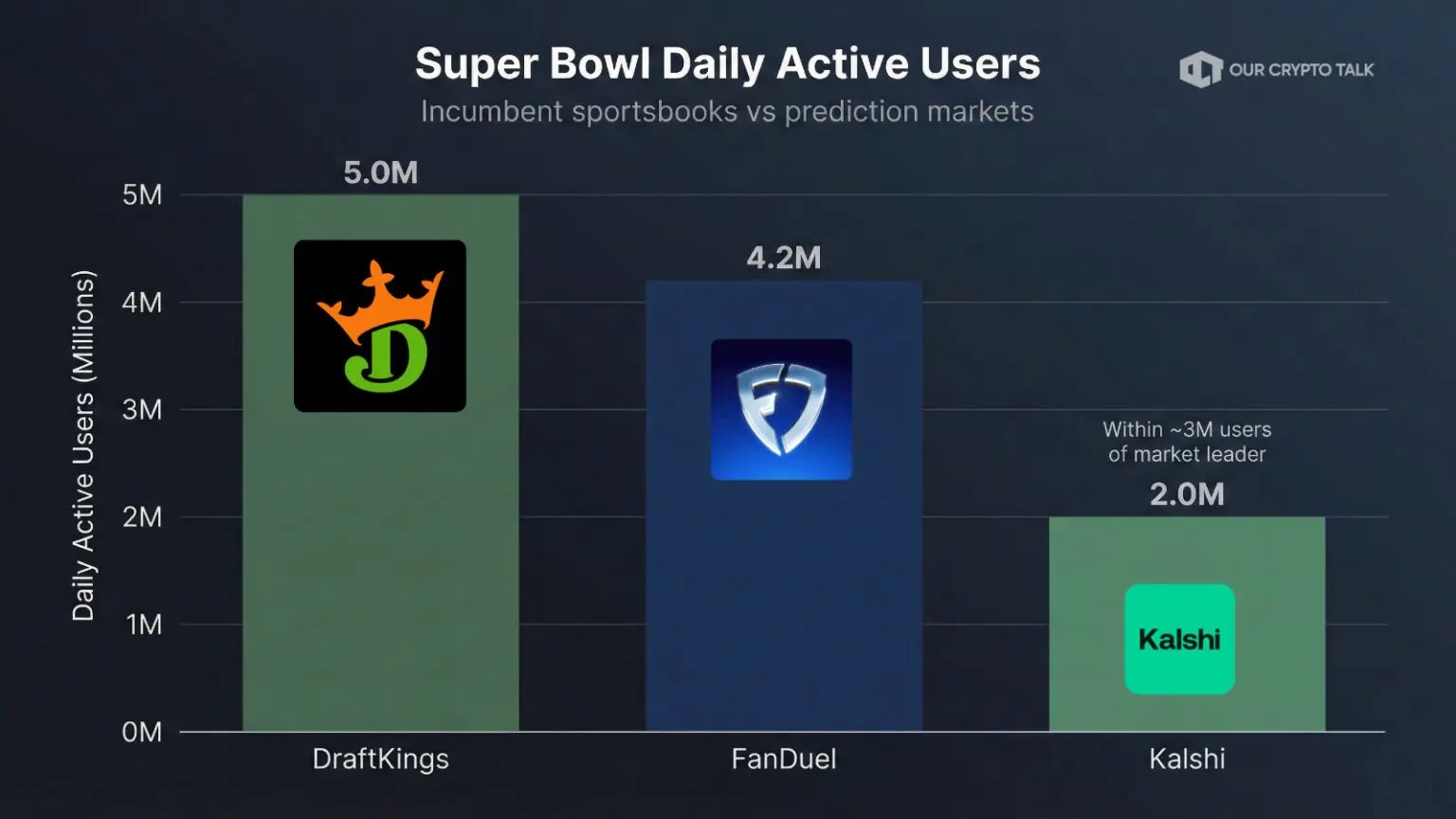
The valuation more than doubled in under 60 days. That doesn’t happen by accident. It happens when you’re growing at 1,100 percent year over year. On Super Bowl Sunday, Kalshi’s app downloads surged 1,544 percent compared to the same period last year. Daily active users jumped over 1,100 percent to nearly 2 million. Kalshi CEO Tarek Mansour told CNBC that Kalshi was the biggest brand of the Super Bowl this year, without running a Super Bowl ad.
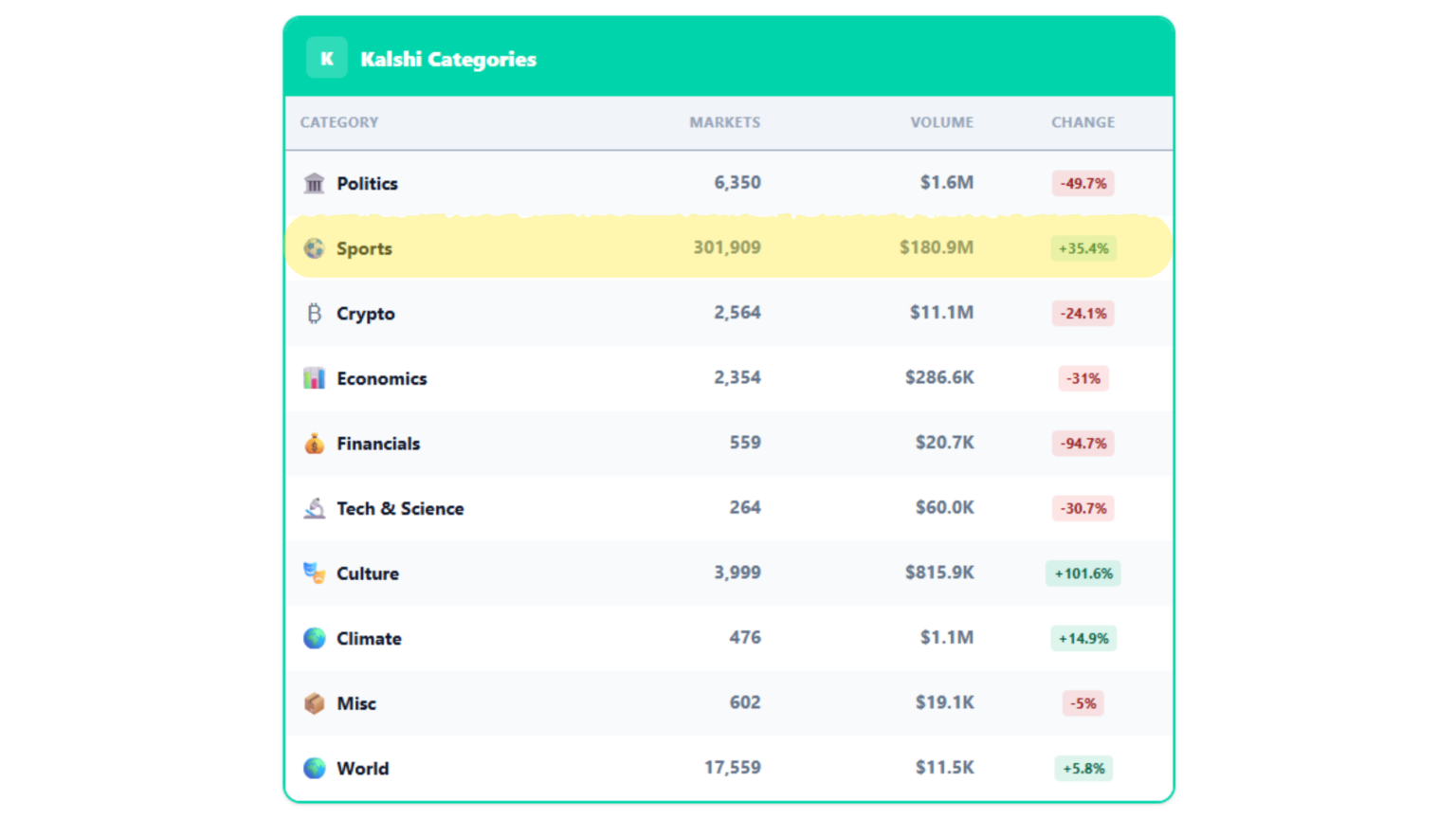
Sports now accounts for over 90 percent of Kalshi’s trading volume. During NFL season from September through November, the platform generated $138 million in sports fee revenue alone. The company has partnership deals with Robinhood, which drives more than half its volume, Sleeper’s 10 million users, CNN as its official prediction markets partner, and even NBA star Giannis Antetokounmpo as a shareholder. Kalshi isn’t competing with DraftKings. It’s building the exchange layer underneath the entire event trading economy.
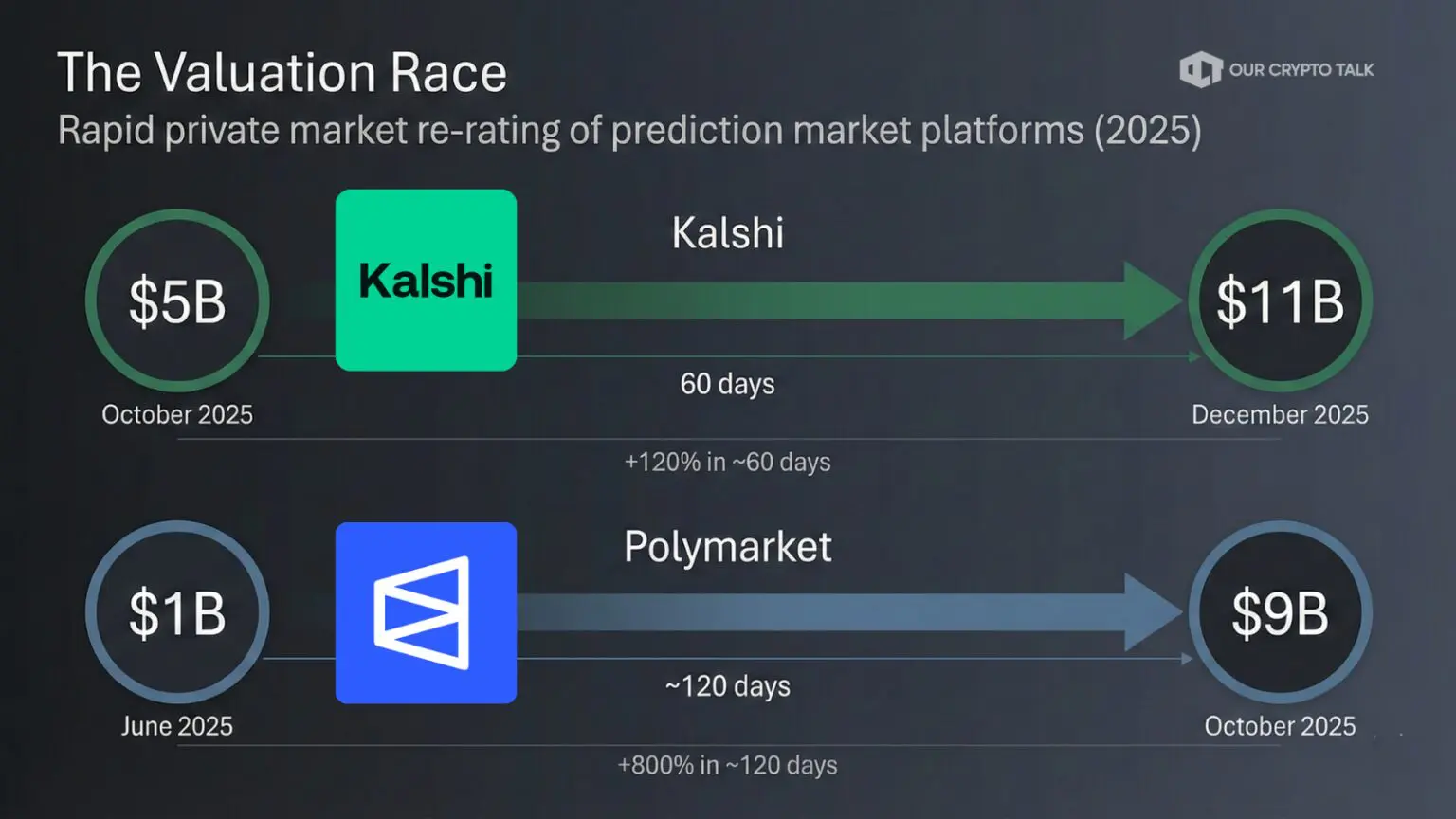
Polymarket took the opposite path, and it worked just as well. Built on Polygon’s blockchain, Polymarket became the world’s largest decentralized prediction market. It correctly predicted Trump’s victory over Kamala Harris when traditional polls wavered, became a staple of political reporting on every major network. It grew from a niche crypto curiosity to a $9 billion company.
The institutional validation came when ICE, the parent company of the New York Stock Exchange, invested $2 billion in Polymarket at an $8 billion pre-money valuation in October 2025. Jeffrey Sprecher, ICE’s CEO, called it a blend of the NYSE, which was founded in 1792, with a forward-thinking, revolutionary company pioneering change within the Decentralized Finance space.
That’s the man who runs the world’s most important stock exchange, putting $2 billion behind a crypto-native prediction market. Polymarket used part of its war chest to acquire QCEX, a CFTC-licensed derivatives exchange and clearinghouse, for $112 million, paving the way for its legal re-entry into the U.S. market. In August 2025, the platform saw 13,800 new markets created in a single month. It’s reportedly in talks for additional funding at a $12 to $15 billion valuation.
The Seahawks-Patriots matchup was more than a football game. It was the most heavily traded sporting event in prediction market history. Kalshi’s game-winner market alone surpassed $499 million in total volume. Of that, roughly $138 million traded in-game, meaning 28 percent of the action happened while plays were running. Bets on Bad Bunny’s opening halftime song exceeded $100 million. Markets on halftime guests drew another $45 million.
The prediction markets had Seattle at a 66 to 69 percent win probability heading into the game. The Seahawks won 29-13 in a defensive masterclass, forcing three turnovers and six sacks on Drake Maye. Kenneth Walker III ran for 135 yards and won MVP. The markets, as they often do, were right.c
But here’s the detail that matters most for the industry’s future: prediction markets offered something sportsbooks couldn’t. When the Patriots were scoreless through three quarters, traders who bought Seahawks to Win contracts early could have sold their position at a massive profit without waiting for the final whistle. When Maye hit Mack Hollins for a 35-yard touchdown to cut it to 19-7, the line swung. Traders who bought the dip on Seattle at that moment were rewarded minutes later when Julian Love intercepted Maye and Uchenna Nwosu returned another interception for a pick-six.
It’s not betting. It’s trading. And that distinction is worth billions.
Every empire needs a legal framework, and prediction markets are fighting for theirs right now. The Trump administration has thrown its full weight behind prediction markets. On January 29, 2026, CFTC Chairman Michael Selig announced plans to support the responsible development of event contract markets at a joint summit with SEC Chairman Paul Atkins. Days later, on February 4, Selig withdrew the Biden-era proposal that would have banned sports and political event contracts entirely.
Then Selig went further. On February 18, the CFTC filed an amicus brief supporting Crypto.com in its lawsuit against Nevada’s gaming regulators, arguing that the federal government has exclusive jurisdiction over prediction markets. To those who seek to challenge our authority in this space, let me be clear: we will see you in court, Selig said in a video posted to X.
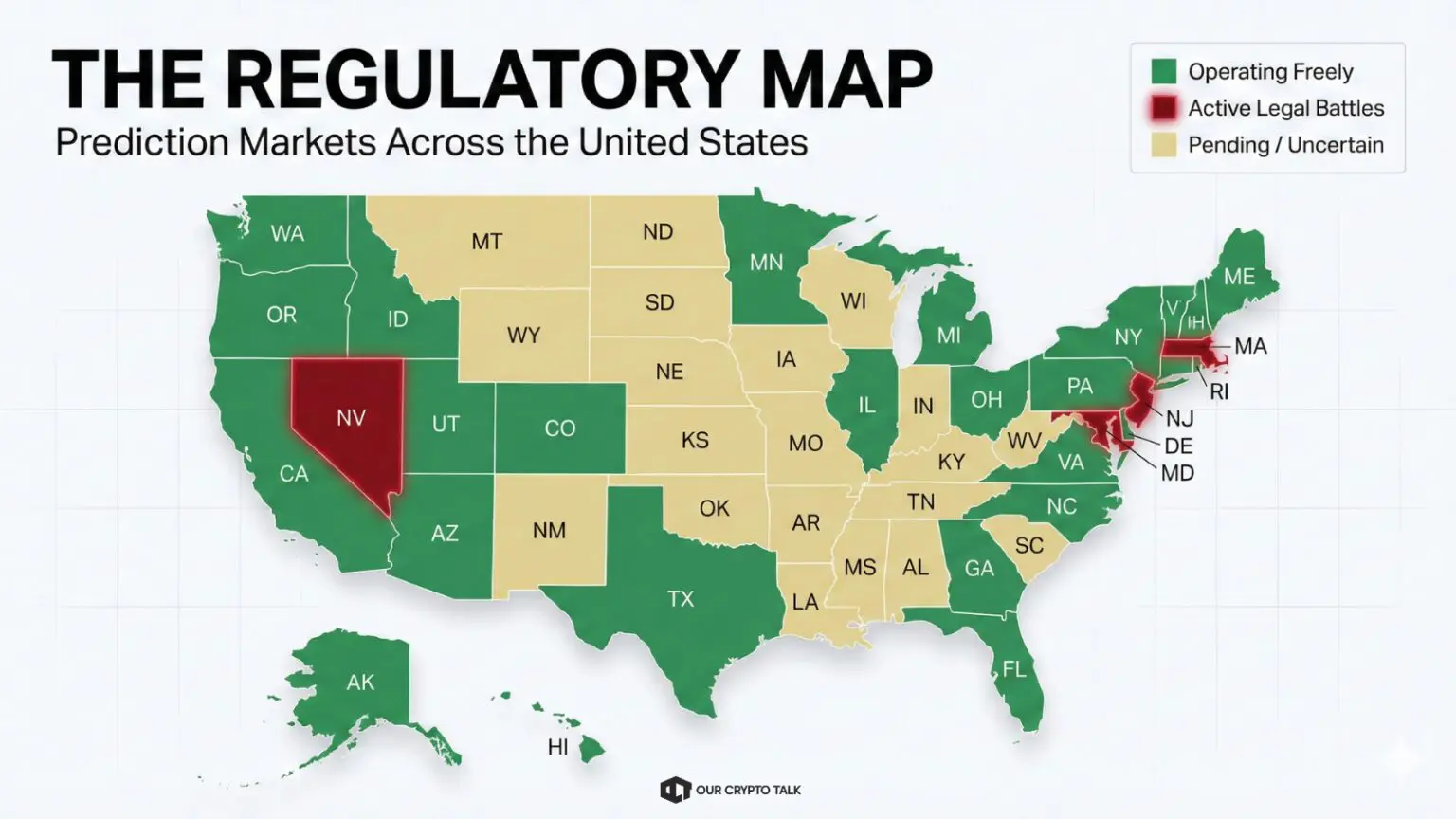
The states aren’t going down without a fight. Massachusetts won a preliminary injunction blocking Kalshi’s sports contracts. Nevada blocked both Kalshi and Polymarket from offering event contracts. Utah Governor Spencer Cox fired back at Selig directly: These prediction markets you are breathlessly defending are gambling, pure and simple. They are destroying the lives of families and countless Americans, especially young men.
The legal landscape is a patchwork. Federal judges in different states have reached different conclusions about whether prediction markets constitute gambling under state law. Multiple cases are working through the circuit courts. Legal experts widely believe this question will eventually reach the Supreme Court.
The stakes are enormous. If the CFTC maintains exclusive jurisdiction, prediction markets can operate in all 50 states, bypassing the state-by-state licensing that constrains DraftKings, FanDuel, and every other sportsbook. If states win, prediction markets face the same fragmented regulatory maze that took traditional sports betting a decade to navigate.
There’s a conversation the industry desperately wants to avoid. Prediction markets are accessible to anyone 18 and older. Traditional sportsbooks in most states require users to be 21. The National Council on Problem Gambling has flagged this gap as a serious risk, noting that research consistently shows young people are more vulnerable to developing gambling problems.
A 2024 Fairleigh Dickinson University poll found that 24 percent of men reported at least one problem gambling behavior. For men 30 and under, that number jumps to 45 percent. About 1 in 5 online sports bettors show signs of a gambling disorder.
Kalshi does offer voluntary self-exclusion, deposit limits, and mental health support through Birches Health. Polymarket does not have a responsible trading program. Neither platform lists the National Problem Gambling Helpline. Meanwhile, the NFL itself has pointedly refused to participate in prediction markets. The league banned prediction market ads from airing during the Super Bowl. NFL executive Jeff Miller warned that sports-related event contracts could pose substantially greater risks to contest integrity.
Insider trading is another vulnerability. A Polymarket user made over $400,000 on a contract predicting when Maduro’s rule in Venezuela would end, raising concerns about inside knowledge of the U.S.-backed operation. Rep. Ritchie Torres has introduced the Public Integrity in Financial Prediction Markets Act of 2026 to address the gap. The industry is growing faster than its safeguards. That’s not sustainable, and it’s the one thing that could kill this entire category before it reaches its potential.
The prediction markets Super Bowl moment was the proof of concept. But the real test is what happens when the football ends. Robinhood’s data offers a clue. Tenev noted that in January 2026, NBA contracts actually surpassed NFL in trading activity on the platform. The World Cup kicks off in June with 104 games spread across North America, and Kalshi already has markets listed. March Madness historically generates more gambling dollars than the Super Bowl.
The business model is evolving too. Robinhood is building Rothera, a joint venture with Susquehanna International Group, to operate its own CFTC-licensed exchange and clearinghouse. Interactive Brokers’ ForecastEx platform is capturing institutional demand around economic indicators. Crypto.com is pushing into prediction markets. Even traditional sportsbooks DraftKings and FanDuel are launching their own prediction-style products.
The addressable market is staggering. Americans spent $120 billion on legal sports betting in 2024. Global derivatives markets process trillions daily. Prediction markets sit at the intersection of both, and they’re still less than three years into their mainstream moment.
Here’s the core thesis: Prediction markets don’t just let you bet on outcomes. They let you trade positions, hedge risk, express complex views, and exit at any time. That’s not a feature upgrade to sports betting. That’s a category change. It turns passive entertainment into active participation. It turns fans into traders and traders into fans.
Kalshi’s annualized trading volume has crossed $100 billion. Polymarket is valued at $9 billion heading toward $15 billion. Robinhood’s prediction markets are the fastest-growing product line in a company that literally invented zero-commission stock trading.
The question isn’t whether prediction markets will continue growing. The trajectory is clear, the capital is deployed, and the product-market fit is undeniable. The question is what happens when the regulatory dust settles, the infrastructure matures, and the next generation of sports fans grows up trading outcomes instead of just watching them.
The future of sports isn’t just watching. It’s trading. And the prediction markets Super Bowl just proved it with a billion-dollar receipt.
All the opinions in this article are that of the author and in no way are financial advice. Our Crypto Talk and the author always suggest you do your own research in crypto and to never take anything as financial advice that you read on the internet. Check our Terms and conditions for more info.