Loading Search...


Farcaster pivots from decentralized social media to a wallet -first strategy, we explain the what and why behind it.

Author: Sahil Thakur
Farcaster’s recent pivot to a wallet-first strategy marks one of the most significant course corrections in the Web3 social landscape. Once positioned as a leading contender for decentralized social media, the project spent years building a protocol, cultivating a tight community, and chasing product market fit. Yet the network’s growth stalled, and a surprising insight emerged. Users engaged far more with Farcaster’s built-in wallet than with its social feed. This discovery reshaped the project’s trajectory. The Farcaster pivot to a wallet reflects both a pragmatic response to market realities and a revealing moment for the future of Web3 social platforms. The story of how it happened offers a deeper look into the challenges, lessons, and evolving strategies behind decentralized social media.
Farcaster launched in 2020 during a wave of excitement around Web3 social networks. Dan Romero and Varun Srinivasan founded the project. Both had worked at Coinbase. They wanted to build a decentralized alternative to platforms such as Twitter. Their vision aimed to fix issues that plagued Web2 social media. These issues included user data control, censorship concerns, and weak creator monetization.
The team designed the Farcaster protocol to be sufficiently decentralized. It supported multiple independent client apps. It also stored social relationships on-chain. This prevented any single company from owning the social graph. Early work focused on building this open protocol layer. At the same time, the team released a familiar social feed through the first client, Warpcast.

Early adopters came mostly from crypto and tech circles. The project started as a closed beta. Romero personally onboarded users with invite-only access. He drew heavily from his Coinbase network and contacts in Silicon Valley. The user base stayed small for the first year. Daily active users ranged from a few hundred to roughly a thousand. This small group allowed the team to iterate quietly.
Romero also shaped the culture intentionally. He discouraged speculation and financialization. He encouraged users to build apps and to share normal, everyday updates. Many prominent crypto figures joined early. This included Coinbase leaders such as Brian Armstrong and Balaji Srinivasan. It also included a16z partners like Marc Andreessen and Chris Dixon. Ethereum ecosystem developers joined as well.
Vitalik Buterin also became a frequent user. His posts on Warpcast created strong credibility. They encouraged other crypto enthusiasts to join. As a result, the early Farcaster community formed a tight group of builders, investors, and Web3 believers.
Farcaster’s vision attracted major investors very quickly. In mid-2022, the team raised 30 million dollars in a round led by a16z. This helped the company expand hiring and move development forward. Then, in May 2024, Farcaster raised 150 million dollars in a round led by Paradigm. A16z and Variant also participated. Reports valued the company at or above 1 billion dollars.
In total, Farcaster raised about 180 million dollars. This level of funding signaled strong confidence in the project. Praise from leaders in the crypto ecosystem, including Vitalik Buterin, increased the hype. Many people began to wonder if Farcaster could finally scale decentralized social media.
By late 2023, Farcaster shifted from invite-only access. In October 2023, anyone could join without an NFT invite or referral code. Around this time, SocialFi trends gained momentum. Apps like Friend.tech went viral and brought attention to the entire Web3 social category.
Farcaster benefited from this momentum. In early 2024, daily active users surged. The platform grew from around 5,000 daily users in late January to more than 20,000 by early February. This was a tenfold increase in two weeks. Many Crypto Twitter influencers joined. Commentators began describing Farcaster as a prototype for next-generation social networking.
Growth continued into mid-2024. Monthly active users had been minimal for most of 2023. Yet by June and July 2024, MAUs climbed toward 80,000. This became the high point for Farcaster’s social network.
External market narratives helped. Interest in Base chain projects and other SocialFi experiments created excitement. Internally, the team shipped new features. Channels offered themed community rooms. Frames allowed one-click on-chain actions inside the app. The combination of new tools and market buzz produced the strongest growth period in Farcaster’s five years of development.
Despite the growth, Farcaster still attracted mainly crypto-native users. Analysts observed that the user base consisted of practitioners, VCs, and builders. Very few everyday internet users joined. Farcaster expanded within the crypto community. However, it did not reach people outside that bubble.
Crypto leaders dominated the activity. Vitalik Buterin posted frequent updates. Jesse Pollak from Base, Marc Andreessen, and many other recognizable figures participated. Ethereum projects and DAOs also created official accounts. This gave the environment a strong insider feel.
However, this insider culture created challenges. New users often commented that content assumed deep crypto knowledge. Discussions focused on governance debates, DeFi memes, and niche humor. This could feel alienating to casual users.
Onboarding also posed barriers. New users needed an Ethereum wallet. Many early users even needed an invite NFT. These requirements contrasted sharply with the simple signup flows of Web2 platforms. As a result, many interested users dropped off. Romero later admitted that the idea of decentralization alone could not keep most people engaged. The platform lacked an everyday “killer app” that appealed to a broader audience.
Existing platforms created a much larger challenge. By 2024, Twitter (now X) had entrenched network effects. Billions of users and strong engagement loops made direct competition extremely difficult. Analysts called this a structural problem.
Farcaster’s numbers showed the gap clearly. Even at 80,000 MAUs, it remained tiny compared to major platforms. One user illustrated this with a simple test. Wiimee, a crypto creator, posted mainstream content on Twitter for a few days. He reached 2.7 million impressions. This was more than twice his total yearly views for crypto content. He concluded that crypto social media lived inside a small bubble. Many agreed with this view.
Consequently, Farcaster faced a core problem. The community felt passionate but remained limited. Without expanding beyond crypto insiders, the platform could not achieve true network effects or mainstream adoption.
Farcaster’s story revealed several major obstacles for decentralized social platforms. The first challenge involved onboarding. The app required an Ethereum identity. Early users even needed an invitation. These requirements filtered out most people who did not already live in the crypto world. Those who did join often found content that catered to insiders. As a result, the user base reinforced itself. Crypto users talked mainly to other crypto users. This created a tight community. However, it also limited wider growth. Analysts later noted that Farcaster’s users looked highly homogeneous. They included practitioners, investors, and builders. The platform never reached network effects beyond that inner circle.
A second challenge came from Farcaster’s refusal to mimic earlier Web3 social strategies. Projects like Steemit and BitClout attracted users with token incentives or creator coin speculation. These tactics produced early spikes. They also failed to create lasting engagement. Farcaster rejected this approach. The team preferred a build-first strategy. They wanted real usage, not hype-driven growth. This choice likely protected Farcaster from short-lived cycles. Yet it also slowed momentum. Organic growth in social media is extremely difficult without a unique hook or a better user experience than existing apps.
Farcaster also struggled to prove its value to a general audience. The team shipped a polished interface and a decentralized backend. Still, most people asked a simple question. Why use this instead of Twitter? Dan Romero admitted that repeated feature experiments did not change this reality. The team never found a sustainable growth mechanic.
The content on Farcaster did not appeal strongly to people outside the crypto niche. The user experience improved over time. However, it did not outperform mainstream platforms that offered smoother discovery, more varied content, and large preexisting networks. Decentralization mattered in principle, but most users cared more about convenience. Competing with platforms where everyone already communicates created a high barrier.
Farcaster built a unique system that used on-chain identifiers and off-chain data storage through community-run hubs. This kept on-chain costs low. It also delivered reasonable performance. Even so, the model required many independent hubs to store and serve data reliably. Maintaining enough hubs and managing rising storage needs created ongoing pressure.
Critics pointed out that Warpcast, the main client, still relied heavily on a hub operated by the founders. This made the experience only partially decentralized. The team defended this as a practical balance. They believed it allowed faster development while still protecting user data ownership. Purists disagreed and argued that the model fell short of true trustlessness. This tension between user experience and deeper decentralization stayed present throughout the project.
Eventually, Farcaster met the same cold start problem that affects most new social platforms. The challenge intensified because Farcaster targeted a niche community. Growth spiked briefly in early 2024. It then stalled. Soon after, it reversed. Data from mid to late 2024 showed a steady decline in monthly active users. Small upticks happened during new feature releases or busy crypto news cycles. Each one faded faster than the last.
By late 2025, monthly active users dropped below twenty thousand. This figure looked similar to numbers from before the early 2024 surge. Farcaster had returned to a familiar pattern. It grew within the crypto bubble but could not expand beyond it. The team experimented with search improvements, ranking algorithms, and community activities. None of these solved the core issue. One observer summarized the situation clearly. Farcaster finally acknowledged what the broader community had sensed. A social-first strategy did not work as the entry point for Web3 adoption.
Farcaster attracted a passionate community and strong funding, yet the social network could not keep its early momentum. The usage trend revealed this clearly. For most of 2023, activity stayed almost flat near zero. Then, in January 2024, growth suddenly accelerated. Monthly active users climbed toward seventy five to eighty thousand by mid-2024. This became the peak.
However, the surge did not last long. By late 2024, growth reversed. Throughout 2025, usage continued to decline. Activity dropped into the mid five figure range and later slipped even lower. Small rebounds appeared at times. These often aligned with product updates or busy moments in the crypto market. Even so, none of them slowed the long downward slide. The brief expansion ended, and Farcaster returned to a level close to where it had started. The bubble had grown, then deflated.
Inside the company, the founders faced a difficult truth. After four to five years of building, the social network still lacked the stickiness needed for success. Dan Romero discussed this openly near the end of 2025. He stated that the team tried a social-first approach for four and a half years and could not make it work.
He acknowledged one major achievement. The team shipped a functioning decentralized protocol, and many independent apps adopted it. Even so, they could not find a growth mechanic that sustained activity. Several experiments created short bursts of usage, but none remained stable. In simple terms, the social product did not reach product market fit. Time was running out. By late 2025, the team needed to pivot or watch the social network continue to fade.
While the social feed struggled, a surprising bright spot emerged. Farcaster’s built-in crypto wallet began to gain real traction. The app introduced it in early 2024 as a simple convenience feature. Users could send tokens or sign blockchain transactions without leaving the social interface.
Over time, the wallet grew faster than anyone expected. Data showed that wallet adoption and engagement outperformed the social feed. By mid-2025, this difference became impossible to ignore. People joined Farcaster not to post or read casts. Instead, they joined to use the wallet for everyday on-chain actions.
The wallet solved practical problems. Users could send tokens, sign messages, trade assets, and interact with new Web3 apps. These actions occur frequently for crypto users. Posting on a new social network, on the other hand, required forming habits that many did not maintain.
Farcaster’s internal data showed that wallet users returned more often and stayed longer. Their retention beat the retention of users who came mainly for social features. Romero later summarized this shift by saying that every new wallet user also became a new protocol user. In other words, people who valued the wallet automatically contributed to network growth. This insight changed the team’s thinking. The social feed might not serve as the main product. Instead, it could complement a more essential tool.
This realization pushed the team to invest in wallet features throughout 2025. They improved usability and added more capabilities. The product began moving toward a wallet super app. In October 2025, Farcaster acquired Clanker, an AI token launchpad built on Base. The acquisition integrated new token discovery and token issuance features directly into the wallet.
The strategy became clear. The team would focus on native Web3 financial tools such as wallet management, trading, and token creation. These features showed organic traction. The social feed did not. From a business standpoint, this choice made sense. Wallets offer more obvious monetization paths, including transaction fees and financial services. They also match the primary reasons people use blockchain networks.
An industry observer captured the moment well. It is easier to add social features to a wallet than to add a wallet to a social product. By late 2025, Farcaster’s leadership strongly agreed.
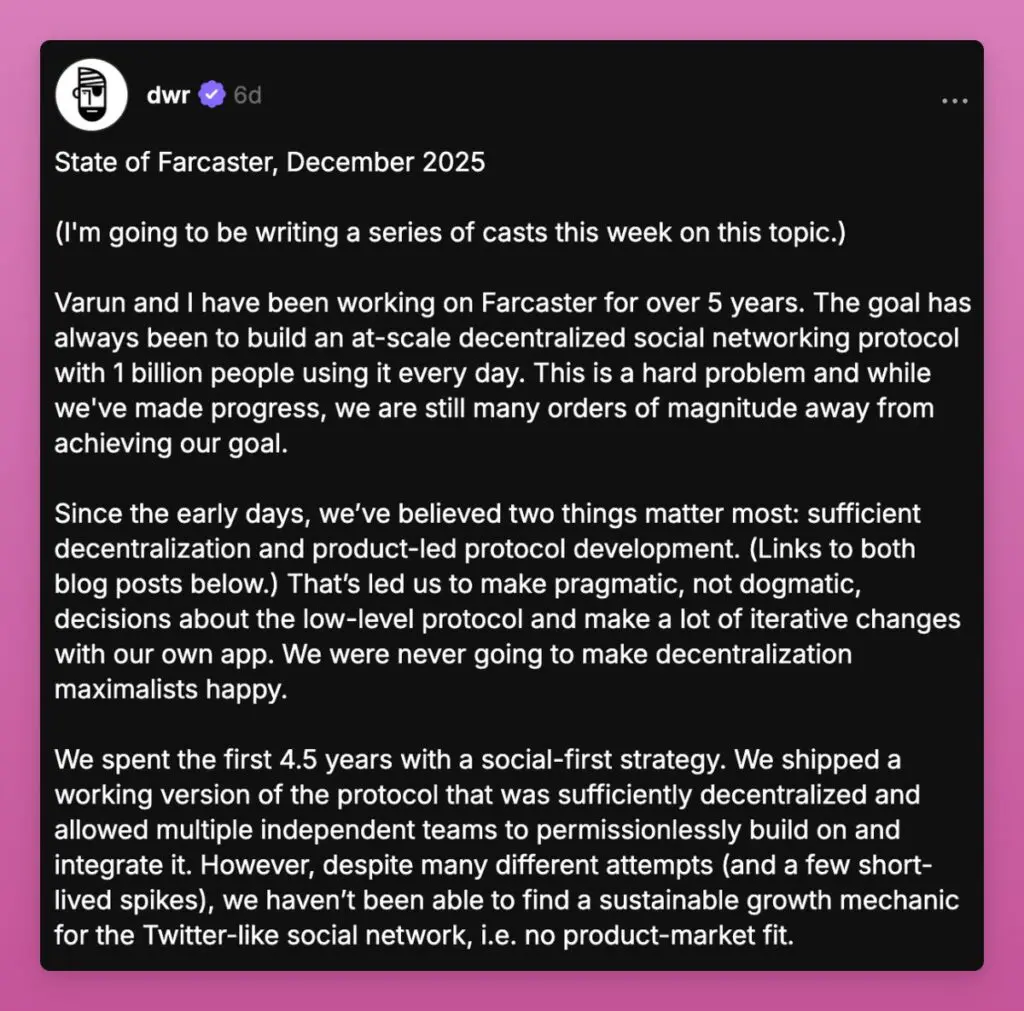
In December 2025, Farcaster officially announced the pivot. The founders confirmed that they would shift the project’s focus away from social networking and prioritize the wallet. Romero explained the decision in a series of posts. He said the team now planned to double down on the wallet because it showed stronger signs of product market fit. The wallet also grew faster than anything else they had built.
He wrote that building a great wallet could attract more users. He added that this direction represented the closest the team had come to clear product market fit in five years.
The pivot required immediate changes. The Farcaster app shifted its emphasis to wallet and trading features. Social graph elements, such as following lists and casts, remained available. However, they no longer shaped the roadmap. In fact, the team announced plans to remove the traditional follower and following model from the main interface. This shift pushed the app further toward wallet centric interactions.
The team described the new vision with a simple phrase. Come for the tool. Stay for the network. The wallet would attract users. The social layer would become optional. Since the wallet linked directly to the protocol, each wallet user automatically joined the larger Farcaster ecosystem. As a result, growth could come from a tool people needed rather than from direct competition with Twitter.
Romero emphasized one important point. Farcaster would not shut down its social protocol or remove user data. The social layer would remain open and accessible. Developers could continue building social-focused clients. Power users who preferred a social-first experience could switch to alternatives like Uno or Degen. Several such apps already existed by 2025.
The pivot simply meant that Farcaster Inc. would redirect its resources. The company would invest in wallet development instead of expanding social features or further decentralizing the protocol. Romero stated clearly that deeper decentralization or social improvements did not represent near-term growth priorities. The wallet-first strategy, however, might finally allow Farcaster to reach a larger network than the social app ever achieved.
The community responded to Farcaster’s pivot with mixed emotions. Early adopters who believed deeply in the social vision felt the strongest impact. Some users appreciated the practical nature of the decision. They believed it could help Farcaster survive and eventually grow. Yet many others felt disappointed or even betrayed. They saw the pivot as a move away from the original mission of decentralized social media.
A notable critique came from Cassie Heart, a longtime community member. She praised the new wallet and called it best in class, so the tool itself did not cause frustration. Instead, she pointed to a cultural shift. Users who once identified as community members now felt labeled as traders. This shift hit hard because the group spent years building a friendly and collaborative atmosphere. The new framing felt abrupt. It also threatened the identity that held the community together.
Several early supporters also reacted strongly to how the change was communicated. Reports surfaced that a team member referred to critical long-term users as the old guard. This language frustrated many. It seemed to dismiss the people who helped shape Farcaster’s culture in the first place.
The tension grew as the startup pushed forward with its new direction. One commentator observed that product direction can shift quickly. However, community sentiment rarely moves at the same speed. Farcaster demonstrated this clearly. The protocol remained decentralized and open, yet the company’s pivot changed the tone and priorities. Some dedicated social users felt pushed aside during the transition.
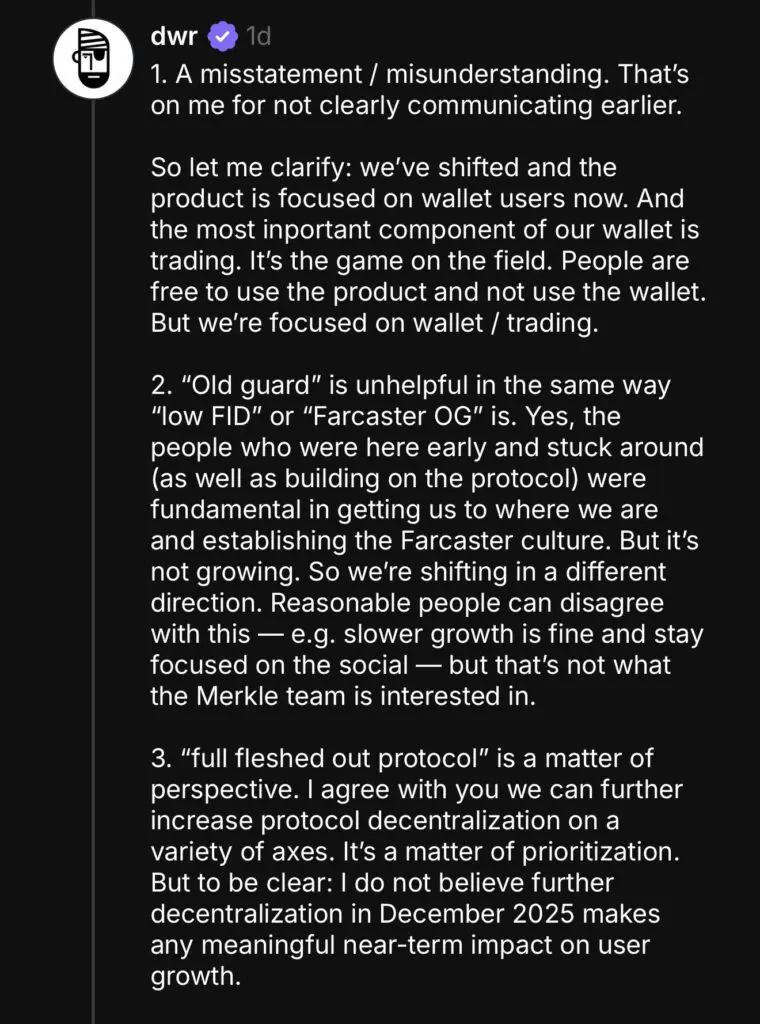
Dan Romero addressed the concerns with a partial mea culpa. He acknowledged communication mistakes and apologized for any condescending language toward loyal users. He also clarified that anyone who wanted to keep using Farcaster as a social network could do so. The protocol would remain open. Users could even build or fork clients that ignore wallet features entirely.
At the same time, Romero emphasized the hard reality. The app was not growing as a social product. The team needed a new approach. He framed the pivot as a strategic shift rather than an abandonment of the long-term vision. A phrase circulated repeatedly within the community. Let users stay for the tool first. Then social will have room to exist. This idea suggested that strong utility could bring in a larger base, which might then support a renewed social layer.
Farcaster’s transformation raised an important question. What does this mean for the broader goal of decentralized social networking? Some observers saw the pivot as evidence that the Web3 social thesis is failing. Farcaster had strong founders, substantial funding, and real product development. Yet the project stepped back from the decentralized Twitter idea. Analysts pointed out that the challenges Farcaster faced are not unique. Slow mainstream adoption, dominant incumbents, and a limited crypto audience all present structural barriers. Many users do not prioritize decentralization when choosing a social platform.
Even so, it may be too early to declare the entire concept dead. Farcaster’s retreat represents one project’s learning curve. Other experiments continue. Lens Protocol takes an NFT-based approach to user ownership on Polygon. Bluesky builds a federated protocol that aims for interoperability and user control. Nostr appeals to users who value simplicity and censorship resistance. None of these efforts have gone mainstream yet, but they prove the space is still evolving.
Farcaster’s pivot also offers a lesson. A decentralized social network may need to attach itself to something users already value. Instead of trying to bootstrap network effects from zero, it might need to ride on top of an existing utility. Farcaster’s wallet-first model reflects this idea. Other projects might find similar pathways through specific communities, content niches, or creator-focused tools.
Importantly, Farcaster has not abandoned its social ambitions. The protocol and social layer remain active. They could grow again if the wallet-first strategy succeeds in bringing more users into the ecosystem. Romero continued to repeat the principle. Come for the tool. Stay for the network. This approach could allow social interaction to flourish more naturally once a larger user base exists.
Success still depends on execution. The crypto wallet market is crowded, and building a standout product will not be simple. Yet this path appears more achievable than competing with Twitter’s global scale. If the wallet attracts enough people, some of them will likely explore the built-in social features. Peer-to-peer interaction may then return in a more organic and sustainable form.
Farcaster’s journey highlights both the promise and struggle of Web3 social media. It proved that decentralized identity and data ownership are technically possible. It built a community that valued these principles. However, it also showed the difficulty of scaling such systems to mainstream relevance. Users need strong reasons to switch platforms, and decentralization alone rarely provides that incentive.
The pivot toward wallets suggests that finance might serve as a more natural entry point for mass Web3 adoption. Tools can bring people in. Networks can grow afterward. As many observers noted, social might not be Web3’s first killer app. It could still become one later when the user base is ready.
For now, Farcaster will focus on making its wallet succeed. If it does, the project may return to its social ambitions under better conditions. The crypto community will continue studying this case. It offers a clear example of how difficult it is to build a new social network and how long the road toward a user-owned social web might be.