Loading Search...


Why Hyperliquid Is Defying the Market in 2026. A deep dive into its Layer-1 design, revenue engine, and rise in decentralized derivatives.

Author: Kritika Gupta
As 2026 unfolds, the cryptocurrency market has entered a phase of consolidation and selective pressure. Hyperliquid 2026 stands out as a rare case of expansion during market weakness, with the decentralized derivatives platform continuing to scale while peers retrench.
In contrast, Hyperliquid continues to expand.
Hyperliquid operates as a decentralized perpetual futures platform built on its own high-performance Layer 1 blockchain. While much of the market retrenches, Hyperliquid scales. In 2025 alone, the protocol processed approximately $2.6 trillion in notional trading volume. By comparison, Coinbase handled around $1.4 trillion during the same period.
HYPE, Hyperliquid’s native token, has risen over 31.7 percent year to date. Over the same period, COIN declined sharply, creating a performance gap of nearly 59 percent. Daily perpetual volumes on Hyperliquid routinely exceed $5 billion and frequently capture more than 30 percent of total decentralized perpetuals volume. Open interest remains elevated at roughly $4 to $5 billion.
On February 5, 2026, Hyperliquid recorded a daily revenue high of $6.84 million. A significant share of this revenue funded token buybacks.
Importantly, this is not a simple bull-market story. Hyperliquid continues to outperform during broader market weakness. It does so through a combination of technological advantages, product expansion, and a tightly aligned economic model. Its custom Layer 1 delivers centralized-exchange-level speed with full on-chain settlement. Meanwhile, protocol upgrades such as HIP-3 and the upcoming HIP-4 have expanded Hyperliquid’s scope beyond crypto into real-world assets and event-based markets.
Revenue now approaches $1 billion on an annualized basis. Instead of leaking value, the protocol recycles fees back into the ecosystem through buybacks and burns. As a result, Hyperliquid demonstrates sustainable value capture in an industry often criticized for extractive tokenomics.
The rise of decentralized perpetual futures has been one of the most important trends in crypto over the past three years. Perpetual contracts allow traders to go long or short with leverage while avoiding expiration dates, making them ideal for speculative and hedging activity. Historically, these instruments were dominated by centralized exchanges due to their speed, liquidity, and ease of use.
That dominance is eroding.
In Hyperliquid 2026, decentralized derivatives increasingly rival centralized venues in execution quality while offering transparency and self-custody. Unlike most DeFi protocols that rely on shared execution environments, Hyperliquid controls its entire stack: execution, settlement, and economic incentives. This vertical integration has proven decisive as traders seek alternatives to custodial risk and opaque execution.
This design choice has proven decisive. While centralized exchanges face custody risk, regulatory pressure, and geographic fragmentation, Hyperliquid offers traders transparency, self-custody, and execution quality that increasingly rivals centralized venues.
By early 2026, this shift accelerated further. Daily perpetual volumes on Hyperliquid routinely exceeded $5 billion, often capturing more than 30 percent of total decentralized perpetuals volume. Open interest remained elevated in the $4 to $5 billion range, signaling not just speculative bursts, but sustained engagement from large and sophisticated participants
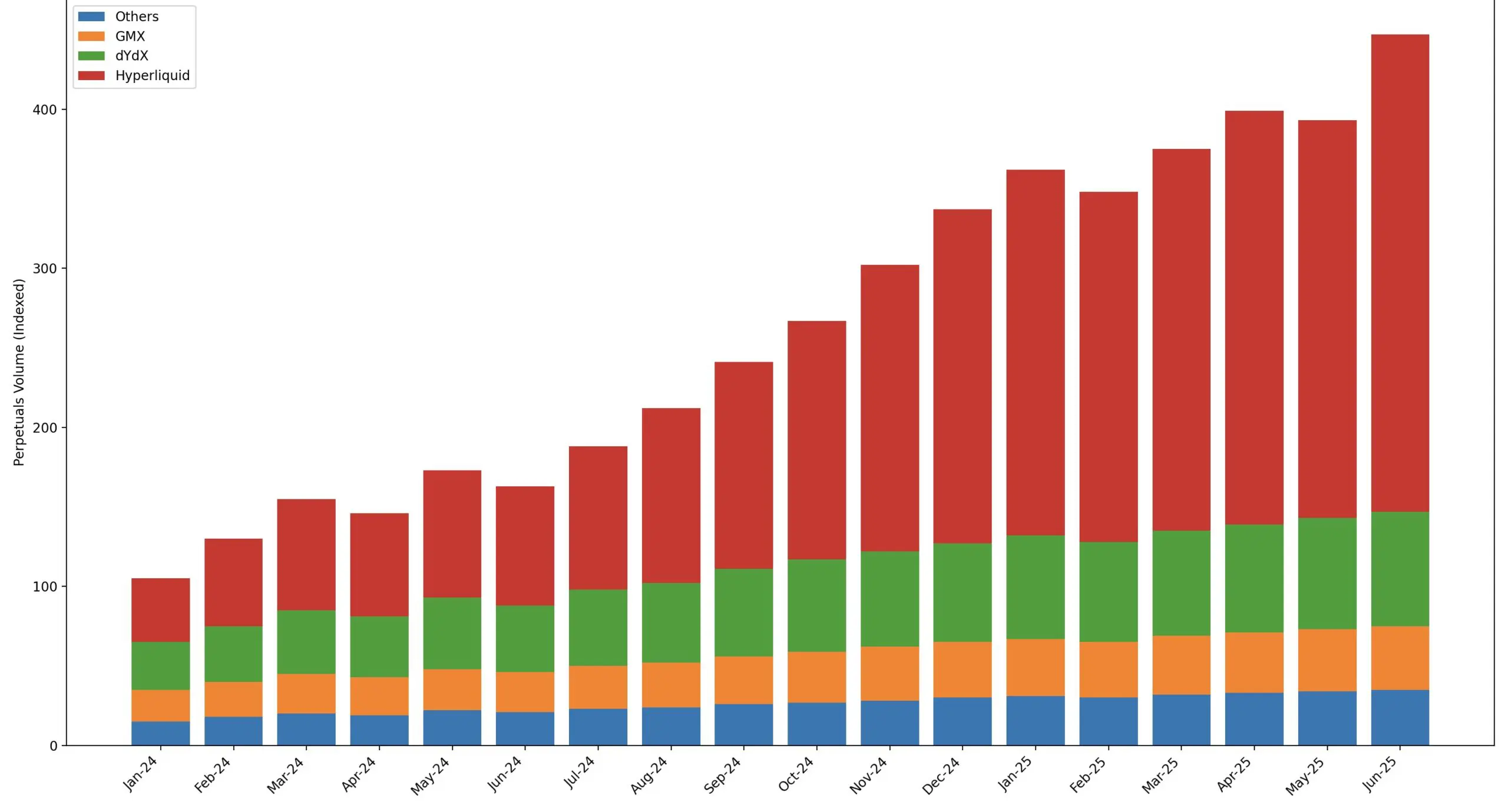
The perpetual futures sector has evolved rapidly since the early days of GMX and dYdX. PerpDEXs allow leveraged trading without expiration while preserving self-custody. However, success depends on three core pillars: liquidity depth, execution speed, and user experience.
Hyperliquid leads on all three, but competition continues to intensify.GMX, deployed on Arbitrum and Avalanche, pioneered the GLP liquidity pool model using an AMM-style design. GMX v2 improved capital efficiency and oracle integration. Nevertheless, the platform still faces slippage during high volatility and slower execution compared with order-book systems.
dYdX v4, now operating on its own Cosmos-based chain, offers a hybrid order-book design with institutional appeal. However, it has lost retail volume momentum due to higher onboarding friction and slower expansion into non-crypto assets.
Meanwhile, a new wave of challengers emerged in 2025 and 2026.Aster positions itself as a high-leverage platform, offering up to 1000x leverage on select markets alongside yield-optimized collateral. Through aggressive incentive programs, Aster has surpassed Hyperliquid on specific high-volume days, particularly among yield-driven traders.
Lighter, built on Ethereum, differentiates itself through zero or near-zero trading fees and strong EVM compatibility. While it has occasionally matched Hyperliquid’s volume, it has struggled to maintain consistent liquidity depth.
Other platforms such as Apex, edgeX, Paradex, and Variational target narrower niches. These include advanced order types, institutional flows, or specific ecosystems. However, liquidity remains fragmented across these venues.
Despite rising competition, Hyperliquid 2026 maintains several structural advantages. By operating its own application-specific chain, it achieves sub-millisecond latency, fully on-chain order books, and gas-free trading for users. The Hyperliquidity Provider vault, which holds roughly $350 to $500 million in TVL, functions as a community-owned market-making and liquidation backstop.
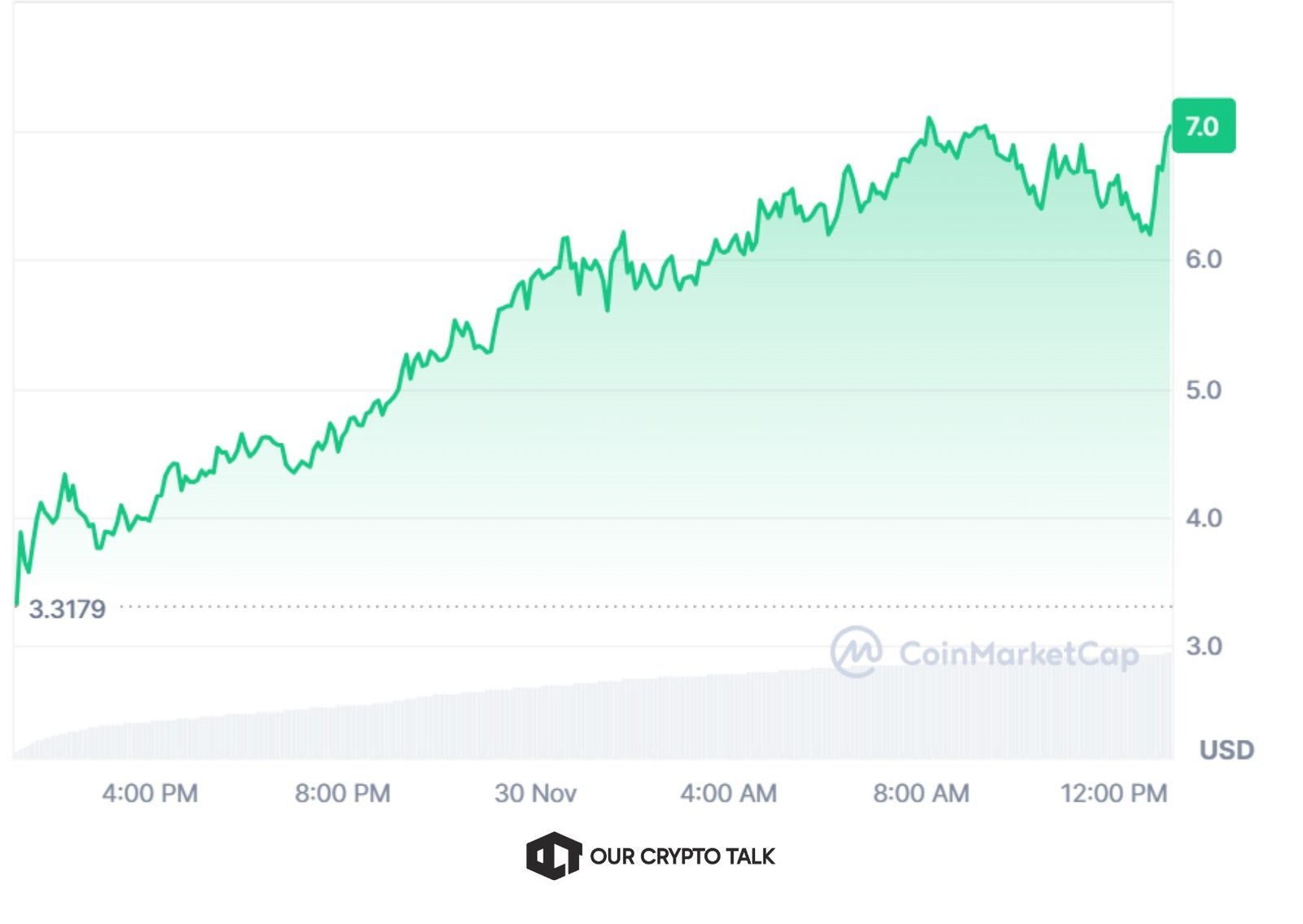
Market structure changes often express themselves most clearly through relative performance. Hyperliquid’s native token, HYPE, has risen over 31.7 percent year to date in 2026. Over the same period, Coinbase’s equity declined sharply. The resulting performance gap approaches 59 percent, a striking divergence given the broader market’s weakness.
Importantly, this is not a reflexive bull-market trade. Hyperliquid’s outperformance has occurred during periods of volatility, consolidation, and risk-off sentiment. On February 5, 2026, the protocol recorded a daily revenue high of $6.84 million, a significant portion of which was used for token buybacks.
Revenue, not narrative, is driving the token’s behavior.Annualized protocol revenue now approaches $1 billion, placing Hyperliquid 2026 among the highest-grossing entities in all of crypto. Unlike many DeFi protocols that leak value through emissions or incentives, Hyperliquid recycles fees back into its ecosystem through buybacks, burns, and liquidity incentives.
Hyperliquid’s 2026 volume expansion stems from multiple reinforcing factors that span technology, product design, token economics, and market behavior.
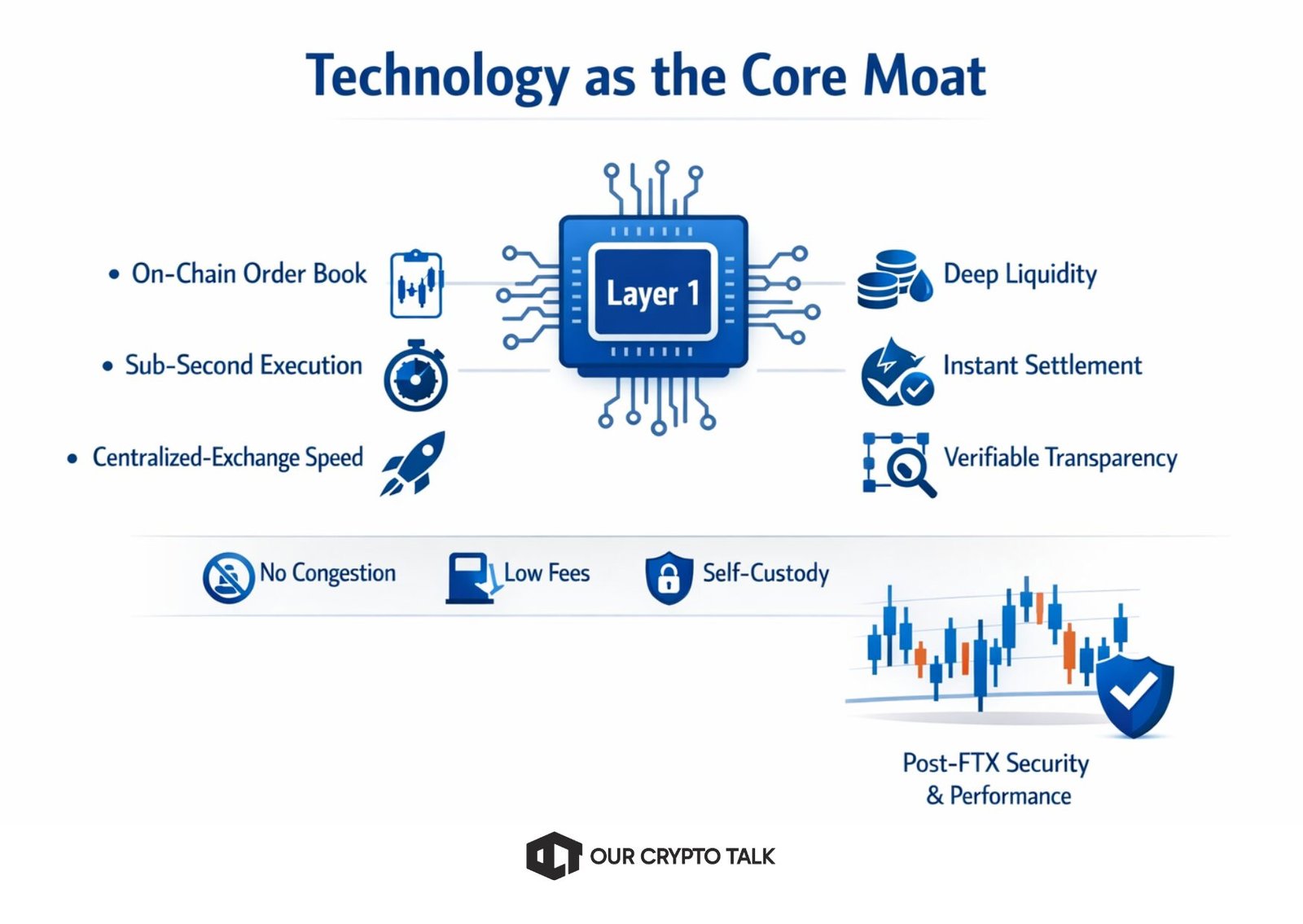
Hyperliquid’s custom Layer 1 is purpose-built for high-frequency derivatives trading, rather than being adapted from a general-purpose blockchain. This design enables fully on-chain order books with deterministic execution and sub-second latency, allowing the platform to deliver centralized-exchange-level speed while preserving decentralization. Traders benefit from deep liquidity, minimal slippage, instant settlement, and verifiable execution at every stage of the trade lifecycle.
Unlike rollup-based or shared execution environments, Hyperliquid 2026 avoids congestion, gas fee volatility, and external sequencing risk. In a post-FTX environment, where counterparty risk and opaque execution have become unacceptable to many participants, this combination of performance, transparency, and self-custody has proven especially compelling for both professional and high-volume retail traders.
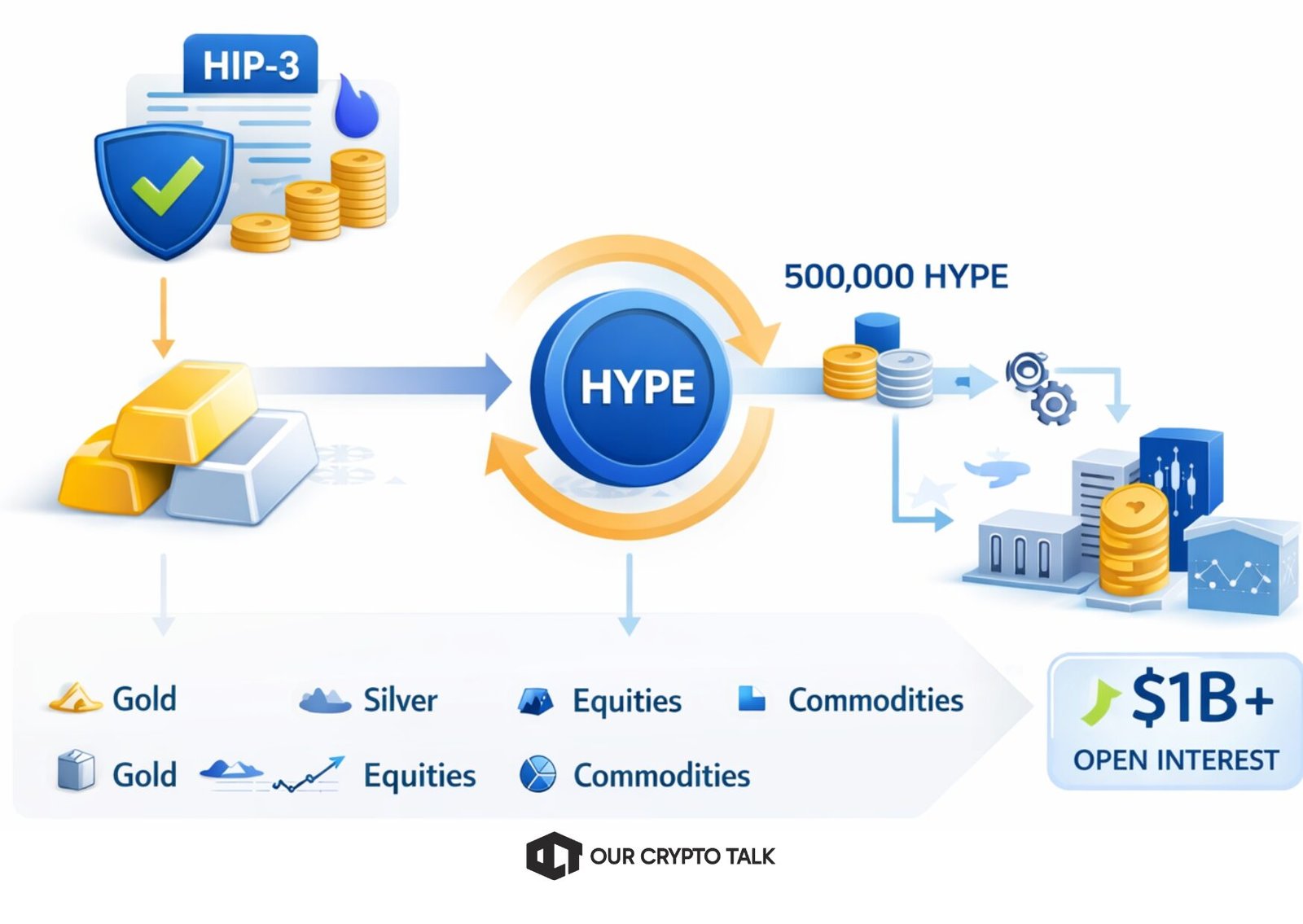
The HIP-3 upgrade in October 2025 introduced permissionless market creation. Any participant staking 500,000 HYPE can deploy new perpetual markets with customized oracles, leverage limits, and fee structures.
This model catalyzed rapid growth in real-world asset markets. Gold, silver, equities, and commodity perps quickly generated billions in trading volume and exceeded $1 billion in combined open interest. As traditional assets rallied into early 2026, Hyperliquid captured flows from traders seeking leveraged exposure without brokers or custody intermediaries.
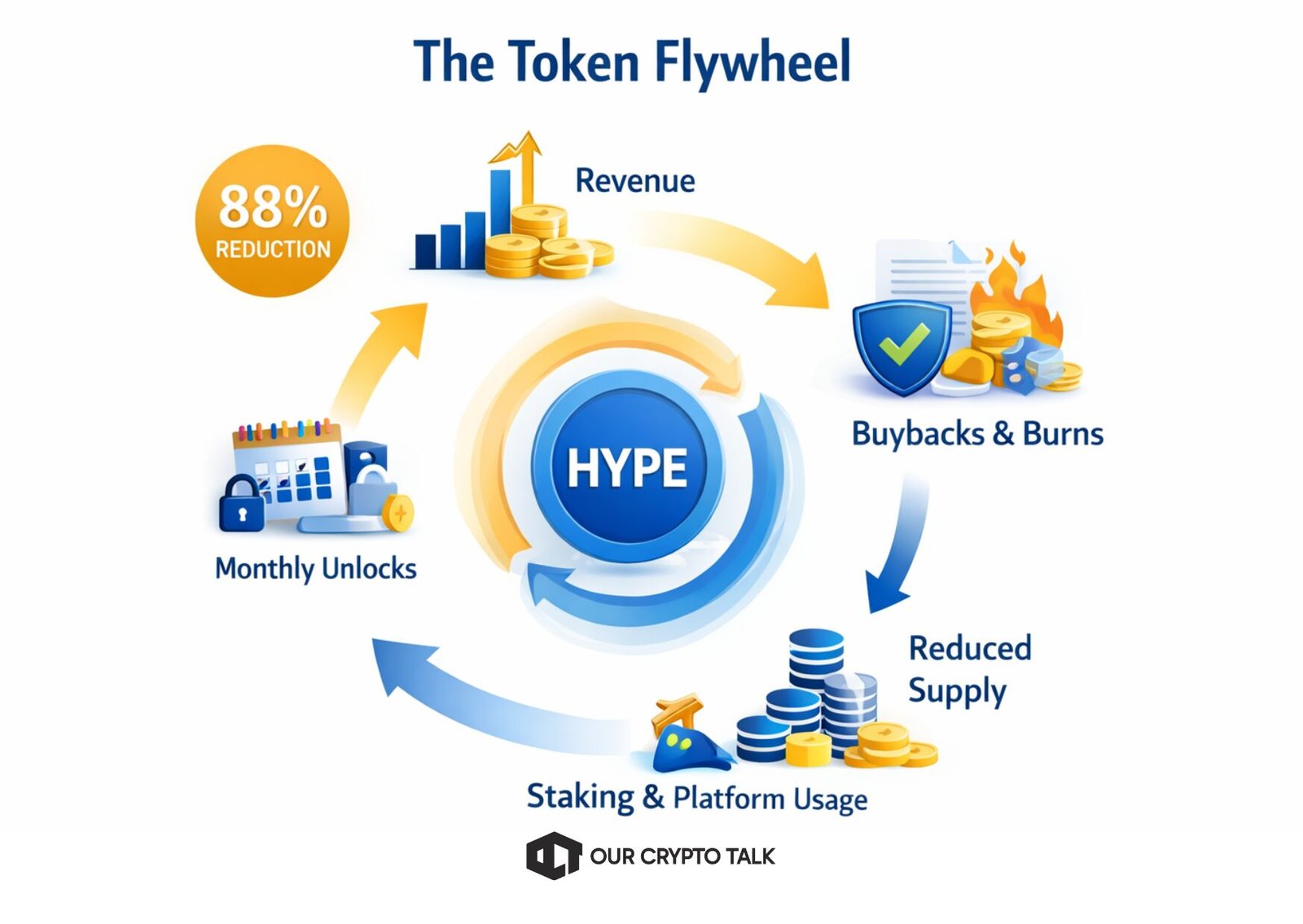
Hyperliquid directly links revenue to token demand. A large portion of fees funds HYPE buybacks and burns. On peak revenue days, the protocol has repurchased over 160,000 HYPE in a single session.
At the same time, monthly unlocks dropped sharply, with an 88 percent reduction implemented in February 2026. Reduced sell pressure combined with staking requirements for market creation reinforces scarcity.
This creates a virtuous cycle. Higher volume generates more revenue. Revenue funds buybacks. Buybacks reduce supply. Rising token value encourages further staking and platform usage.
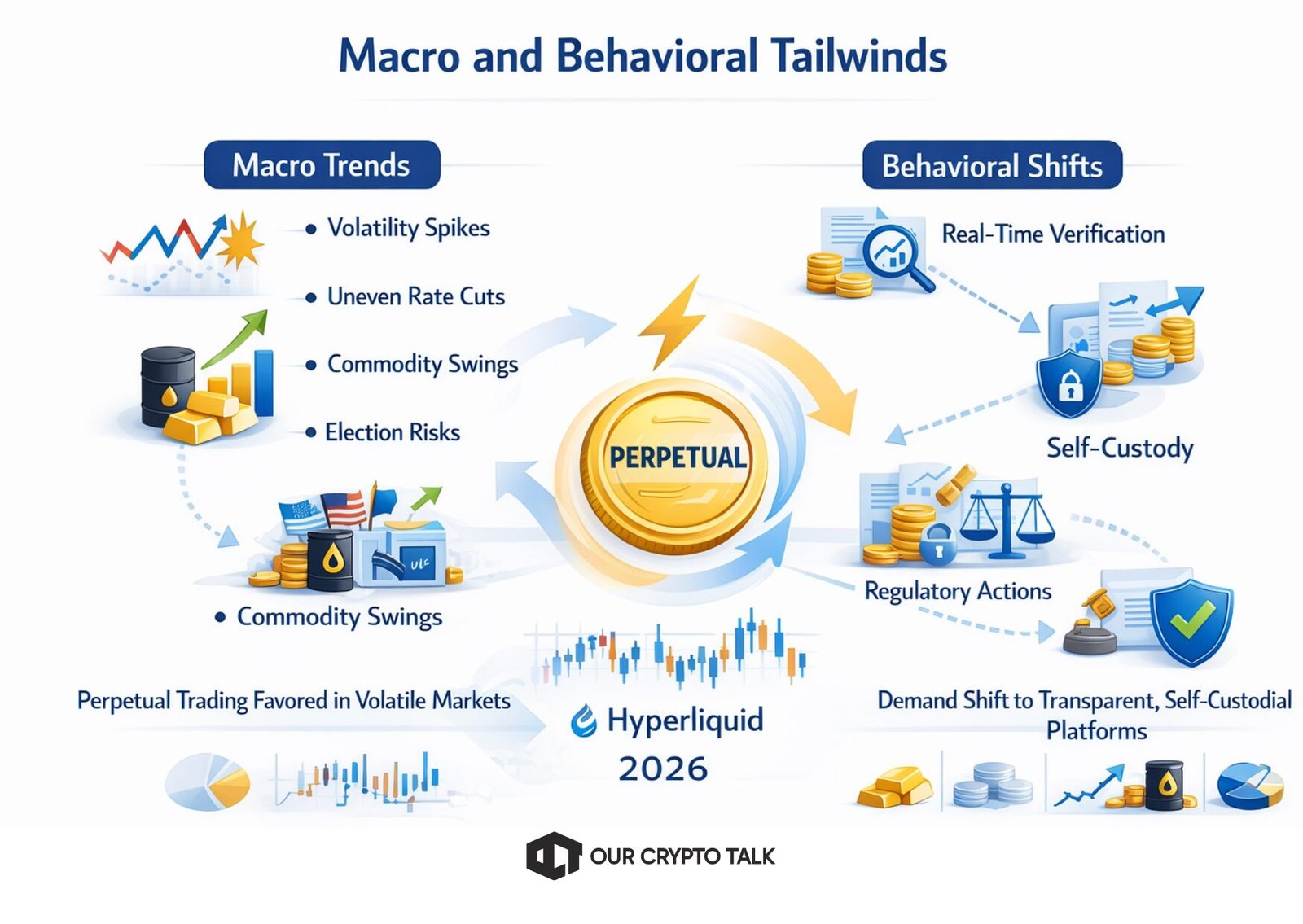
Volatility spikes, renewed interest in RWAs, and declining trust in centralized venues all favored perpetual trading in 2026. Macro uncertainty including uneven rate cuts, commodity price swings, and election-driven risk events pushed traders toward instruments that allow rapid positioning and efficient hedging. Perpetuals naturally benefited from this environment.
At the same time, post-FTX caution and ongoing regulatory actions reinforced a behavioral shift toward self-custody and on-chain transparency. Professional traders increasingly preferred platforms where execution, funding rates, and liquidation mechanics are verifiable in real time. Hyperliquid 2026 capitalized on this shift by rapidly listing trending assets, RWAs, and event-driven markets, capturing demand as it emerged rather than reacting after liquidity migrated elsewhere.
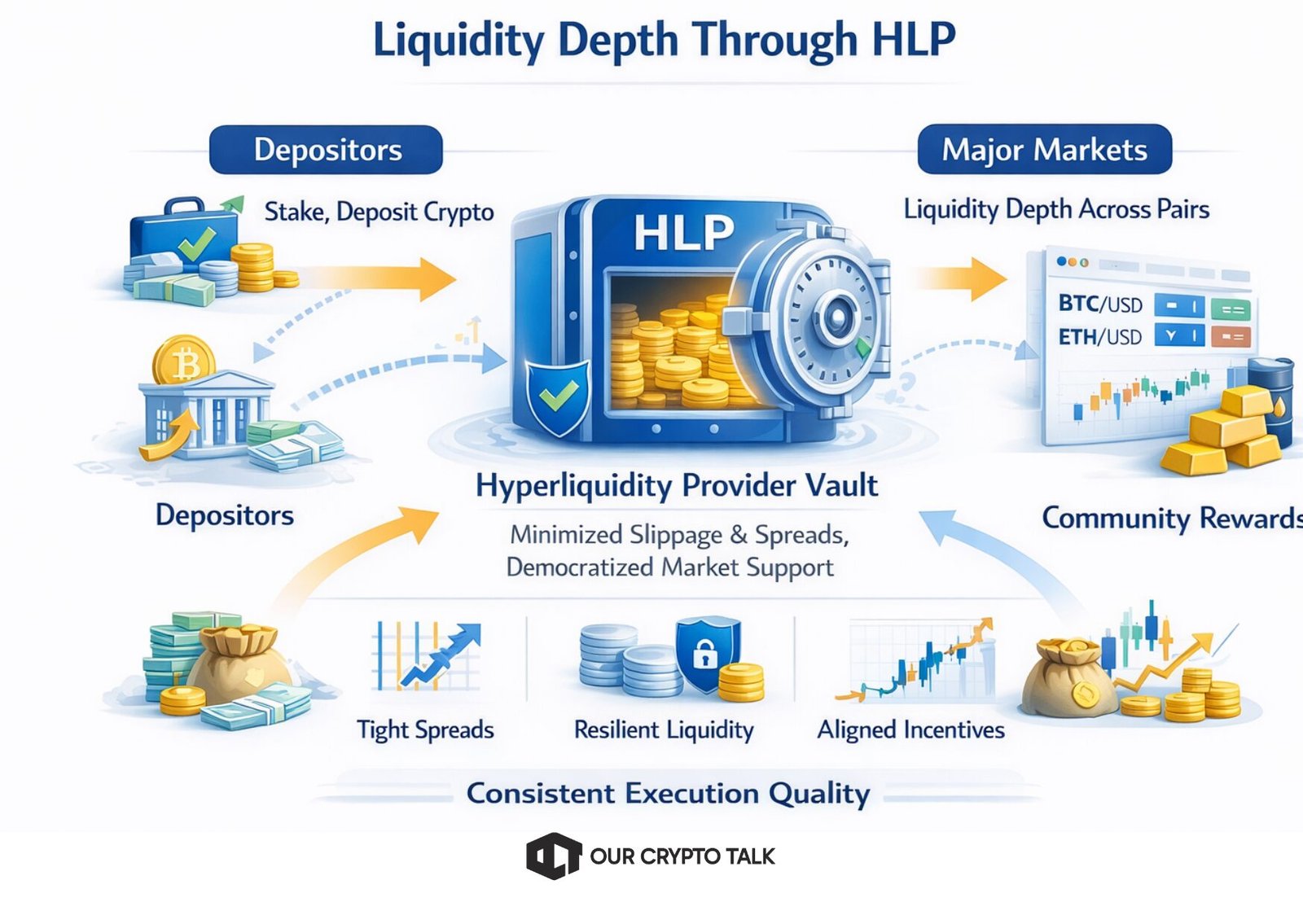
The Hyperliquidity Provider (HLP) vault plays a central role in sustaining Hyperliquid’s execution quality. By pooling community capital into a shared market-making and liquidation backstop, HLP provides consistent depth across major markets, even during periods of stress or sudden volatility.
Depositors earn yield through a combination of PnL sharing and trading fees, effectively democratizing professional market-making. This structure aligns incentives across the ecosystem: traders benefit from tighter spreads and lower slippage, liquidity providers earn returns tied to real trading activity, and the protocol gains a resilient liquidity layer without relying on mercenary incentives. As volumes scale, HLP becomes a reinforcing stabilizer rather than a passive liquidity source.
Hyperliquid increasingly resembles a foundational derivatives venue rather than a single application.
HIP-4 introduces outcome-based contracts. These instruments feature full collateralization, defined expiries, and no liquidation risk. Builders can deploy markets for elections, sports, and macro events, expanding Hyperliquid into prediction markets and structured products.
In parallel, deeper integration with equities, forex, and commodities remains likely. Institutional on-ramps and compliance-friendly tooling could unlock additional capital.
As the ecosystem matures, native lending protocols, yield strategies, and cross-chain bridges may transform Hyperliquid into a broader DeFi hub.
Despite strong performance, Hyperliquid faces several structural risks. First, competition remains intense. Rival perpDEXs continue to use aggressive incentives, higher leverage, or fee suppression to attract liquidity, which could fragment volume during periods of lower activity. Second, regulatory uncertainty persists, particularly around perpetual futures and real-world asset markets.
Although on-chain transparency helps, evolving global frameworks may restrict access or participation. Third, technical risk scales with usage. As volumes grow, maintaining sub-millisecond execution, oracle integrity, and smart contract security becomes increasingly critical. Finally, prolonged low-volatility market conditions could reduce trading demand, slowing revenue growth despite diversification efforts.
Hyperliquid’s 2026 outperformance reflects deliberate design rather than market luck. A purpose-built chain, permissionless innovation through HIP upgrades, aligned token economics, and deep liquidity form its foundation.
While competitors iterate at the application layer, Hyperliquid builds infrastructure. As on-chain trading converges with traditional finance, this positioning becomes increasingly valuable.
For traders, builders, and investors, Hyperliquid represents more than another DEX. It serves as a case study in how decentralized systems can outperform centralized incumbents through transparency, speed, and economic alignment.
As HIP-4 and future upgrades roll out, Hyperliquid may define the next phase of derivatives trading. In a market saturated with hype, Hyperliquid delivers measurable execution and sustained volume.