Stablecoins have become the backbone of digital finance, enabling trading, remittances, payments, and global settlement. However, most stablecoins still rely on general‑purpose blockchains that were never designed for monetary settlement. Users must pay fees in volatile native tokens, face unpredictable costs, and deal with congestion that undermines stablecoins’ core promise of reliability. This friction prevents stablecoins from functioning as true digital dollars. This Stable Review analyzes how Stable addresses these structural limitations by making stablecoins the foundation of the network itself.
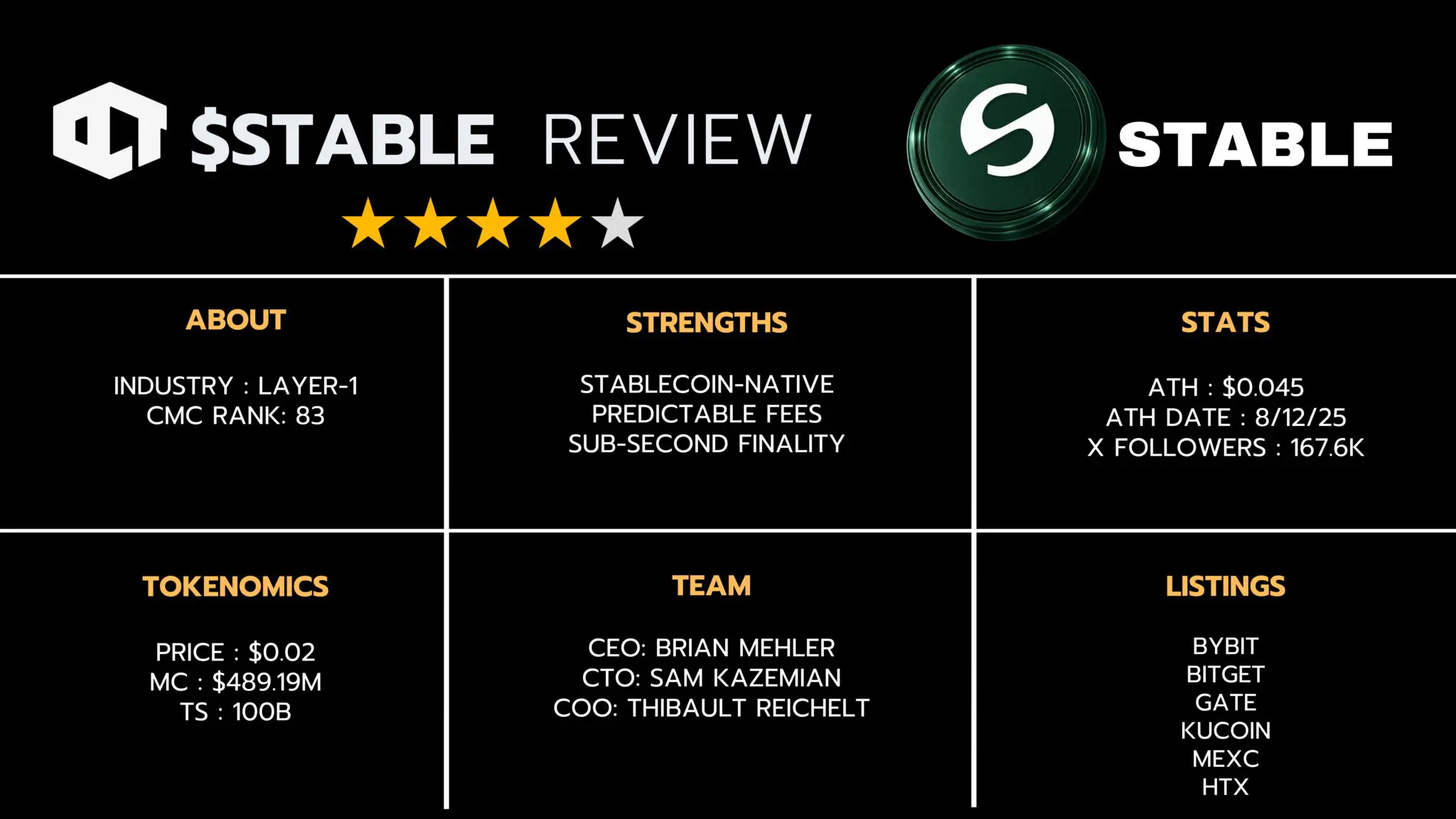
Stable, a Layer‑1 blockchain purpose‑built to solve these structural limitations. Instead of treating stablecoins as secondary assets, Stable makes them the foundation of the network itself. The protocol removes dependence on volatile gas tokens, enabling users to transact directly in stablecoins like USDT with predictable fees and consistent settlement performance.
By aligning consensus, execution, and transaction design around stablecoin usage, Stable aims to create infrastructure optimized for payments, financial applications, and institutional settlement. Its architecture prioritizes cost predictability, performance, and reliability, positioning stablecoins as functional digital money rather than speculative assets dependent on external gas economies.
Problem Statement
General‑Purpose Blockchains Are Not Optimized for Stablecoins: Most blockchains were designed for broad programmability, not monetary settlement. This leads to inefficiencies when used for stablecoins, including unpredictable performance, unnecessary computational overhead, and infrastructure misaligned with payment‑focused workloads.
Dependence on Volatile Gas Tokens Creates Financial Risk: Users must acquire and hold volatile native tokens to pay transaction fees. This introduces unnecessary exposure to price fluctuations, creating friction and undermining the stability that stablecoins are meant to provide.
Unpredictable Transaction Costs Limit Financial Utility: Network congestion causes gas fees to fluctuate unpredictably. This makes stablecoins unreliable for payments, treasury management, or financial operations where cost predictability is essential.
Settlement Latency Prevents Real‑Time Financial Applications: Many blockchains require multiple confirmations and experience inconsistent finality times. This latency limits stablecoins’ effectiveness for real‑time payments, remittances, and institutional settlement workflows.
Lack of Infrastructure Tailored for Financial Institutions: Existing networks do not provide sufficient guarantees around cost certainty, performance consistency, and compliance readiness. This prevents broader institutional adoption of stablecoins for operational financial use.
Solutions Provided by Stable
Native Stablecoin Gas Model Eliminates Volatility Risk: Stable allows users to pay transaction fees directly in stablecoins like USDT. This removes the need to acquire volatile gas tokens, ensuring that transaction costs remain predictable and aligned with dollar‑denominated usage.
StableChain Architecture Optimized for Monetary Settlement: The network is designed specifically for stablecoin transaction patterns. Consensus, execution, and blockspace allocation are optimized for financial transfers rather than generalized computation.
Predictable Fee Structure Enables Reliable Financial Operations: By eliminating dependency on volatile gas tokens and optimizing execution, Stable ensures consistent and predictable transaction costs. This enables stablecoins to function reliably for payments, treasury operations, and financial applications.
Sub‑Second Finality Enables Real‑Time Transactions: Stable delivers fast and deterministic settlement, enabling near‑instant finality. This supports real‑time payments, trading, and financial workflows requiring immediate confirmation.
Enterprise‑Grade Infrastructure Supports Institutional Adoption: The protocol integrates performance guarantees, efficient execution, and stablecoin‑native settlement. This provides financial institutions with infrastructure aligned with operational and regulatory requirements.
Problem–Solution Overview
ProblemsSolutions
General-Purpose Blockchains Are Not Optimized for Stablecoins: Broad programmability creates inefficiencies, overhead, and infrastructure misalignment for payment-focused stablecoin usage.
StableChain Architecture Optimized for Monetary Settlement: Consensus, execution, and blockspace allocation are purpose-built for stablecoin transfer patterns and financial settlement efficiency.
Dependence on Volatile Gas Tokens Creates Financial Risk: Users must hold volatile native tokens to pay fees, undermining the stability promise of stablecoins.
Native Stablecoin Gas Model: Transaction fees are paid directly in stablecoins like USDT, eliminating volatility exposure and simplifying financial operations.
Unpredictable Transaction Costs Limit Financial Utility: Congestion-driven gas fluctuations make stablecoins unreliable for payments, treasury, and financial workflows.
Predictable Fee Structure: Stable ensures consistent, transparent costs by aligning execution and gas payments with stablecoin-denominated usage.
Settlement Latency Prevents Real-Time Applications: Multi-confirmation requirements and inconsistent finality limit stablecoins’ effectiveness for instant payments and settlement.
StableChain embeds stablecoins directly into its core transaction model, enabling exclusive interaction with dollar-denominated assets.
Stablecoin-NativeSettlement Layer
Monetary Settlement Focus
Aligns network architecture with financial settlement requirements rather than general-purpose computation.
PaymentsFinancial Infrastructure
Consensus & Execution Optimization
High-Throughput Processing
Consensus and execution pipelines are optimized for fast transaction throughput and rapid settlement.
High ThroughputFast Settlement
Guaranteed Blockspace
Allocates dedicated blockspace for stablecoin transactions, ensuring predictable execution without congestion delays.
Guaranteed ExecutionPredictable Fees
Enterprise-Grade Execution
Confidential Transfers
Supports confidential transaction capabilities while preserving verifiability and auditability.
ConfidentialAuditable
Tokenomics
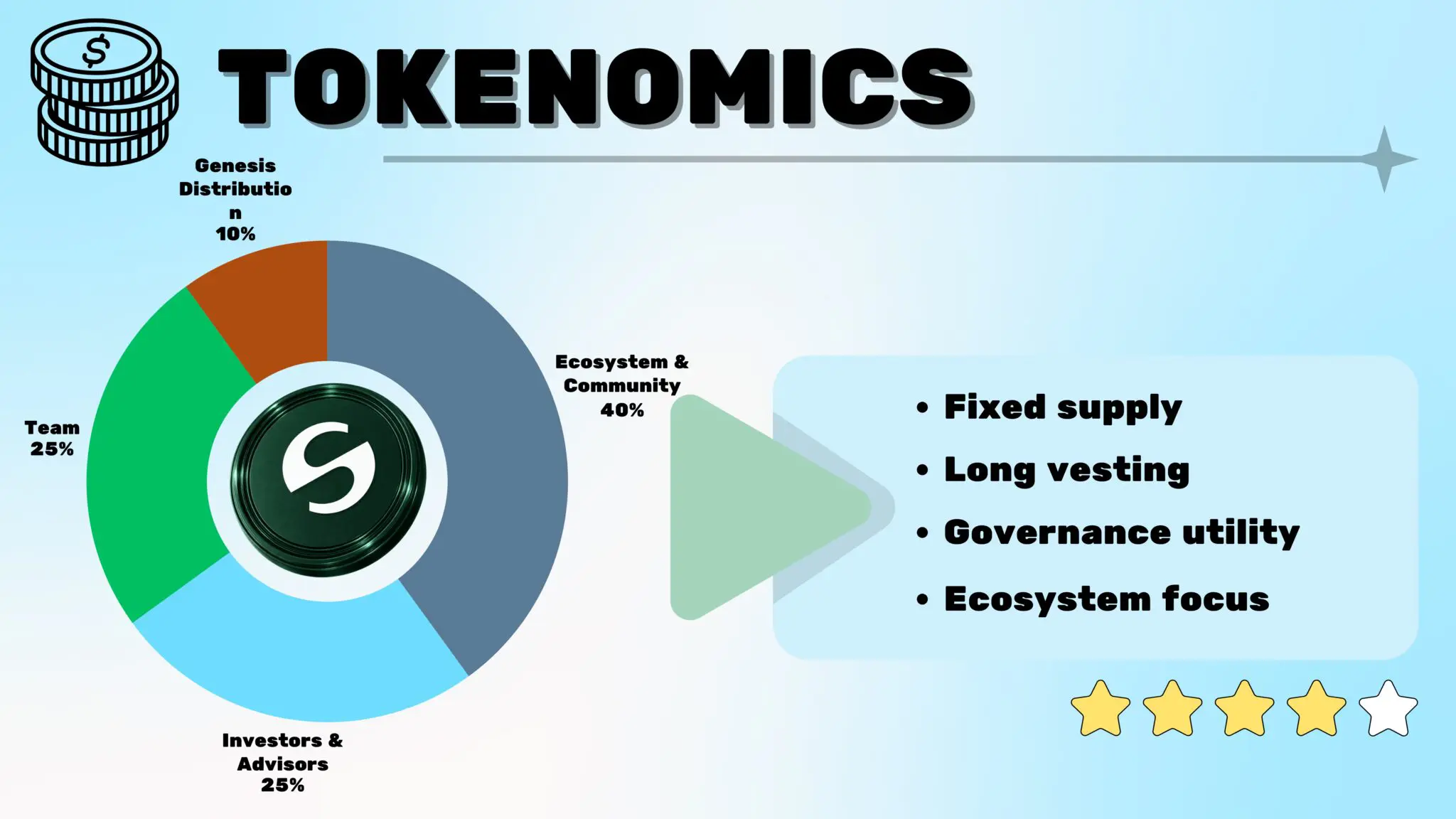
Stable introduces the STABLE token as the governance and economic coordination asset of the Stable ecosystem, while stablecoins such as USDT serve as the native gas and settlement currency. This separation ensures predictable transaction costs for users while aligning governance incentives with long‑term network growth and validator participation.
The STABLE token functions as the governance and staking asset of the Stable Mainnet. It enables validator election, governance participation, protocol upgrades, and access to economic rewards distributed through network activity.
Stable vs. Ethereum: Ethereum supports stablecoins but requires volatile ETH for gas fees. Stable eliminates this friction by allowing direct stablecoin‑based transaction fees.
Stable vs. Tron: Tron is widely used for USDT transfers but was not designed exclusively for stablecoin settlement. Stable optimizes every layer specifically for stablecoin transactions.
Stable vs. Solana: Solana provides high throughput but still requires a native gas token. Stable removes this requirement entirely, simplifying user experience.
Stable vs. General Layer‑1 Chains: Most Layer‑1 blockchains prioritize programmability over monetary efficiency. Stable prioritizes stablecoin settlement as its primary function.
Strengths
Stablecoin‑native transaction and fee model
Predictable transaction costs and settlement performance
Optimized infrastructure for financial applications
Eliminates gas token volatility exposure
Enterprise‑focused infrastructure design
Challenges
Requires ecosystem adoption to achieve network effects
Competes with established stablecoin settlement chains
Must demonstrate long‑term reliability and scalability
Institutional adoption depends on regulatory alignment
Stable vs High-Performance Layer-1 Payment Networks
Project
Core Focus
Execution Architecture
Programmability
Token Utility
Notes
Stable
USD₮-native Layer-1 for stablecoin payments
EVM-compatible high-throughput architecture; future DAG optimization
Full (EVM, Solidity)
Staking, governance, network security
Mainnet launched Dec 2025; USDT used as gas; free peer-to-peer transfers; backed by Bitfinex, Tether, and PayPal Ventures; $28M raised; targeting 10k+ TPS
Tron
High-throughput Layer-1 for payments and DeFi
Delegated Proof-of-Stake (DPoS) consensus
Full (EVM-compatible)
Transaction fees, staking (TRX)
Largest USDT settlement network globally; extremely low fees; founded by Justin Sun; dominant in stablecoin transfers
Stable Review Conclusion
This Stable Review highlights a blockchain designed with a singular focus: transforming stablecoins into true digital money. By removing volatile gas tokens and enabling direct stablecoin-based transactions, Stable eliminates one of the most persistent friction points in blockchain infrastructure.
Its architecture reflects a deliberate shift away from speculative token ecosystems toward infrastructure optimized for financial settlement. Predictable fees, rapid settlement, and stablecoin-native execution provide the reliability required for payments, treasury management, and institutional adoption, reinforcing the core thesis of this Stable Review.
If Stable successfully achieves widespread adoption, it could redefine how stablecoins function within the broader financial system. Instead of relying on general-purpose blockchains, stablecoins would operate on infrastructure specifically engineered for monetary settlement, unlocking their full potential as global digital currency.
TL;DR
USDT-native Layer-1 for stablecoin-only settlement.
Eliminates volatile gas tokens by using USDT.
Sub-second finality optimized for digital payments.
Dedicated infrastructure for enterprise stablecoin adoption.
STABLE token secures the network and governance.
Fully EVM compatible for seamless developer migration.




 Tron
Tron



 Solana
 Fantom
 Hedera
 Near
Near
 Sui
Sui