Loading Search...


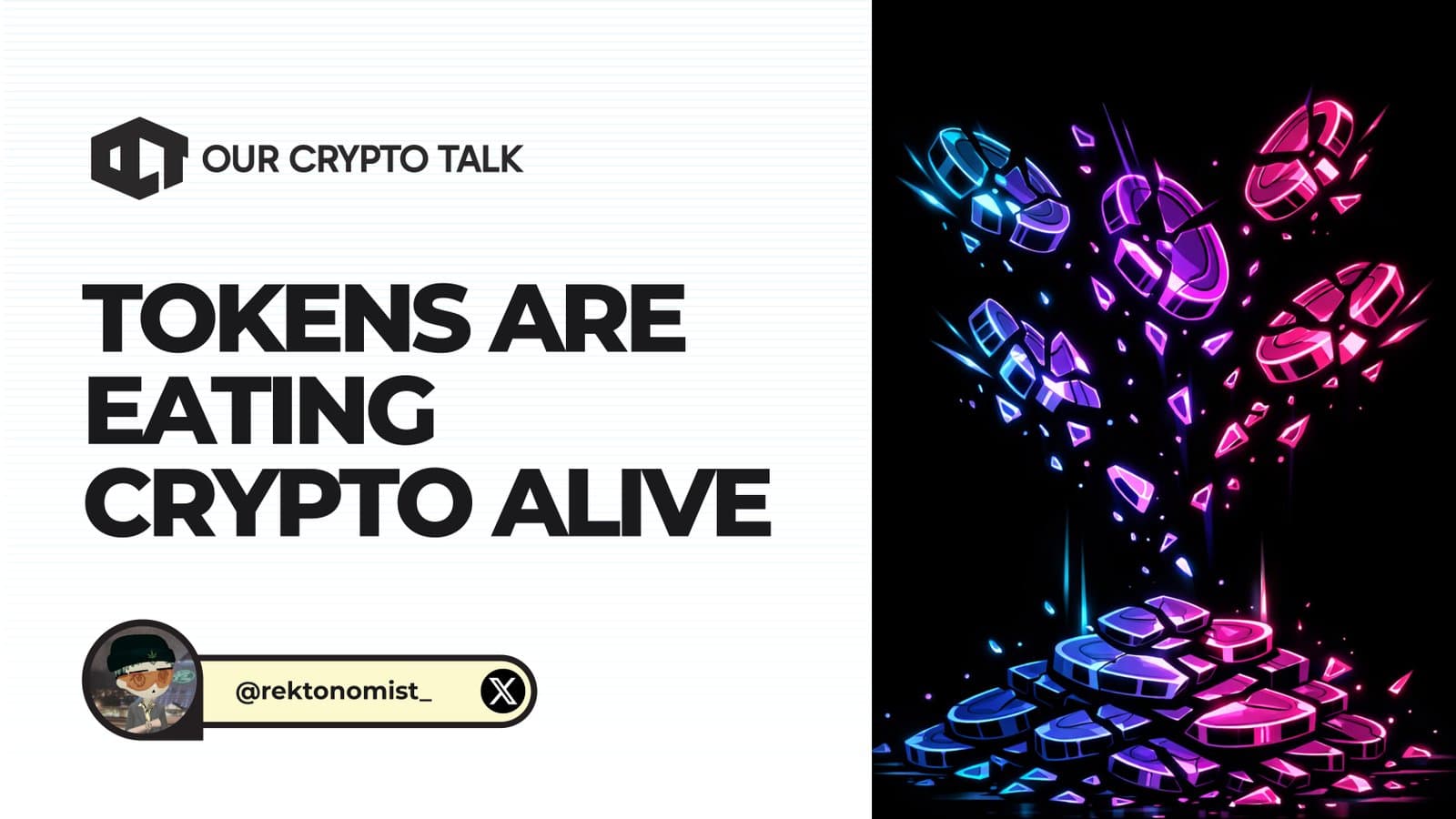
Tokens are eating crypto: low-float launches, inflation, and weak value capture create a system built for dumping.
Tokens are eating crypto. Crypto keeps telling itself a comforting story: tokens are “how you decentralize,” “how you bootstrap networks,” “how you align incentives.”
In practice, tokens have turned into the industry’s favorite self-own.
Not because tokens are inherently bad, but because most tokens are used as a shortcut for something traditional businesses do the hard way: build a product people want, charge for it, reinvest, and only then share upside with long-term owners.
Crypto flipped that order.
It sells the upside first, then hopes the product catches up.
And once you do that, a lot of ugly behavior becomes rational.
In traditional finance, the deal is boring and stable.
A bank does not give equity to depositors. If someone parks money in a checking account, they do not expect a moonshot. They expect safety, access, and a predictable service.
Equity exists, but it’s for owners who take risk and wait years. Stocks represent claims on a business, even if imperfectly.
In crypto, protocols often do the opposite:
That sounds like alignment. It is usually not.
It often creates a system where the user base is recruited as a speculative shareholder base, except the “shares” come with no enforceable link to cash flows, and the supply is frequently designed to inflate.
That is how you get mercenary users, mercenary competitors, and even mercenary teams.
Not because everyone is evil. Because the rules pay people to behave that way.
Most tokens sit in a weird middle ground:
In equity, value typically accrues because shareholders have some claim, direct or indirect, on future cash flows.
In many DeFi protocols, the protocol can generate fees, but token holders do not reliably capture them. Fees may go to a treasury, governance may or may not distribute them, and incentives may prioritize growth narratives over actual payouts.
So the token becomes a strange instrument: it is sold as value, used as a governance badge, and treated as a casino chip.
That is a perfect recipe for disappointment and extraction.
One of the most corrosive patterns in recent token launches is the low float, high FDV structure.
The idea is simple:
This creates artificial scarcity early, and predictable sell pressure later.
Even mainstream crypto research has pointed (conducted in 2024) out that low-float structures and future unlock overhangs create sustained pressure on price.

A KPMG report on FTX also flags that FTX held large positions in “low float, high fully diluted value” tokens, including FTT, which becomes relevant because it shows how inflated token valuations can become collateral, and then become systemic fragility when the price falls.
This structure trains the entire market to behave badly:
The token becomes the product.
And once the token is the product, actual product work becomes optional.

Similarly, BNB Research’s report on “Low Float & High FDV: How Did We Get Here?” includes graphs showing the prevalence of this launch strategy across projects, emphasizing the phantom pricing you describe.

A lot of token economies are built on emissions.
Tokens are printed to:
If there is no strong sink, emissions become dilution.
That dilution is not just a number on a chart. It changes behavior:

The industry has a name for this because it keeps happening: mercenary liquidity, mercenary capital.
Even casual DeFi commentary acknowledges the same cycle: protocols rent liquidity with high yields, then lose it when incentives fade.
So tokens turn “users” into “temporary liquidity providers who are paid in inflation.”

Token systems often create a classic coordination failure:
Holders hope for appreciation, but teams and insiders face the rational temptation to sell into liquidity once vesting unlocks.
Even if the team is honest, the market prices in the possibility of dumping. That alone can keep the token from ever becoming a stable store of value.
So the token does not align incentives.
On paper, governance tokens look elegant: the community votes.
In reality, governance often concentrates fast:
That means “decentralized governance” can become a thin veneer over a structure where the people with the biggest bags steer decisions, and everyone else trades around them.
Even worse, governance becomes an attack surface.
Terra is a brutal example of what happens when token price collapses far enough that governance can be captured cheaply. Dragonfly’s postmortem describes how LUNA’s supply exploded from 345 million to 6.5 trillion in about three days, and that the Terra chain was halted partly because the cost of a governance attack dropped so low.
This is what “token as security model” looks like in the real world:
When price goes down, the cost to attack governance goes down.
So the token is not only a fundraising tool, it can become a systemic vulnerability.
If a protocol’s biggest lever is a token price, then the temptation is obvious:
Sometimes that ends as a dramatic rug pull.

Sometimes it is a slow bleed: incentives keep printing, insiders keep selling, and users eventually realize they are funding everyone else’s exit.
If this sounds exaggerated, the research world is now cataloging rug pulls at scale. One recent arXiv paper describes manually analyzing hundreds of rug pull incidents and building detection methods because the problem is so widespread.
This matters because repeated rugs destroy the one thing a protocol cannot buy back with emissions: trust.
Once users assume every token is an exit plan, the entire sector becomes shorter-term, more cynical, and more extractive.
Stablecoins are often treated as “boring crypto,” but they carry similar incentive tensions.
There is a constant pressure to offer yields or benefits while maintaining stability.
A BIS paper on cryptoassets in emerging market economies and broader BIS commentary repeatedly highlights how crypto and stablecoin dynamics can generate systemic risks, especially where currency substitution and capital flight become relevant.
Newer academic syntheses also categorize stablecoin incidents and note how technical flaws and other stressors show up across major failures.
The pattern echoes the rest of crypto:
A token-like promise is made. Risk quietly accumulates. When stress hits, the design incentives get exposed.
When protocols issue tokens to attract users, they train users to behave like this:
Competitors behave similarly:
And teams get dragged into the same logic, even when they have good intentions:
This is how tokens erode protocols and companies.
They replace durable product demand with temporary financial incentives.
They replace long-term ownership with short-term farming.
They replace trust with tradable hype.

A lot of this gets better if crypto stops treating tokens as the default answer.
Some cleaner directions:
1) Build a business first, then decide if a token is necessary
If the product cannot sustain itself without emissions, a token will not fix it.
2) Stop pretending governance tokens are equity
If holders do not capture value, call the token what it is: a coordination instrument, not an investment story.
3) If emissions exist, they need real sinks
Otherwise the token is just a slow dilution machine.
4) Reduce the low-float, high-FDV launch pattern
If the token economics are structured as “pump now, unlock later,” the market will behave exactly that way.
5) Accept that some protocols should not have tokens
Crypto can still be crypto without turning every user into a speculative shareholder.
Tokens were supposed to decentralize crypto.
Instead, they often financialized it into a system where the fastest strategy is extraction.
The industry keeps trying to “fix tokenomics” with more clever math. But the deeper fix is cultural and structural:
Stop using tokens as bait.
Stop using inflation as growth.
Stop selling upside before proving value.
Because the more crypto leans on tokens as its primary incentive tool, the more it trains everyone to treat protocols as temporary ATMs, not lasting systems.




Preventing chads from getting rekt | Ex-CMO | Research & Data | Opinions are my own | NFA | Class of 2017
https://t.co/lVwqcd0PLA
Genome Protocol Rug Pull: Explained
Top 6 ZachXBT Revelations That Shocked The World
AI Agent Payments Explained: Circle Nanopayments and the x402 Protocol
Top 7 Projects in the World Liberty Financial (WLFI) Portfolio
Genome Protocol Rug Pull: Explained
Top 6 ZachXBT Revelations That Shocked The World
AI Agent Payments Explained: Circle Nanopayments and the x402 Protocol
Top 7 Projects in the World Liberty Financial (WLFI) Portfolio