Loading Search...


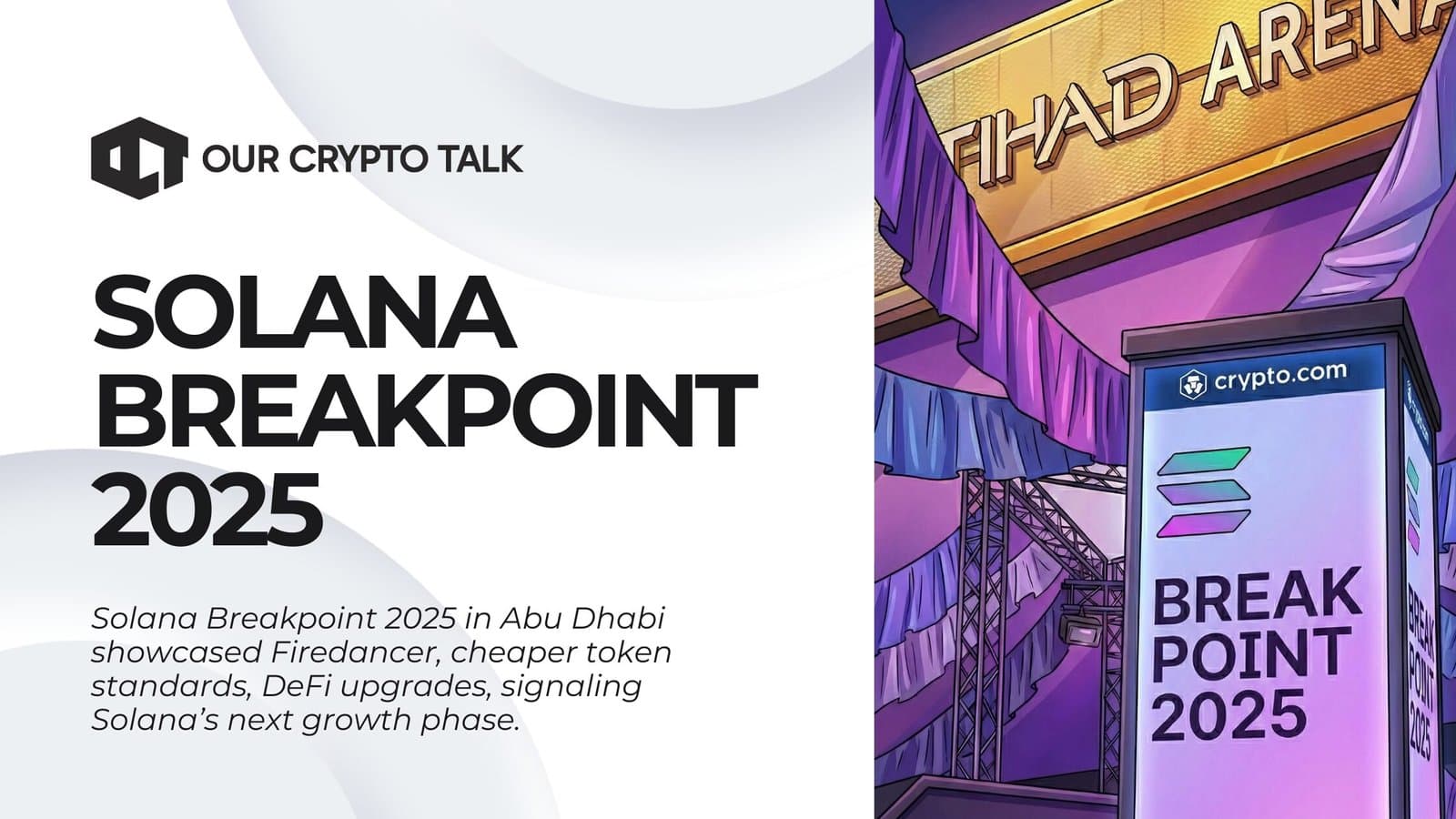
Solana Breakpoint 2025 in Abu Dhabi showcased Firedancer, cheaper token standards, DeFi upgrades, signaling Solana’s next growth phase.

Author: Tanishq Bodh
Solana has spent years living with two reputations at once: the chain that felt impossibly fast, and the chain that critics loved to doubt. Solana Breakpoint 2025 was the clearest signal yet that the conversation has changed.
Held in Abu Dhabi from December 11 to 13 at the Etihad Arena, the conference felt less like a fan meetup and more like an industry checkpoint. Developers came for roadmap clarity. Funds came for ecosystem signal. Builders came to ship. And institutions showed up because the “RWA on-chain” story is no longer theoretical.

The headline theme was acceleration. Not just in throughput, but in product maturity. Not just in DeFi, but in real-world finance. Not just in wallets, but in usability that finally looks like it can onboard the next hundred million users.
This article breaks down what mattered most at Solana Breakpoint 2025: the infrastructure leap, the DeFi rebuild, the institutional tokenization wave, the UX reset, and the developer pipeline that keeps Solana’s pace unusually high.
Every Breakpoint has a “this is real now” moment. In Solana Breakpoint 2025, that moment revolved around reliability and scale.
The biggest narrative shift came from multi-client seriousness. Solana’s early years proved one thing: speed attracts users. However, speed without resilience invites criticism. Breakpoint leaned into a single message: Solana wants to be fast and boring. Boring is good when you are trying to become infrastructure.
The star of that story was Firedancer, Jump Crypto’s independent validator client, positioned as a major step toward client diversity and stronger runtime performance. The point was not just higher theoretical throughput. The point was reducing single points of failure and widening the path to sustained uptime under stress.
Then came the second infrastructure lane: making “small transactions” actually cheap at scale. Light Token standard discussions focused on drastically cheaper token creation and reduced account overhead, specifically designed for high-frequency consumer apps such as gaming and user-generated content. Reports around Breakpoint framed it as roughly 200x cheaper than traditional SPL token account allocation with compatibility goals that keep it usable in real applications.
Finally, the hardware and decentralization debate returned, as it always does when performance rises. Proposals like SIMD-0370 triggered real tension in developer circles. Solana wants to push raw performance. Some worry that higher hardware requirements pull in the opposite direction of validator accessibility. The debate is healthy. It forces the ecosystem to be explicit about tradeoffs rather than hiding behind slogans.
The takeaway from this section of Solana Breakpoint 2025 was simple: Solana is trying to remove its historical fragility while keeping its speed advantage intact. That combination is why the room felt different this year.
If infrastructure was the foundation, DeFi was the proof. Solana Breakpoint 2025 made one theme unavoidable: Solana DeFi is no longer just “fast swaps.” It is becoming a full trading stack.
The loudest announcements came from Jupiter, the ecosystem’s DeFi aggregator heavyweight. Jupiter positioned itself as an end-to-end DeFi hub rather than a routing tool. The headline was JupUSD, a stablecoin developed in collaboration with Ethena, presented as a major step in building native stablecoin liquidity for Solana’s on-chain economy. Around that headline sat a broader suite of upgrades designed to make DeFi safer, smoother, and more institution-friendly.
The deeper story is what those upgrades signal. Solana DeFi is building what centralized exchanges win on: speed, advanced order features, and clean execution. Breakpoint’s DeFi conversation emphasized low-latency perps, better risk engines, limit-order style experiences, and simplified routing across venues. The ecosystem keeps narrowing the gap between a trader’s “CEX comfort” and DeFi self-custody.
This maturity also changed the tone around liquidity. Earlier Solana DeFi cycles often depended on short-lived incentives. This year, the emphasis shifted toward durable primitives: stablecoin rails, fixed-rate borrowing, margin tooling, and better analytics. In other words, the parts that still function when incentives cool.
The signal matters because it reframes what Solana can be. In the old framing, Solana was “fast DeFi.” In Solana Breakpoint 2025, it looked like “fast financial infrastructure,” with the product layer finally catching up to the chain’s raw performance.
Every cycle claims it will onboard institutions. This year, institutions arrived with receipts.
The defining RWA headline tied directly to Solana. J.P. Morgan arranged a U.S. commercial paper issuance for Galaxy Digital on Solana, with reporting indicating the deal size was $50 million, and that Coinbase and Franklin Templeton participated as buyers. ([Reuters][4]) That matters because it moves the conversation from pilots to real issuance, real settlement flow, and real counterparties.
This was not just another “tokenized asset demo.” It was a live example of a traditional instrument being issued and serviced using public blockchain rails. If you want the short version, it is this: TradFi is not only tokenizing. It is starting to use public chains where the economics and throughput make sense.

Breakpoint’s RWA narrative extended beyond a single deal. The event’s broader coverage emphasized an “institutional convergence” tone, with multiple projects pitching tokenized credit, tokenized funds, and stablecoin-led settlement as the bridge product that makes everything else possible.
Stablecoins also sat at the center of this story. They are the practical rails for tokenization, and Solana’s strength has always been cheap, fast transfer capacity. When tokenization graduates from “cool concept” to “cash flow system,” stablecoins become the bloodstream. Breakpoint felt like a stablecoin conference at times, and that is a compliment.
The larger takeaway from Solana Breakpoint 2025 is that RWAs are no longer a side booth topic. They are becoming a core narrative for the chain’s next growth wave. When institutions show up with issuance, the ecosystem stops being only a crypto economy and starts looking like an internet capital market.
Crypto does not lose users because it lacks technology. It loses users because it feels hard. Solana Breakpoint 2025 put consumer UX back on the main stage.
The strongest product theme here was abstraction. Wallet experiences want to feel like apps, not like custody tools. The goal is to make on-chain interaction feel as normal as sending a message or paying a bill.
Hardware wallet innovation and safer transaction flows surfaced as “practical security,” not paranoia. Wallet teams are trying to remove the two biggest consumer blockers: fear of irreversible mistakes and friction that makes onboarding exhausting.
Breakpoint also emphasized app-level distribution. Mobile matters. Embedded trading matters. Account recovery matters. A chain can process a million transactions per second and still fail if the user cannot confidently sign one.
This is why the consumer tooling at Solana Breakpoint 2025 mattered more than it looked at first glance. It reflected a shift away from “teach users to be careful” and toward “make the system harder to misuse.” That is how real adoption happens.
If Solana wants to power consumer internet finance, it needs consumer-grade UX. Breakpoint suggested the ecosystem now treats UX as a competitive moat, not as an afterthought.
Solana’s best advantage is not marketing. It is cadence. Solana Breakpoint 2025 reinforced that the ecosystem behaves like a shipping culture.
Hackathons and builder showcases mattered because they answered a practical question investors ask: where does future growth come from. It comes from teams that keep launching products, iterating fast, and building composable primitives.
This dev culture also explains why Solana narratives refresh so quickly. When builders ship new standards, faster clients, new DeFi venues, and new RWA frameworks, the ecosystem generates “new things to do.” That keeps users engaged. It keeps liquidity moving. It keeps attention sticky.
Breakpoint’s builder energy also created a specific kind of confidence. Not the hype confidence of “price will moon.” The operational confidence of “the roadmap exists and people are executing.”
That confidence is what makes conferences matter when they are done right. The best crypto events do not just announce. They coordinate. They align builders, funds, and partners around the next set of primitives. In Solana Breakpoint 2025, that coordination was the real product.
Even strong conferences can distort reality. The job is to separate signal from stage lighting.
First, Solana still carries reputational baggage from earlier reliability issues. Firedancer and client diversity narratives aim to reduce that risk, but perception only changes after months of stable performance under stress.
Second, performance upgrades can create centralization anxiety. As Solana pushes throughput and lowers latency, validator hardware requirements become a real point of contention. SIMD debates reflect that tension. The ecosystem needs transparency on requirements, participation trends, and how decentralization is measured.
Third, DeFi maturity creates new risk layers. Perps, leverage, and “CEX-like” execution can attract sophisticated liquidity. They can also amplify cascades during sudden volatility. Better risk engines help, but leverage always finds a way to surprise.
Finally, institutional RWAs do not guarantee mass adoption. Tokenization can stall if compliance, custody, or distribution remains fragmented. A $50M on-chain commercial paper deal is meaningful, but it is still early relative to global credit markets. ([Reuters][4])
These risks do not negate the Breakpoint story. They simply keep it honest.
Solana Breakpoint 2025 delivered a clear message: Solana is moving from “fast chain” to “serious infrastructure.”
Infrastructure improvements focused on resilience and performance. DeFi announcements leaned toward professional-grade trading and stablecoin-centered design. RWAs moved from panels to real issuance, with TradFi showing up in size. UX work targeted the core bottleneck that has slowed crypto adoption for years. And the builder pipeline proved, again, that Solana’s culture is oriented around shipping.
If you want one sentence, it is this: Solana is no longer trying to win a narrative war. It is trying to win a systems war.
That is why Solana Breakpoint 2025 mattered. It was not a promise of a future chain. It was a demonstration of a present ecosystem aligning on the next era of on-chain finance and consumer applications.
All the opinions in this article are that of the author and in no way are financial advice. Our Crypto Talk and the author always suggest you do your own research in crypto and to never take anything as financial advice that you read on the internet. Check our Terms and conditions for more info.