Loading Search...


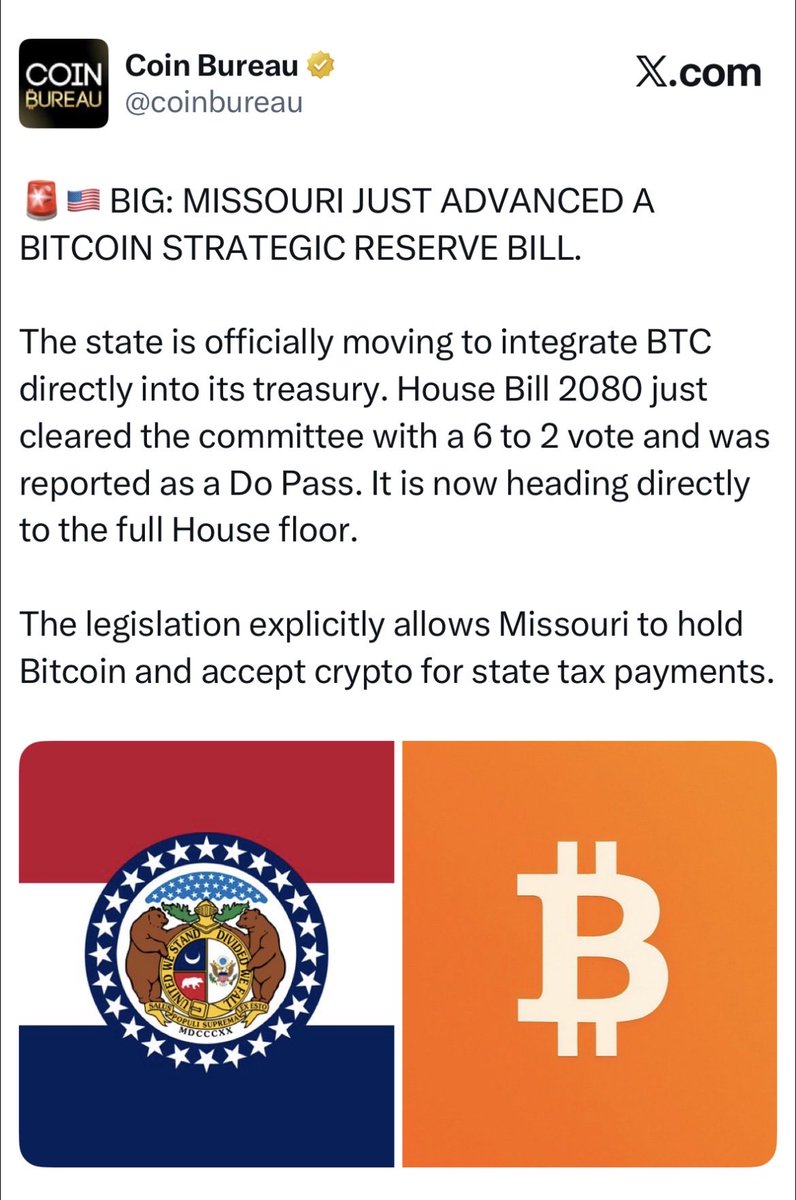
Missouri Bitcoin Reserve Bill clears a key House committee vote, moving closer to allowing crypto tax payments.

Author: Kritika Gupta
High attention and emotional sentiment detected.
13th March 2026- The Missouri Bitcoin Reserve Bill has cleared a major legislative step after a House committee voted 6 to 2 on March 12, 2026 to report the proposal “Do Pass.” As a result, the measure now moves directly to the full House floor for debate. If lawmakers ultimately enact the Missouri Bitcoin Reserve Bill, it will authorize the state treasurer to custody Bitcoin, accept it through donations or grants, and allow state and local government entities to receive approved cryptocurrencies for tax, fee, and other payments. In addition, the legislation requires officials to store the assets in secure cold storage for at least five years before any sales or transfers can occur
High Signal Summary For A Quick Glance

Rep. Ben Keathley
@benKeath

The Bitcoin Strategic Reserve bill advanced in the Missouri House this week. https://t.co/lGJFNMozJN
10:49 PM·Mar 12, 2026
Representative Ben Keathley has driven Missouri’s renewed push toward establishing a Bitcoin reserve. This marks his second attempt at passing such legislation. Previously, he introduced a similar proposal, HB 1217, in 2025. However, that measure stalled before reaching a floor vote.
This time, lawmakers have revived the concept amid growing nationwide interest in digital assets as a potential hedge against inflation and volatility in fiat currencies. Furthermore, federal level discussions and executive actions earlier in the decade regarding a national strategic Bitcoin reserve have helped shape the broader policy environment.
Meanwhile, other states have already moved ahead. New Hampshire became the first state to enact a strategic Bitcoin reserve law in May 2025, allowing officials to allocate up to 5 percent of public funds to qualifying digital assets.
Subsequently, Arizona and Texas passed their own reserve measures later in the same year. Texas even executed a modest purchase through on chain transactions or exchange traded fund exposure to seed its reserve.
Market reactions to these developments have remained broadly positive yet measured. For example, when New Hampshire approved its landmark law in May 2025, Bitcoin traded between $90,000 and $100,000.
Relative positioning against past updates or peers
If lawmakers pass the bill and it takes effect on August 28, 2026, Missouri could position itself as an early mover in digital asset policy. By enabling crypto tax payments, officials may reduce transactional friction for residents and businesses that already hold Bitcoin. In turn, this shift could stimulate local economic activity and attract crypto focused companies.
Moreover, the proposed reserve fund will rely primarily on donations while incorporating safeguards for transparency and security. Policymakers intend the fund to function as a long term store of value rather than a trading vehicle, which aligns with Bitcoin’s widely cited digital gold narrative. Over time, broader adoption may also influence neighboring states to explore similar initiatives while strengthening Missouri’s appeal to fintech talent.
The proposal will now face debate and a floor vote in the Missouri House. If representatives approve the measure, it will advance to the Senate for committee review and another floor vote before reaching Governor Mike Kehoe’s desk. Supporters expect the strong committee outcome to generate momentum.
However, critics may raise concerns about price volatility, custody risks, and potential opportunity costs. Therefore, market observers will watch closely for floor amendments, particularly those affecting funding mechanisms or mandated holding periods.
Our Crypto Talk is committed to unbiased, transparent, and true reporting to the best of our knowledge. This news article aims to provide accurate information in a timely manner. However, we advise the readers to verify facts independently and consult a professional before making any decisions based on the content since our sources could be wrong too. Check our Terms and conditions for more info.



Investors Sue JPMorgan Over $328M Crypto Ponzi Scheme
Missouri Advances Bitcoin Reserve Bill After 6-2 Committee Vote
Trader Loses Nearly $50 Million on Massive AAVE Swap
Pump.fun Multi-Chain Expansion Signals Ethereum, Base, Monad, BSC Launch
Investors Sue JPMorgan Over $328M Crypto Ponzi Scheme
Missouri Advances Bitcoin Reserve Bill After 6-2 Committee Vote
Trader Loses Nearly $50 Million on Massive AAVE Swap
Pump.fun Multi-Chain Expansion Signals Ethereum, Base, Monad, BSC Launch