Loading Search...


Soulja Boy and crypto haven't mixed well in the past but the rapper is now back with his creator token. Let's explore his journey in crypto.

Author: Sahil Thakur
Soulja Boy Crypto has become a phrase loaded with controversy, curiosity, and renewed attention. The rapper’s journey in the digital asset world has taken dramatic turns, from early excitement and crypto-themed music, to a whirlwind of paid token promotions that sparked scams, lawsuits, and major backlash.
Now, after several quiet years, Soulja Boy has reappeared in Web3 with a new creator token and a public apology that aims to rewrite his reputation. His past still shapes how fans, critics, regulators, and industry leaders respond to his comeback. To understand the weight behind Soulja Boy’s return to crypto in 2025, it helps to trace how he got here and why his name has become one of the most polarizing in the space.
Soulja Boy (DeAndre Cortez Way) began talking about cryptocurrency in 2018. He even released a song called “Bitcoin” on his album Young Draco. In it, he bragged that he “made $1 million off of bitcoins” after buying at around $6,000. This track made him one of the first rappers to mention crypto in music. He joined a small group that included Mims and Snoop Dogg. However, even though the song implied he held Bitcoin, no one knew how involved he actually was at that time.
By January 2021, crypto prices had surged. Because of that momentum, Soulja Boy renewed his interest. He even hinted at creating his own cryptocurrency. He tweeted, “Thoughts on me creating my own crypto?” to more than 5 million followers. The reaction came fast and mostly negative. People warned him about legal and reputational risks. For example, some told him he could “get in trouble.” Others urged him not to exploit fans.
Soon, the conversation shifted. Many suggested he explore NFTs instead. Soulja Boy liked the idea. He said the concept “actually looks dope” and asked for help making NFT collectibles. In turn, this period showed his first serious move into crypto beyond music. At that moment, he seemed eager to benefit from the huge crypto and NFT boom.
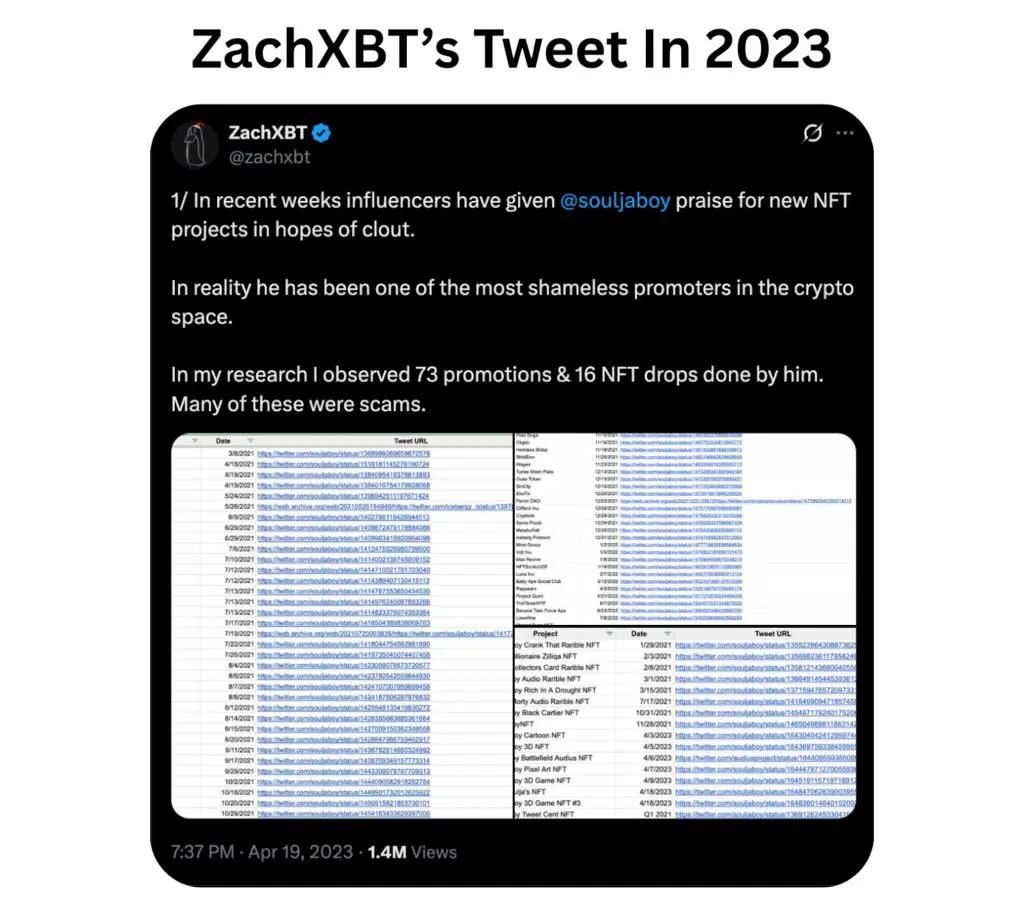
Soulja Boy jumped deeper into crypto endorsements in 2021. He promoted dozens of altcoins throughout the year and into early 2022. Many were memecoins or high-risk projects. Most of the endorsements came through paid tweets. Blockchain investigator ZachXBT later revealed that he promoted at least 73 crypto projects and 16 NFT ventures between March 2021 and 2023. Sadly, many of these projects collapsed or turned into scams. As a result, investors lost money while Soulja Boy moved on.
Several examples stand out:
During this same period, he also launched or promoted many NFT collections. In 2021, he put out at least nine different series under names like “SouljaBoyNFT.” He sold them with promises of future perks and utility. Yet, several were abandoned. In April 2023, he even released NFTs featuring Ferrari and Nike logos without permission. OpenSea removed them within hours. He kept releasing new collections anyway, causing frustration among earlier buyers.
By the end of these promotions, on-chain data suggested he had earned around $730,000. He appeared to treat crypto shilling as a business. Reports claimed he charged up to $10,000 for a Twitter post and $12,000 for an Instagram post during the peak hype. However, the fallout from so many failed projects damaged his name in the crypto world.
Soulja Boy’s crypto activity in 2021 fit into a much bigger celebrity trend. During that time, memecoins and speculative tokens exploded in popularity. Influencers and public figures rushed in. Many did not understand what they were promoting. Many also did not understand the legal responsibilities tied to these campaigns. Soulja Boy became one of the most active promoters. However, he was not alone.
Several examples stand out:
Overall, Soulja Boy joined a long list of celebrities tied to questionable crypto schemes. By late 2022, public opinion had shifted. Fans felt more skeptical. Regulators became more aggressive. Soulja Boy’s name, in particular, grew linked to risky, get-rich-quick tokens. This context shaped how people reacted when he attempted to return to crypto later.
Soulja Boy returned to crypto in December 2025 after a quieter stretch following the regulatory crackdowns. This time, he presented himself as a more serious Web3 creator. He launched a personal creator token on Base, which is Coinbase’s Ethereum Layer 2 network. The token, often called $SOULJABOY, was part of a larger creator monetization concept.
He promoted the idea by comparing crypto income with social media revenue. For example, he said Twitch pays once each month. TikTok pays once a week. Platform X pays daily. He hinted that blockchain platforms could pay creators even more directly and more often. He framed this as a way for artists to earn daily income through on-chain tools. The idea landed during a renewed wave of interest in social and creator tokens.
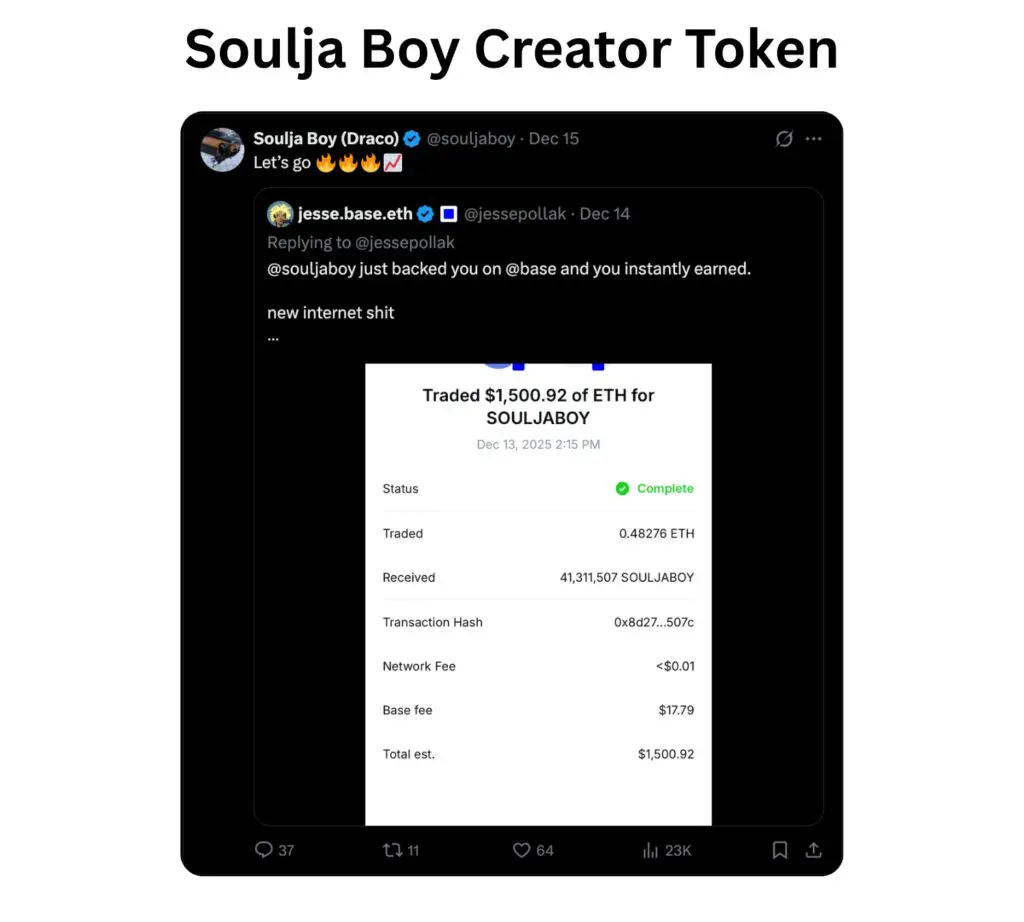
The launch gained extra attention when Jesse Pollak, a Coinbase executive and the lead at Base, interacted with Soulja Boy online. Pollak posted on X that he “just backed Soulja Boy on Base and had instantly earned.” He described this as an example of the “new internet” spirit. He did not offer financial advice or directly name the token. Yet his message suggested he supported Soulja Boy’s launch in some form. Pollak also highlighted Base as a platform focused on creator monetization.
This raised immediate concerns. Many felt Pollak’s comments gave Soulja Boy credibility he did not deserve. Others said that the message conflicted with Base’s usual emphasis on compliance and quality. Because of Soulja Boy’s controversial history in crypto, Pollak’s post struck critics as risky and confusing. They argued that it linked Base to a celebrity who had promoted many failed or fraudulent tokens.
The reaction came quickly. Critics in the crypto community pushed back, and most responses were negative. Blockchain investigator ZachXBT questioned Pollak publicly, asking why Soulja Boy should get a platform again. Others said that Soulja Boy had a long record of supporting projects that collapsed or disappeared. They feared that Pollak’s post signaled acceptance of a figure tied to repeated crypto failures.
Many observers argued that the issue went beyond one token. They felt it undermined trust in Base and Coinbase. They worried that it shifted focus from real innovation to celebrity hype. Some pointed out that when trusted builders interact with controversial influencers, credibility can erode very fast.
Soon after the criticism spread, Soulja Boy addressed the situation. On December 15, 2025, he posted a public apology on X. He acknowledged his mistakes from 2021 through 2023 and admitted to poor judgment. Soulja said that he “was doing paid promos without understanding the crypto and NFT space” at that time. He claimed he has since learned how crypto works and now understands the industry much better.
He also stated that he did not knowingly promote scams. Then he named a person he believed had misled him. He said he had “no knowledge that a scammer named Sahil was involved or paying me to promote anything fraudulent.” This appears to reference Sahil Arora, who has been linked to many celebrity memecoin schemes. Soulja Boy suggested that a middleman arranged the paid promotions and hid the truth about the projects. Critics remain divided on that claim because he endorsed so many questionable projects.
In his apology, he stressed that these events happened years ago. He expressed regret and said he wants to be transparent going forward. He asked the crypto community for a second chance and tried to turn the page on his past reputation.
However, the timing of the apology raised questions. He posted it only after reentering the space with his own token. Some analysts mocked this approach. Others pointed out that the crypto world had already documented the long list of failed projects long before he said sorry.
In summary, Soulja Boy’s crypto journey has been turbulent. He showed early interest. Then he promoted dozens of risky projects. Many ended in disaster for buyers. Regulators got involved, and his reputation suffered. Now he is trying to start fresh with a creator token on Base. The reaction shows how difficult it is to regain trust in crypto. Soulja Boy says he learned from past mistakes and promises to act responsibly today. Even so, many people remain cautious. His story highlights the risks of celebrity-backed tokens and why investors and platforms need to stay careful.