

Loading Ratings...



Spot Crypto ETFs vs Futures Crypto ETFs explained. Learn differences in structure, costs, risks, and which ETF suits long-term investors

Author: Chirag Sharma
Published On: Sun, 04 Jan 2026 15:39:29 GMT
As crypto markets mature in 2026, exchange-traded funds have become the most institutionally accepted gateway into digital assets. Among these, the debate around Spot Crypto ETFs vs Futures Crypto ETFs has taken center stage, especially as capital inflows accelerate and regulatory clarity improves across major markets.
Crypto ETFs allow investors to gain exposure to assets like Bitcoin and Ethereum without directly holding private keys or interacting with on-chain infrastructure. Yet not all ETFs are built the same. Spot crypto ETFs directly hold the underlying cryptocurrency, tracking real-time market prices with minimal deviation. Futures-based crypto ETFs, on the other hand, rely on derivative contracts that speculate on future prices rather than owning the asset itself.
This distinction shapes everything from performance and fees to risk profiles and ideal use cases. Early 2026 has already demonstrated the importance of this choice, with U.S. crypto ETFs attracting nearly $670 million in inflows on the first trading day alone. Bitcoin spot ETFs accounted for a majority of that capital, signaling a clear investor preference toward direct exposure.
While futures-based ETFs were introduced earlier due to regulatory constraints, spot ETFs gained approval in 2024 and rapidly reshaped the landscape. Today, investors must decide not just whether to allocate to crypto, but how to do so efficiently. Understanding the mechanics, advantages, and trade-offs of spot versus futures products is no longer optional for serious market participants.
This article breaks down both ETF structures, compares them head-to-head, highlights platforms for accessing each, and outlines the benefits and risks that define their role in a modern crypto portfolio.
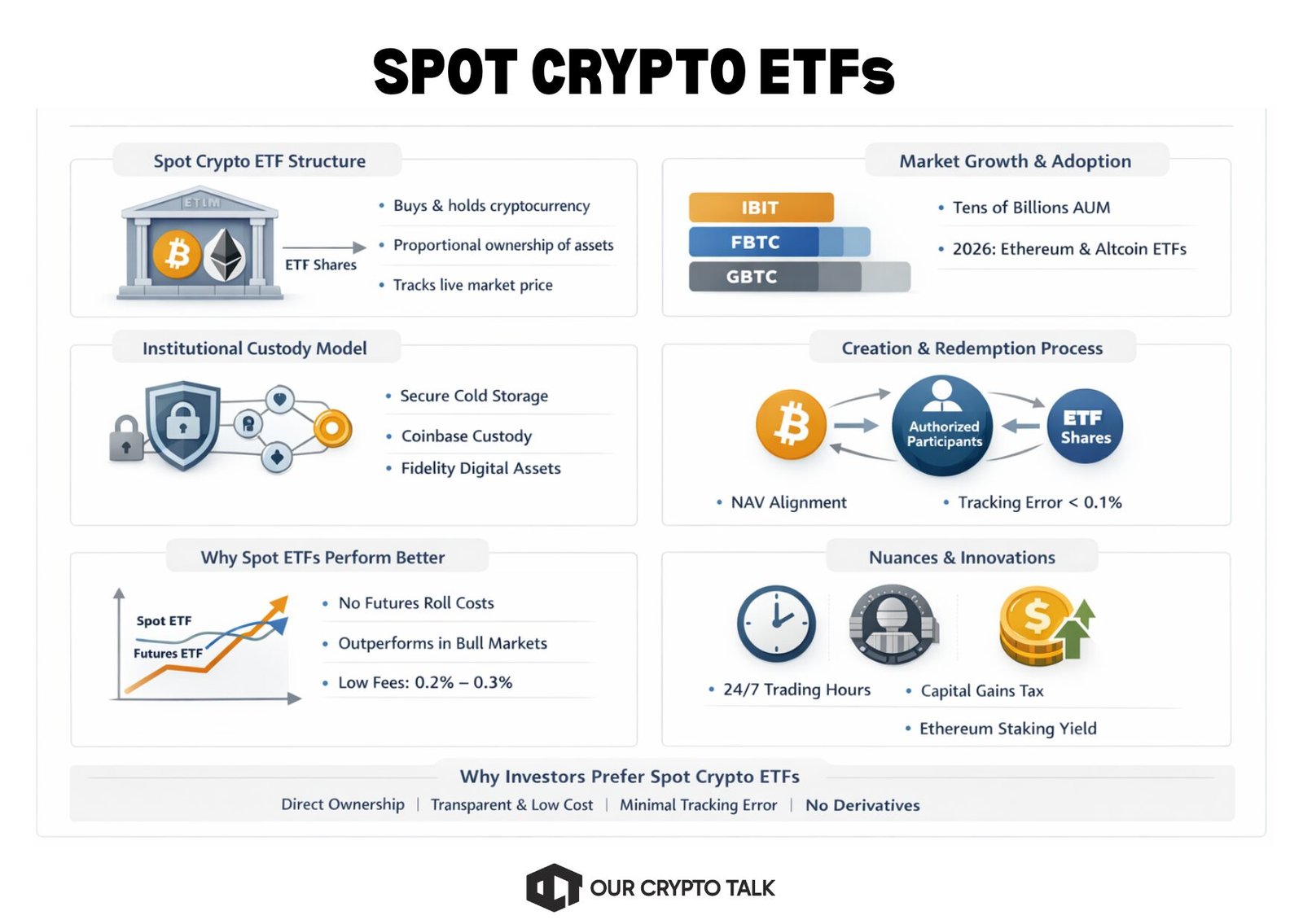
Spot crypto ETFs operate by directly purchasing and holding the underlying cryptocurrency in regulated custody. Each ETF share represents proportional ownership of assets such as Bitcoin or Ethereum held in reserve by the fund. This structure allows the ETF price to closely mirror the live market price of the crypto asset.
Major spot crypto ETFs like BlackRock’s IBIT, Fidelity’s FBTC, and Grayscale’s GBTC collectively manage tens of billions of dollars in assets. By 2026, the product lineup has expanded beyond Bitcoin to include Ethereum spot ETFs and select altcoin products following favorable regulatory shifts.
Custody plays a central role in spot ETFs. Assets are stored in institutional-grade cold wallets managed by providers such as Coinbase Custody or Fidelity Digital Assets. These custodians employ multi-signature security, geographic key distribution, and insurance coverage to mitigate hacking and operational risks.
The creation and redemption mechanism keeps prices tightly aligned with net asset value. Authorized participants can exchange baskets of crypto for ETF shares or vice versa, enabling arbitrage that minimizes premiums and discounts. As a result, tracking errors for spot ETFs typically remain below 0.1 percent.
From a performance perspective, spot ETFs shine during sustained bull markets. Because they hold the asset directly, there is no drag from contract rollovers or derivative pricing inefficiencies. During the 2025 rally, spot Bitcoin ETFs consistently outperformed futures-based alternatives, especially over longer holding periods.
Expense ratios are another advantage. Most spot crypto ETFs charge annual fees between 0.2 percent and 0.3 percent, making them cost-effective for long-term exposure. Some Ethereum spot ETFs introduced in 2026 have also begun integrating staking rewards, distributing yield to shareholders and adding an income component to passive crypto exposure.
However, spot ETFs are not without nuance. Crypto markets trade 24/7, while stock exchanges operate on limited hours. This mismatch can occasionally lead to temporary premiums or discounts during periods of high volatility. Tax treatment also follows standard capital gains rules, with short-term and long-term classifications depending on holding duration.
Overall, spot ETFs offer a clean, transparent, and increasingly favored method for investors seeking direct exposure to crypto assets without operational complexity.
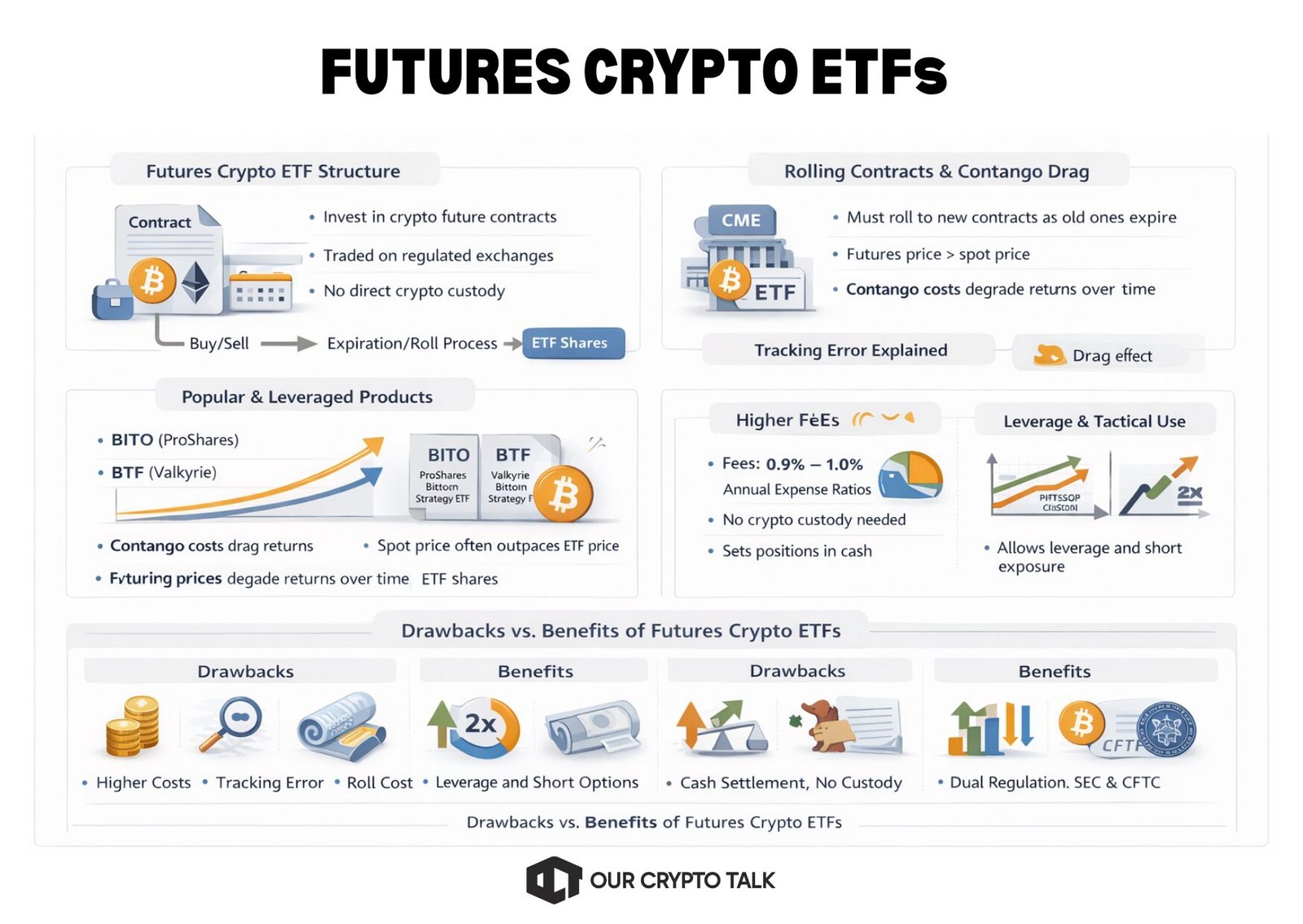
Futures-based crypto ETFs take a fundamentally different approach. Instead of holding cryptocurrencies directly, these funds invest in futures contracts traded on regulated exchanges such as the Chicago Mercantile Exchange. These contracts represent agreements to buy or sell crypto at a predetermined price on a future date.
To maintain exposure, futures ETFs must continuously roll contracts as they approach expiration. This process introduces additional variables that impact performance. When markets are in contango, meaning futures prices are higher than spot prices, rolling contracts can erode returns as funds sell lower-priced contracts and buy higher-priced ones. Over time, this roll cost can significantly drag performance.
In contrast, backwardation environments can generate positive roll yield, though such conditions have historically been less persistent in Bitcoin markets. As a result, futures ETFs often experience tracking error relative to spot prices, especially during long holding periods.
Popular futures-based products include ProShares Bitcoin Strategy ETF (BITO) and Valkyrie Bitcoin Strategy ETF. Leveraged and inverse versions also exist, allowing traders to amplify gains or hedge downside risk without directly trading futures themselves.
Fees for futures ETFs are higher, typically ranging from 0.9 percent to 1 percent annually. These costs reflect the complexity of managing rolling contracts, margin requirements, and derivative exposure.
Despite these drawbacks, futures ETFs offer unique advantages. They eliminate the need for crypto custody entirely, settling positions in cash. They also fall under dual oversight from the SEC and CFTC, which appeals to certain institutional investors.
Futures ETFs are particularly useful for short-term strategies, including hedging, tactical positioning, and exploiting basis spreads between spot and futures markets. They also enable leverage and short exposure, tools that are not available in spot ETFs.
That said, leverage amplifies both gains and losses, and futures ETFs can underperform significantly during volatile or sideways markets. For most long-term investors, futures products function better as tactical instruments rather than core holdings.
When evaluating Spot Crypto ETFs vs Futures Crypto ETFs, the structural differences drive distinct outcomes across performance, cost, and risk.
Spot ETFs provide direct exposure by holding the underlying asset. This results in tight price tracking, low deviation, and predictable performance aligned with crypto markets. Futures ETFs rely on derivatives, introducing roll costs, basis risk, and tracking discrepancies that compound over time.
Cost is a major differentiator. Spot ETFs are cheaper, with expense ratios often half those of futures products. Over multi-year holding periods, this fee gap can materially impact returns.
Risk profiles also diverge. Spot ETFs expose investors primarily to crypto price volatility and custody risks, which are mitigated through insured institutional storage. Futures ETFs introduce additional layers of risk, including contract pricing inefficiencies, leverage amplification, and counterparty exposure.
Liquidity is strong for both structures, but spot ETFs benefit from continuous alignment with underlying crypto markets. Futures ETFs may experience distortions during periods of high volatility or contract expiration.
Suitability ultimately depends on investor intent. Spot ETFs align with long-term, buy-and-hold strategies focused on capturing secular growth. Futures ETFs cater to active traders, hedgers, and institutions executing short-term strategies.
Data from early 2026 reinforces this distinction, with spot Bitcoin and Ethereum ETFs capturing the majority of inflows during bullish market phases.
Choosing the right platform for Spot and Futures Crypto ETFs is as important as choosing the ETF structure itself.
For spot crypto ETFs, traditional brokerages dominate. Fidelity offers commission-free trading and deep research tools. Charles Schwab provides low-cost access with strong educational resources. Interactive Brokers appeals to advanced users with global market access and low margins. E*TRADE and Robinhood cater to retail investors seeking simplicity and ease of use.
Futures-based ETFs require platforms with strong derivatives infrastructure. tastytrade excels for active traders, while Interactive Brokers offers direct CME access and advanced risk management. Schwab and E*TRADE support futures ETFs with comprehensive charting and analytics.
The benefits of spot ETFs include precise tracking, lower costs, simplicity, and long-term efficiency. Staking integrations and institutional adoption further strengthen their appeal.
Futures ETFs offer leverage, hedging flexibility, and cash settlement advantages. However, higher fees, roll decay, and amplified risk make them less suitable for passive investors.
Balancing these options requires aligning ETF structure with investment horizon, risk tolerance, and portfolio objectives.
Real voices. Real reactions.