Loading Search...


Aether Games collapse explained: how a Wheel of Time Web3 game raised millions, launched a token, and still shut down in 2025. K

Author: Tanishq Bodh
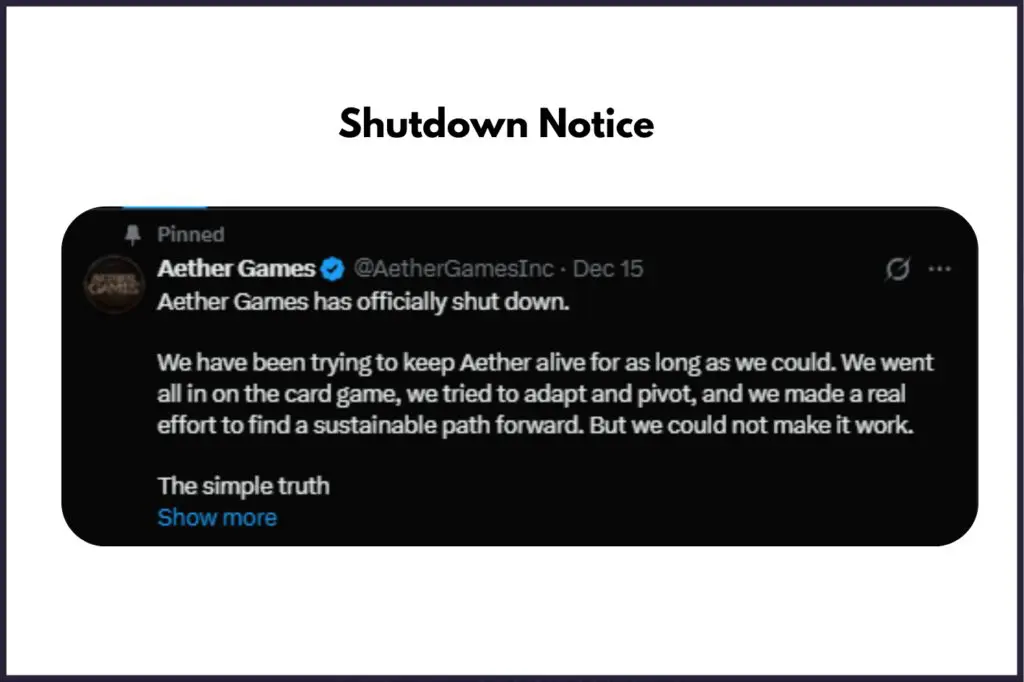
In the volatile world of Web3 gaming, where blockchain ambition collides with traditional game design, few stories capture the promise and the pain as clearly as Aether Games. On December 15, 2025, the studio behind Cards of Eternity, a blockchain-based trading card game set in The Wheel of Time universe, announced it was shutting down permanently.
The announcement did not come as a vague farewell or a polished PR statement. Instead, Aether Games published a raw, deeply detailed post-mortem that exposed the internal struggles, financial missteps, and structural flaws that ultimately destroyed the studio. Two days later, the shutdown has already become a cautionary tale for Web3 builders, investors, and players alike.
Aether Games was not a small experiment. It had millions in funding, a globally recognized intellectual property license, exchange listings, and more than 221,000 followers across social platforms. Yet none of that was enough. The studio’s collapse highlights a harsh reality that much of Web3 gaming is now being forced to confront: combining crypto incentives with traditional game development is far harder than the hype suggested.
Aether Games launched in 2021 with a sweeping vision. Founded by CEO Jens Peeters, the studio aimed to build transmedia franchises where games, films, and storytelling interconnected, with blockchain acting as the economic backbone. Ownership, revenue sharing, and player participation were meant to redefine how entertainment ecosystems functioned.
Early funding reflected that ambition. Aether raised roughly $4.5 million through private rounds and conducted high-profile IDOs on Polkastarter and Avalaunch. Estimates place total capital raised north of $10 million. For a young Web3 studio, that level of backing created significant expectations.
The centerpiece of the strategy was Cards of Eternity: The Wheel of Time. Securing the license to Robert Jordan’s legendary fantasy universe was a major achievement. The Wheel of Time has a massive global fanbase and had recently received renewed attention through Amazon Prime’s television adaptation. Aether positioned itself as the first studio to bring the franchise into a blockchain-enabled game environment.
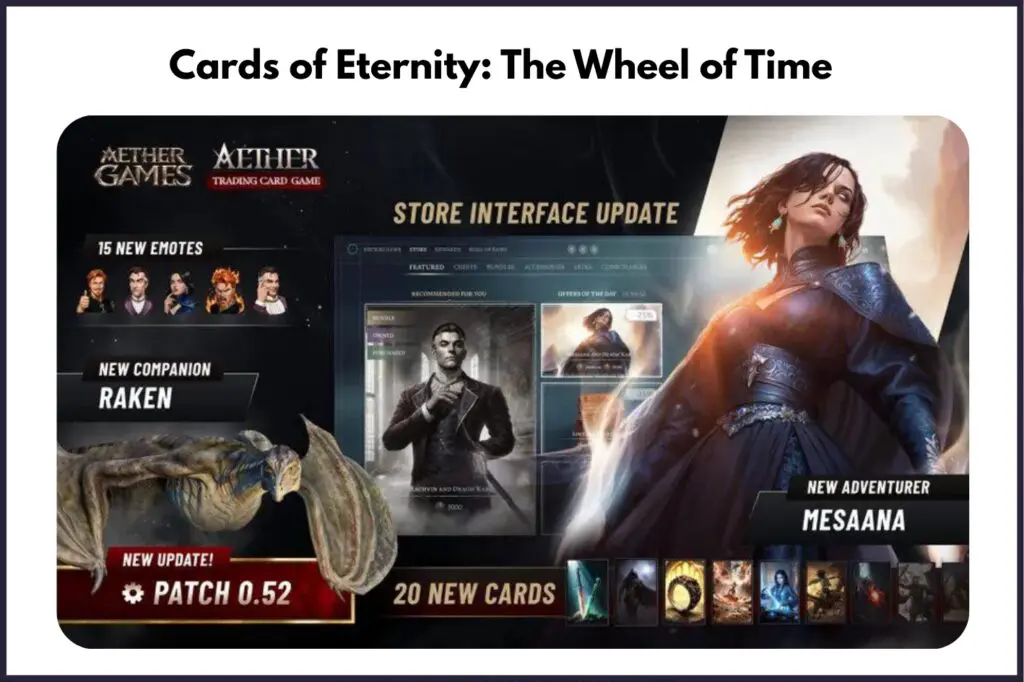
The game itself was a digital trading card game inspired by titles like Magic: The Gathering. Players built decks using NFT cards representing characters, factions, and abilities from the Wheel of Time lore. Battles were strategic and lore-driven, featuring Aes Sedai, Forsaken, and iconic story arcs. The $AEG token tied everything together, enabling staking, governance, and revenue sharing.
By early 2024, momentum appeared strong. The $AEG token launched via a Token Generation Event on Ethereum and surged to an all-time high of roughly $0.35. Listings on major exchanges like Bybit, KuCoin, and Gate boosted liquidity and visibility. Aether’s social presence grew rapidly, and gameplay demos showcased polished art and deep thematic design.
For a brief moment, Aether Games looked like a blueprint for how Web3 gaming could finally break into the mainstream.
That momentum did not last.
Following the token launch, $AEG began a relentless decline. By mid-2025, the token had lost more than 99.9 percent of its value, trading at fractions of a cent with minimal liquidity. Trading volume dried up. Delistings followed. Bybit removed the token in July 2025, while other exchanges issued warnings and risk notices.
Loading chart...
Token collapse triggered a chain reaction. Market makers burned capital trying to stabilize price action. Advisors and early promoters exited quietly. Liquidity incentives failed to attract sustainable demand. As the token weakened, the studio’s ability to fund development, marketing, and security evaporated.
Aether attempted multiple strategic pivots. In July 2025, the team announced a remastered version of Cards of Eternity that removed blockchain entirely. The goal was to appeal to traditional gamers through platforms like Steam, while snapshotting assets so players would not lose their progress.
However, the pivot created confusion. Web3 players felt abandoned. Web2 gamers remained skeptical. Development costs increased instead of falling. Later, Aether reversed course again, reintroducing crypto mechanics and revenue-sharing staking, while also attempting to publish third-party Web3 games.
Marketing failures compounded the damage. The team openly admitted that agencies and KOLs promised growth but delivered little. Influencer campaigns drained liquidity without bringing players. Advisors extracted value and disappeared. The studio found itself paying for visibility while failing to build a real player base.
Security issues accelerated the collapse. Multiple hacks targeted the ecosystem, with at least one successful breach. Scam links flooded community channels. Aether was forced to shut down Discord and Telegram entirely to protect users. Public warnings urged players not to connect wallets under any circumstances.
At the same time, operational costs kept rising. Smart contract audits, compliance reviews, and exchange listings consumed hundreds of thousands of dollars. None of it translated into meaningful revenue.
Despite the strength of the Wheel of Time brand, adoption never reached critical mass. Gameplay confirmations became sparse. Tournament rewards went unpaid. Players questioned whether development was still active. By late 2025, the studio’s funds were effectively gone.
On December 15, Aether Games published its final statement.
The post-mortem did not sugarcoat reality. The team acknowledged that despite effort, sacrifice, and belief, the project failed to find enough players to survive. The token launch went wrong due to bad early deals. Publishing additional crypto games failed to create sustainable income. Marketing was ineffective. Costs were overwhelming.
Most importantly, the studio delivered a blunt conclusion: combining crypto with gaming introduced massive complexity without providing meaningful upside unless scale was enormous. Without millions of players, blockchain mechanics became a burden rather than an advantage.
All services were shut down permanently. Games went offline. $AEG was effectively declared dead. There were no refunds, migrations, or burns. The team apologized and walked away.
Community reaction was divided. Longtime players expressed gratitude for the experience and the transparency. Others criticized the studio for blaming external factors rather than gameplay quality. Industry observers pointed to Aether as another casualty in Web3 gaming’s brutal 2025 shakeout.
Aether Games did not fail quietly, and that honesty may be its most valuable contribution.
The shutdown exposes structural weaknesses across the Web3 gaming sector. Token-first models struggle without scale. Liquidity incentives attract speculators, not players. IP alone does not guarantee engagement. Compliance, audits, and security costs punish smaller studios. Marketing driven by influencers rarely builds sustainable communities.
Aether’s own lessons were clear. Small public raises. Fair launches. Minimal reliance on KOLs. Focus on gameplay before tokenomics. Build real demand before financialization.
For builders, the message is uncomfortable but necessary. Fun still matters more than ownership narratives. For investors, due diligence must go beyond token charts and brand licenses. For players, self-custody and skepticism remain essential.
Aether Games is gone, but its story will echo through Web3 gaming for years. It shows how ambition, capital, and intellectual property can still fail without sustainable fundamentals. It also shows that transparency, even in failure, still has value in an industry scarred by silence and rug pulls.
As 2025 comes to a close, Web3 gaming appears to be resetting. Fewer projects. Less hype. More scrutiny. Whether that leads to a stronger ecosystem remains uncertain.
The Wheel turns, as the books say. Aether Games will not be part of the next cycle. But its fall may help others survive it.