Loading Search...



Explore how Satoshi Nakamoto would see Bitcoin and crypto in 2026, from self-custody to CBDCs and the evolution of the financial system.

Author: Arushi Garg
If Satoshi were here in 2026, he’d see Bitcoin growing fast but moving away from his original idea of true decentralization, as ETFs, big institutions and CBDCs change how money works.
Imagine this scenario. It is February 2026. Somewhere in a quiet study or a forgotten server room, Satoshi Nakamoto returns to check on the state of Bitcoin. This moment captures Satoshi Nakamoto Bitcoin 2026 as he observes how the network and ecosystem have evolved.
What he sees is not failure. Bitcoin survived. It thrived. It became a global asset class. But the ecosystem built around it feels unfamiliar. The infrastructure, the financialization, the institutional layers stacked on top of the protocol have taken it far from its original simplicity.
This story does not follow Satoshi’s return. Instead, it reflects how Bitcoin evolved beyond its original design. It explores the gap between sovereignty and convenience, between decentralization and institutional adoption, and between Bitcoin’s intended purpose and the way the financial system shaped it.
Satoshi Nakamoto launched Bitcoin during a financial collapse, not a bull market. On October 31, 2008, he posted the nine-page Bitcoin whitepaper to a cryptography mailing list. He shared no marketing strategy, no token allocation, no venture funding, and no roadmap.
Just a simple title:
“Bitcoin: A Peer-to-Peer Electronic Cash System.”
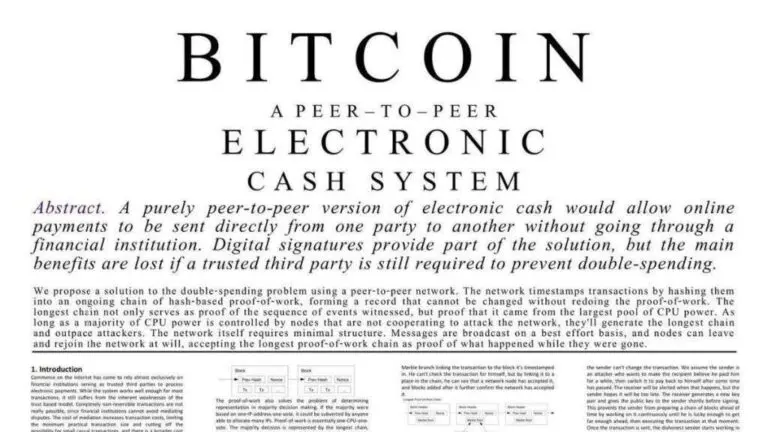
When Bitcoin was created, the global financial system was collapsing. Lehman Brothers had fallen. Major banks were insolvent. Governments were scrambling to prevent total systemic failure. Millions of ordinary people were losing their homes, savings, and jobs.
Policymakers responded swiftly and controversially. They issued bank bailouts, printed money aggressively, and deployed emergency stimulus. They socialized losses and rescued financial institutions, expecting public trust to return overnight. Bitcoin did not emerge in isolation from this crisis. Satoshi created it because of it.
Satoshi Nakamoto was not chasing price appreciation or institutional adoption. The goal was far more structural.
Bitcoin aimed to solve two fundamental problems:
Central banks could expand supply indefinitely. Commercial banks could freeze accounts or fail without warning. Governments ultimately controlled access to money.
Most importantly, Bitcoin introduced self-custody.
If you held your private keys, you controlled your money. There was no bank to freeze your account. No intermediary to block a transaction. No authority deciding who was allowed to participate. Censorship resistance was not a secondary feature. It was the foundation.
Bitcoin’s promise was simple but radical: financial sovereignty through cryptographic ownership. Not “not your keys, not your coins” as a slogan but as a structural truth of the protocol. Self-custody was the point.
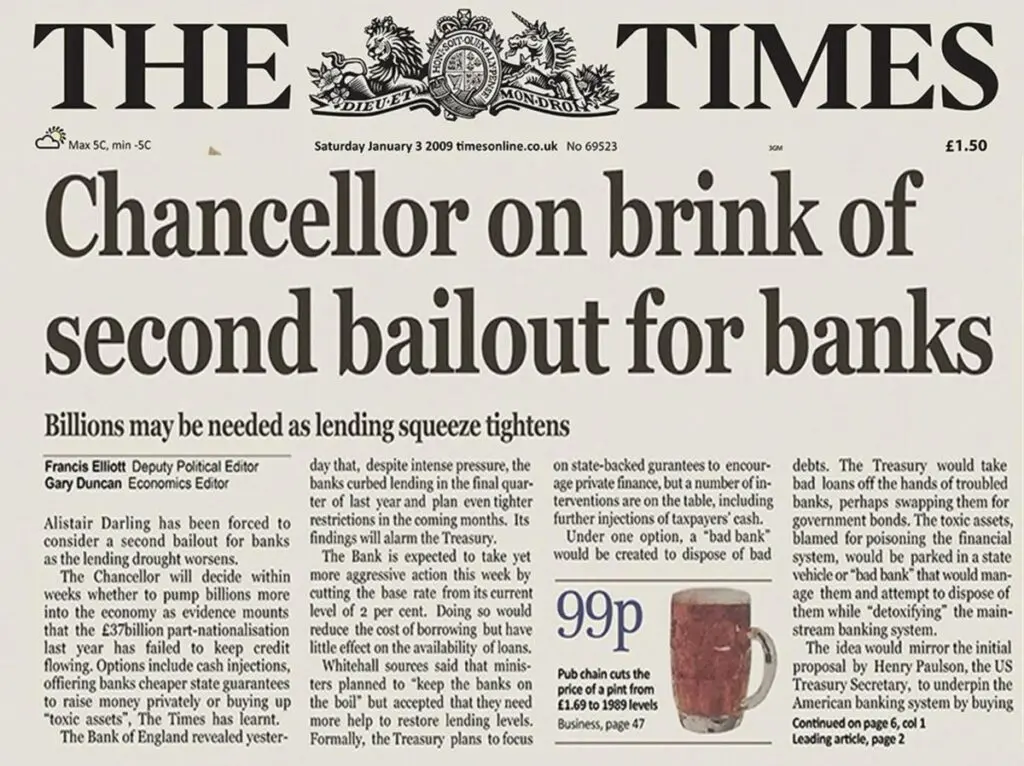
On January 3, 2009, miners produced the Genesis Block. Embedded within it, Satoshi included a message taken directly from The Times newspaper:
“Chancellor on brink of second bailout for banks.”
This was not branding. This was neither marketing nor a victory lap; it served as a timestamp and a warning.
The message permanently anchored Bitcoin’s origin to the global banking crisis and the era of government bailouts. It signaled that Bitcoin was born as a response to systemic fragility, not as a speculative tech experiment. From block one, Bitcoin positioned itself as an alternative to centralized financial rescue culture, a decentralized system designed to operate without trust in governments or banks.
Bitcoin never acted neutrally. It directly responded to the 2008 financial crisis and the collapse of trust in centralized banks. Satoshi engineered it so that bank bailouts, uncontrolled money printing, and systemic failures could no longer threaten individual savings.
The protocol replaced institutional trust with mathematical certainty. Fixed supply. Transparent rules. Decentralized consensus. Bitcoin was built to remove the possibility that governments or banks could rewrite the rules overnight.
He frequently posted on BitcoinTalk, refined the Bitcoin protocol, and collaborated with early developers.
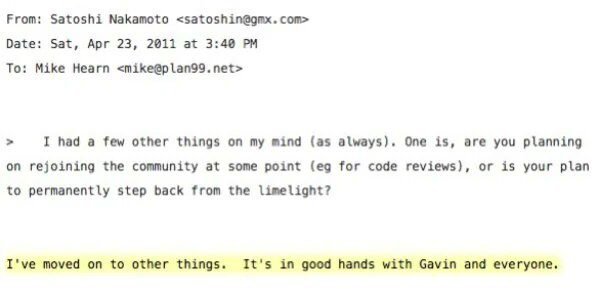
His communication style was calm, precise, and focused entirely on the code. There was no personal branding, no public appearances, and no visible ego attached to the project. Then he gradually stepped away. On April 23, 2011, Satoshi sent his final known message and disappeared from public communication.
He exited deliberately. By leaving, he eliminated any central authority from a system built to be decentralized. No founder remained to influence decisions, guide narratives, or control direction. The network now had to stand on its own.
There was no victory lap, no foundation, and no leadership cult.
Why?
Leaders centralize systems, but Bitcoin removes single points of control. It survives its creator. When Satoshi Nakamoto stepped away, he aligned the network with decentralization. By disappearing, he prevented Bitcoin from becoming personality-driven or politically captured. Consensus, open-source development, and economic incentives now govern the network, not a founder’s authority.
To understand Bitcoin’s evolution, it helps to revisit the global landscape at the time of its creation.
Bitcoin was fringe. It was considered strange, experimental, and irrelevant by mainstream finance.
Yet the macro trajectory was clear. Expanding debt, currency debasement, and increasing financial control were not short-term anomalies. They were structural shifts. Satoshi recognized that early.
This is the financial system Bitcoin exists within today:
The macro environment that gave birth to Bitcoin did not disappear. It intensified.
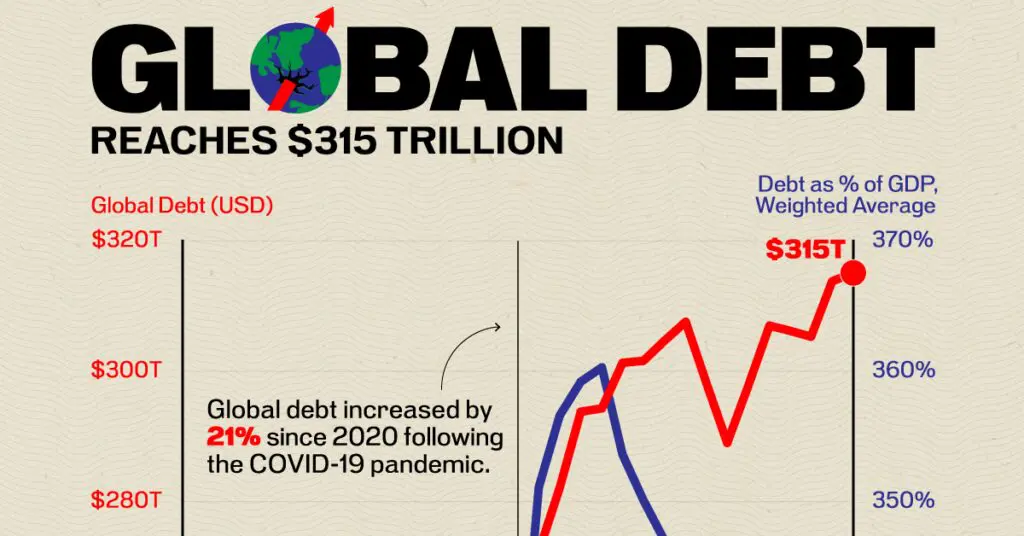
Money printing is no longer controversial. It is expected. But something else has emerged alongside persistent quantitative easing and rising sovereign debt.
Central Bank Digital Currencies, or CBDCs, are no longer theoretical. More than 130 countries are actively exploring or deploying CBDC frameworks.
In the framework of Satoshi Nakamoto Bitcoin 2026, this global acceleration signals a defining monetary shift. India is expanding the digital rupee through the Reserve Bank of India. The European Union has advanced legislative timelines for a digital euro. China is already operating a large-scale digital currency system through the People’s Bank of China.
The infrastructure is moving from pilot programs to policy-backed implementation, reinforcing how state-controlled digital money is becoming a structural reality. This is no longer decentralized crypto infrastructure; it has become programmable, state-issued money.
CBDCs introduce capabilities that traditional cash never had:
Money begins to function less like bearer property and more like permissioned access. For a system built on censorship resistance and self-custody, this represents a philosophical inversion. To Satoshi Nakamoto, this would not look like financial evolution. It would look like regression toward centralized control.
Satoshi would likely experience two reactions simultaneously.
Vindication, because the structural problems Bitcoin highlighted became more visible:
This raises concern because policy responses have often expanded oversight and reinforced financial controls within digital infrastructure.
Viewed through the lens of Satoshi Nakamoto Bitcoin 2026, the divergence becomes stark. Rather than reducing systemic fragility, many governments embedded monetary authority directly into software. Bitcoin exposed the dangers of centralized monetary control, while CBDCs now hardcode that same control into technology.
In its earliest years, Bitcoin was radically grassroots.
It was chaotic, but it was decentralized chaos. Then came the collapse of Mt. Gox.
Roughly 850,000 BTC disappeared in one of crypto’s largest custodial failures. The incident exposed a harsh truth: centralized intermediaries reintroduced the counterparty risk Bitcoin was meant to eliminate, even as the protocol itself stayed secure. The lesson stayed simple: not your keys, not your coins.
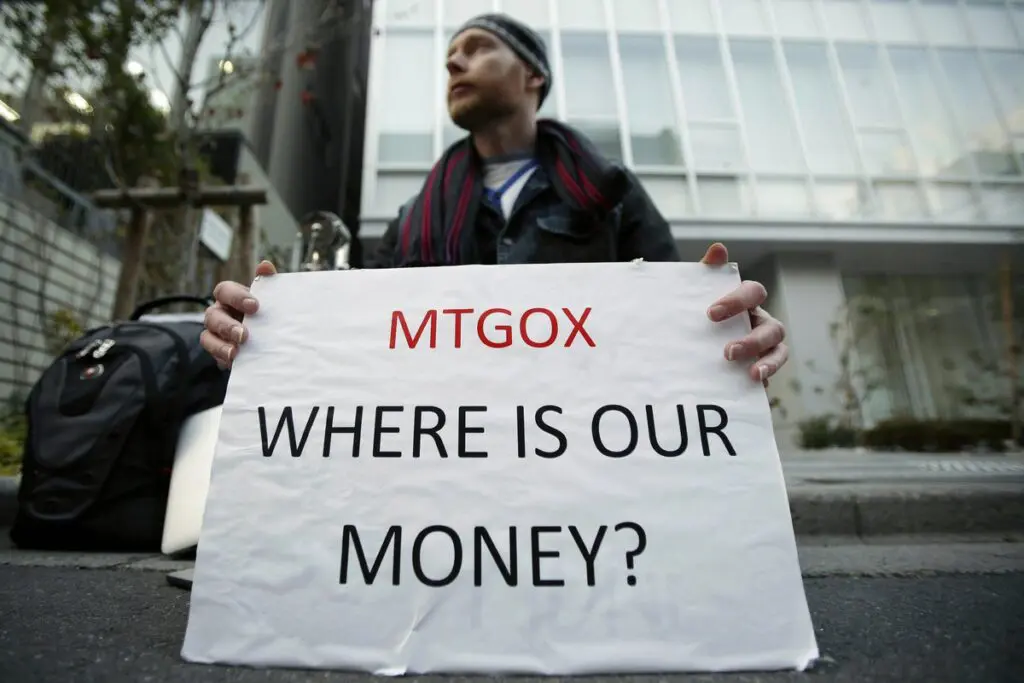
The lesson was clear:
Not your keys, not your coins.
For a time, the community followed this principle. Users held their own keys, relied on personal wallets, and transacted through decentralized exchanges, making self-custody central to Bitcoin’s use and identity.
And that victory brought a shift. In 2017, speculative mania swept through the market. Prices skyrocketed, ICOs exploded, and attention drifted toward short-term gains over foundational principles.
In the broader arc of Satoshi Nakamoto Bitcoin 2026, this marked a cultural turning point. By 2020–2021, the narrative shifted again. Bitcoin became part of corporate treasury strategies. MicroStrategy famously allocated billions of dollars into BTC, signaling institutional validation but also a new phase far removed from Bitcoin’s original cypherpunk roots.
Soon after, nation-states began exploring Bitcoin exposure, regulatory frameworks, and digital asset integration. What started as a decentralized peer-to-peer currency evolved into a globally recognized financial instrument. The core promise of self-custody remained, but the ecosystem around Bitcoin had fundamentally changed.

Bitcoin had moved from fringe experiment to legitimate financial asset. Adoption was no longer just about ideology, it was now about utility, recognition, and market legitimacy.
January 2024 marked a pivotal moment. Spot Bitcoin ETFs received regulatory approval.
Institutional capital began flowing into the market at unprecedented scale. Corporations, hedge funds, and traditional investors could now participate directly, further cementing Bitcoin’s status as a mainstream financial instrument.
What began as a decentralized experiment had entered global finance, bringing both legitimacy and new pressures that Satoshi Nakamoto may never have anticipated.
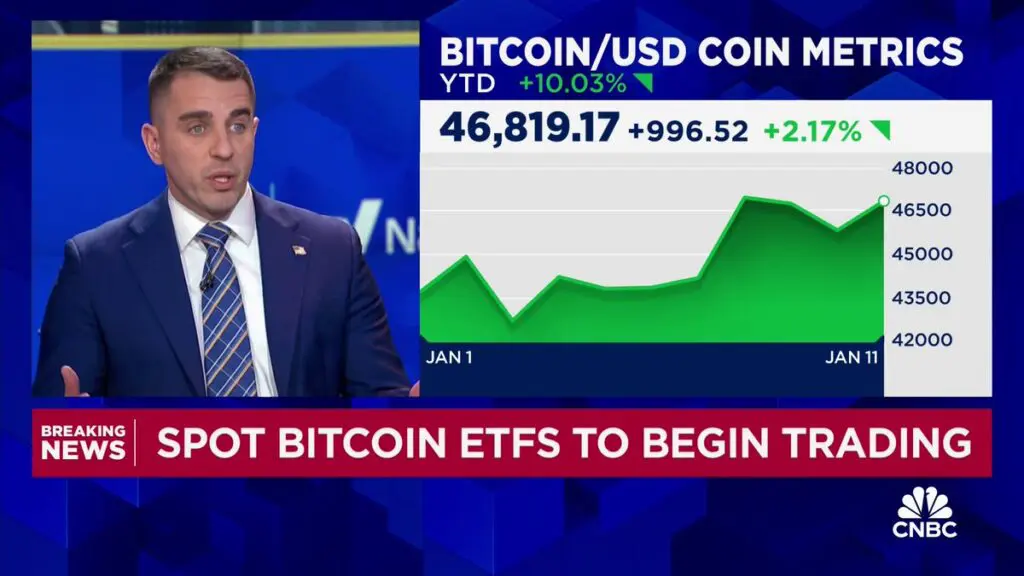
By 2026, Bitcoin had become a major global asset.
Bitcoin did not get banned. Institutions and traditional financial systems absorbed it instead.
The same institutions that required bailouts in 2008 now custody Bitcoin for millions of users. People celebrate legitimacy. Fees are collected. Keys are outsourced. Convenience wins. Sovereignty loses. Bitcoin survived. But the culture around it softened.
It would not be the price. Satoshi expected volatility, adoption, and speculation.
What he would not expect is who controls the rails:
Bitcoin did not escape the system. It was wrapped by it. Custody became optional, then niche, then inconvenient. The warning from Genesis still applies: Not your keys, not your coins. Most people chose comfort over control.
Self-custody is challenging. You can lose keys, and there is no customer support. ETFs made Bitcoin easy: click a button, gain exposure, and sleep soundly. But in the context of Satoshi Nakamoto Bitcoin 2026, convenience was never the goal. Bitcoin was meant to be yours. That difference matters. Centralized custody concentrates power, and power always comes with conditions.
If Wall Street surprised Satoshi, the culture of crypto would likely disturb him. Not because of experimentation, but because of nihilism:
Bitcoin survived the system, but the ecosystem around it has evolved into something far from its original vision.

By early 2026, memecoins had ballooned into a $50–70 billion market. Not building. Not solving. Just extracting value. . Crypto culture reintroduced trust but now it was trust in hype, influencers, and social signals instead of code and protocol.
Early Bitcoin users:
They built and maintained the network. They understood the system.
In the era of Satoshi Nakamoto Bitcoin 2026, the contrast became clear. By 2026, much of the broader crypto audience had shifted from active participation to passive speculation, prioritizing memes, trends, and quick profits over sovereignty, self-custody, and foundational principles.
This cultural shift highlights how the ecosystem diverged from Satoshi’s original vision. It also created both opportunity and risk for investors who value structural resilience over hype.

By 2026, many crypto participants behave very differently from the early community:
Chase trends instead of understanding protocols
Screenshot short-term gains rather than secure assets
Blame platforms for losses instead of taking responsibility
Demand refunds instead of learning from mistakes
The contrast highlights a shift from active, responsible participation to passive, convenience-driven speculation. This evolution underscores why self-custody, long-term strategy, and understanding tokenomics remain critical for serious crypto investors.

Risk did not disappear. Accountability did. Every rug pull, every collapse, every freeze is met with the same reaction: “Someone should fix this.” That instinct alone would unsettle Satoshi Nakamoto. Bitcoin was built for people who did not want rescuing.
If ETFs are ironic, Central Bank Digital Currencies are alarming. CBDCs promise efficiency, compliance, and stability. What they deliver is surveillance, control, and programmability. Money can be turned off, expired, restricted, or profiled. Bitcoin removed trust from money. CBDCs hardcode trust into authority.
In the context of Satoshi Nakamoto Bitcoin 2026, this contrast feels even sharper. What Satoshi envisioned was a system beyond centralized power. CBDCs represent the opposite direction. To Satoshi, this is not progress. It is a warning label brought to life.
The world that produced Bitcoin was hardened by failure:
Pain forced clarity. By contrast, the 2020s normalized cushioning: stimulus on demand, bailouts expected, losses deferred, and responsibility outsourced. Discomfort became unacceptable. With comfort came dependency.
In Satoshi’s era, censorship was a threat. In 2026, it is policy:
Accounts frozen
Platforms deplatform
Funds blocked
Narratives curated
Most people do not resist. They adapt. Because resistance is inconvenient. Bitcoin was never meant to be convenient. It was meant to be unstoppable.
This is the part Satoshi would quietly smile at. Despite everything:
Bitcoin has never gone down
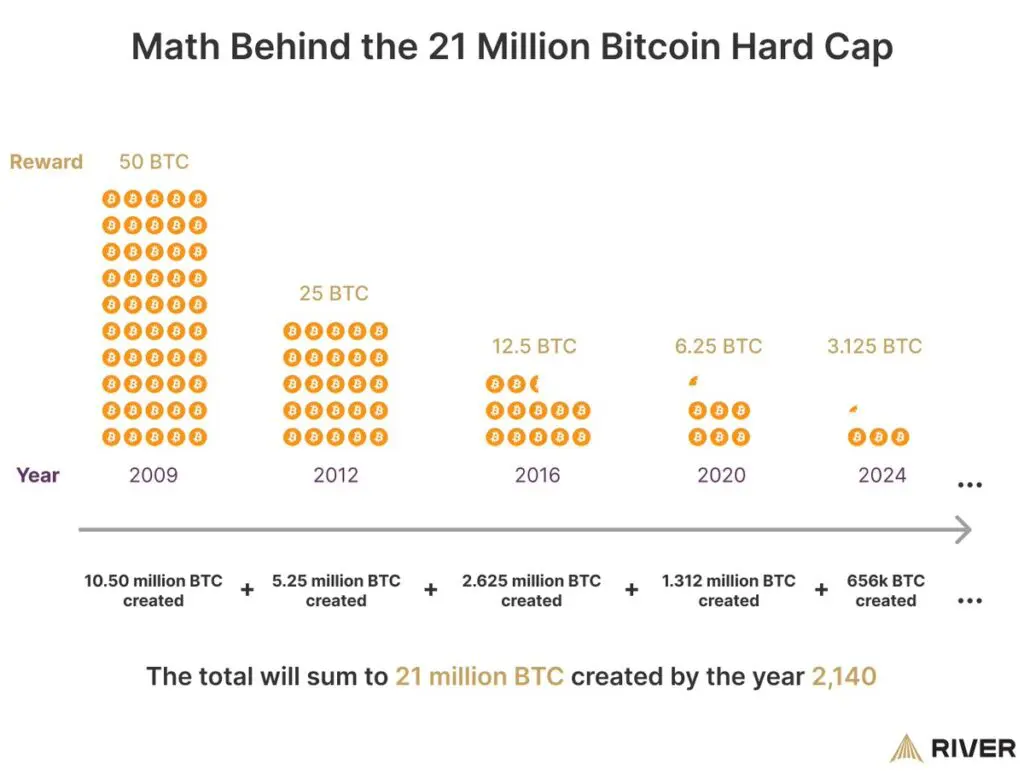
The supply cap remains untouched
The network keeps producing blocks
Protocol rules still apply equally
No bailouts, no emergency rewrites
In countries where fiat fails, Bitcoin continues to perform its role.
Argentina: Widespread Bitcoin and stablecoin adoption helps citizens preserve savings amid high inflation and peso volatility.
Venezuela: Hyperinflation drives mass cryptocurrency usage for payments and retaining purchasing power.
Lebanon: Currency collapse and banking instability push individuals and businesses to use Bitcoin and other crypto as alternative methods for saving and transacting.
Bitcoin’s design continues to function even as the system it was meant to bypass integrates it. The ecosystem around it has changed, but the core network remains resilient and unstoppable.

Bitcoin in 2026 is not about headlines or hype. It is about the reality of how the network functions and what it enables.
While speculation dominated media attention, the Lightning Network quietly matured.
Bitcoin as money, not just narrative. ETFs and banks never captured this growth or packaged it for investors. It grew organically, and that would matter to Satoshi.
Satoshi returning would not pump the market. It would fracture narratives.
Bitcoin was built for people to use. Every generation must make a choice: convenience or control, delegation or responsibility, comfort or sovereignty. Bitcoin does not force the choice. It simply makes it available.
Bitcoin was created to prevent the next crisis, not to enrich traders, fuel memes, or legitimize institutions. If people forget its origins, its purpose erodes, and systems that lose their reason to exist eventually serve something else.
He would ask people to remember. The real danger lies not in Bitcoin failing, but in Bitcoin succeeding while people forget why it was built.
All the opinions in this article are that of the author and in no way are financial advice. Our Crypto Talk and the author always suggest you do your own research in crypto and to never take anything as financial advice that you read on the internet. Check our Terms and conditions for more info.