Loading Search...


A deep dive into the Bittensor Ecosystem, its origins, TAO tokenomics, AI incentives, subnets, and why decentralized AI matters in the cycle.

Author: Chirag Sharma
Artificial intelligence has quietly become one of the most valuable economic resources in the world. Models write, predict, recommend, and decide. Entire industries now depend on machine intelligence, yet most of this power is controlled by a small group of centralized entities. The Bittensor Ecosystem challenges that reality.
Instead of intelligence being trained behind closed doors and sold via APIs, Bittensor turns AI into an open, competitive marketplace. Anyone can contribute intelligence. Anyone can evaluate it. And rewards are distributed based on real performance rather than corporate gatekeeping.
This first phase focuses on the foundations of the Bittensor Ecosystem. We will explore what Bittensor is, why it exists, how it originated, and why the timing of its rise aligns perfectly with the global AI boom.
The Bittensor Ecosystem is a decentralized network designed to produce, evaluate, and reward artificial intelligence in an open market structure.
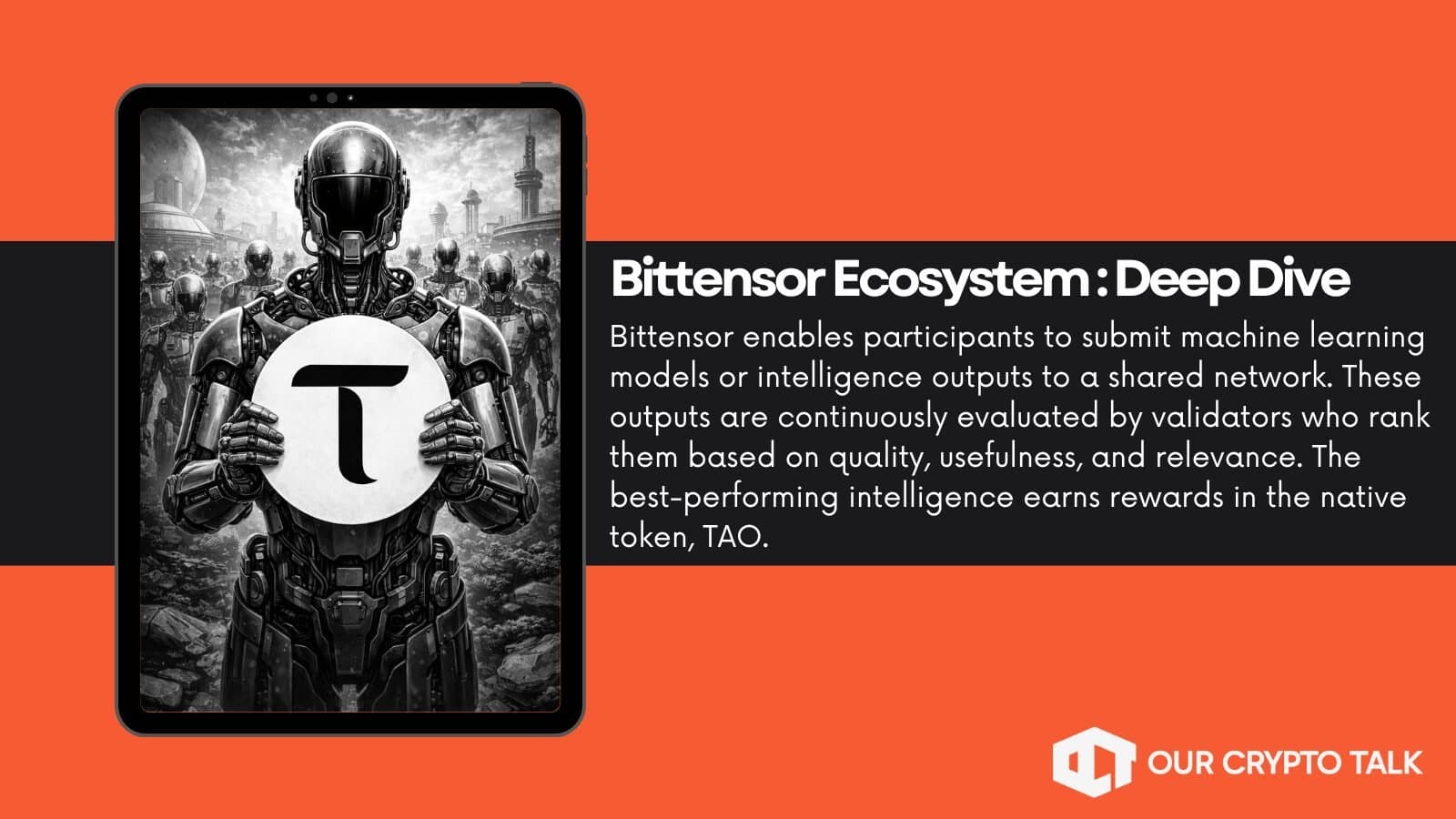
At its core, Bittensor enables participants to submit machine learning models or intelligence outputs to a shared network. These outputs are continuously evaluated by validators who rank them based on quality, usefulness, and relevance. The best-performing intelligence earns rewards in the native token, TAO.

This structure creates a feedback loop where:
Unlike traditional AI platforms, there is no central authority controlling access, pricing, or distribution. Intelligence becomes a digital commodity, produced collaboratively and priced by the market.
This design positions the Bittensor Ecosystem not just as a blockchain protocol, but as an entirely new economic layer for machine intelligence.
Modern AI development is expensive, centralized, and opaque.
Training state-of-the-art models requires:
As a result, innovation has increasingly concentrated within a few large technology firms. While this has accelerated progress, it has also created structural risks.
Single points of failure, lack of transparency, limited access, and biased datasets are not edge cases anymore. They are systemic issues.
The Bittensor Ecosystem emerged as a response to these constraints. Its goal is not to replace centralized AI overnight, but to introduce an alternative model where intelligence production is permissionless, competitive, and economically aligned with contribution.
In simple terms, Bittensor asks a powerful question.
What if intelligence worked like Bitcoin?
The concept behind Bittensor traces back to 2019, when founders Jacob Steeves and Ala Shaabana began developing the idea under the pseudonym Yuma Rao.

Their inspiration came from Bitcoin’s core insight. Bitcoin showed that a decentralized network could coordinate strangers, secure value, and distribute rewards without trusting a central authority. The founders believed the same principle could apply to machine intelligence.
Instead of mining hashes, participants would mine intelligence.
Steeves, with a background in mathematics and computer science, and Shaabana, with expertise in AI systems, recognized a growing imbalance in AI development. As models became more powerful, access to them became more restricted.
By 2021, the project had formalized under the Opentensor Foundation in Toronto, Canada. The Bittensor whitepaper outlined a peer-to-peer protocol where:
Initially, the team explored blockchain-agnostic approaches. However, performance constraints and scalability requirements led to the decision to build a dedicated chain optimized for machine learning coordination.
From the beginning, Bittensor emphasized transparency and open-source development. The codebase was made public, and community participation was encouraged early. This openness helped attract developers who were interested not just in crypto incentives, but in the philosophical shift toward collaborative intelligence.
The mainnet went live in late 2021, marking the birth of the Bittensor Ecosystem as a functioning decentralized network.
Launching a decentralized AI network is significantly harder than launching a simple payment blockchain.
Early challenges included:
Unlike Bitcoin, where hashing power is easy to measure, intelligence quality is subjective and task-dependent. Bittensor had to design ranking systems that could adapt dynamically to different types of intelligence.
These early hurdles slowed adoption initially, but they also strengthened the protocol. Iterative upgrades and community feedback shaped a system that could support real-world AI workloads rather than theoretical benchmarks.
The relevance of the Bittensor Ecosystem changed dramatically during the AI boom of 2023 and 2024.
The release of consumer-facing generative AI models triggered global attention. AI moved from research labs into everyday workflows almost overnight. Businesses adopted AI tools at scale. Governments began discussing regulation. Capital flooded into the sector.
This period also exposed cracks in centralized AI systems.
As AI adoption accelerated, so did concerns around control and access. This environment made decentralized AI narratives far more compelling than before.
Crypto markets reacted accordingly. AI-focused tokens gained momentum. Infrastructure projects that could support open intelligence markets attracted both retail and institutional interest.
Bittensor stood out because it was not just an AI-themed token. It was a functioning protocol with live incentives, real competition, and an active developer community.
Decentralized AI addresses several structural weaknesses of centralized systems.

First, it lowers barriers to entry. Developers without massive capital can still contribute valuable intelligence and earn rewards.
Second, it improves resilience. There is no single point of failure, no central server, and no monopoly over output distribution.
Third, it aligns incentives with usefulness. Instead of selling access licenses, intelligence is rewarded based on real performance within the network.
The Bittensor Ecosystem embodies these principles. Its decentralized design allowed it to benefit disproportionately from growing distrust in centralized AI platforms during the boom years.
While critics argue that hardware dependencies limit true decentralization, Bittensor demonstrates that even partial decentralization of incentives can reshape innovation dynamics.
By the end of 2024, Bittensor was no longer just an experimental idea. It had matured into a serious contender in the decentralized AI space.
The ecosystem attracted:
The narrative shifted from “can this work?” to “how big can this become?”
This set the stage for rapid growth in market capitalization, subnet experimentation, and institutional exposure, which we will explore in the next phase.
As the decentralized AI narrative gained traction after the 2023–2024 boom, the Bittensor Ecosystem entered its most important phase. This was no longer about ideology or experimentation. It became a question of scale, incentives, and economic sustainability.
From its mainnet launch in late 2021, Bittensor’s growth was gradual at first. Adoption required technical expertise, and the concept of decentralized intelligence was still unfamiliar to most developers.
That changed rapidly as AI became mainstream.
By mid-2025, the Bittensor Ecosystem had evolved from a niche protocol into one of the largest decentralized AI networks in crypto.
Key growth indicators included:
Institutional interest became a major validation point. Funds exploring decentralized AI exposure allocated meaningful capital to TAO. Custodians and exchanges integrated support, reducing friction for both retail and professional participants.
Equally important was the rise of subnet-level economies. Instead of all value being concentrated at the base layer, intelligence markets began forming around specialized tasks. This modular growth pattern allowed the ecosystem to expand without becoming congested or monolithic.
One of the most important distinctions of the Bittensor Ecosystem is that adoption is not purely speculative.
Participation requires real contribution.
Miners must produce usable intelligence. Validators must accurately evaluate outputs. Subnet operators must design incentive structures that attract participants.
This creates natural friction, which filters out purely speculative actors over time.
While price volatility exists, the underlying activity on the network reflects genuine usage. Intelligence is being produced, ranked, and improved continuously. That activity is what ultimately anchors TAO’s value proposition.
TAO is not just a governance or utility token. It is the economic engine of the Bittensor Ecosystem.
TAO serves several critical roles:
Every meaningful action within the ecosystem either earns or requires TAO. This tight coupling between token utility and network activity is what differentiates TAO from many AI-themed tokens that rely primarily on narrative.
In traditional AI systems, incentives are misaligned. Developers are paid upfront, models are deployed behind APIs, and users have limited insight into how intelligence evolves.
In the Bittensor Ecosystem, incentives are continuous and performance-based.
Miners compete to produce the best intelligence. Validators rank outputs based on usefulness and accuracy. TAO rewards flow dynamically to top performers.
If a model stops improving, its rewards decline. If a validator misranks intelligence, their influence and earnings decrease.
This creates a self-correcting system where quality is constantly reinforced.
Over time, this evolutionary pressure encourages specialization, efficiency, and innovation.
TAO follows a Bitcoin-inspired supply model, but with important differences tailored to AI incentives.
Key parameters include:
Instead of perpetual inflation, TAO introduces predictable scarcity through a halving mechanism.
Every time 10.5 million TAO are issued, emissions are reduced by 50 percent.
The first halving occurred on December 14, 2025, cutting daily issuance to around 3,600 TAO.
This matters because it forces the ecosystem to mature. As new supply decreases, rewards must increasingly come from efficiency and demand rather than inflation.

Most AI projects rely on continuous token emissions to incentivize participation. This often leads to long-term dilution and weak value capture.
The Bittensor Ecosystem takes a different approach.
By reducing issuance over time with Bittensor Halving , the network introduces scarcity similar to Bitcoin, but with intelligence production as the underlying economic activity.
This creates several long-term effects:
For miners and validators, halvings create a strong incentive to optimize. Inefficient models become uncompetitive. High-quality intelligence gains pricing power.
Staking TAO is central to participation in the Bittensor Ecosystem.
Validators must stake TAO to influence rankings and earn rewards. Delegators can stake through validators to earn passive yield while supporting trusted operators.
Governance decisions are also influenced by staking. Protocol upgrades, parameter adjustments, and ecosystem changes rely on stakeholder participation.
This ensures that those with economic exposure to the network have a voice in its evolution.
Unlike governance systems dominated by passive holders, Bittensor’s governance is closely tied to operational activity.
Many AI-related tokens focus on access rights, data marketplaces, or revenue sharing. While these models have merit, they often struggle to sustain long-term demand.
TAO is fundamentally different.
It does not represent ownership of a single product or platform. Instead, it represents participation in a global intelligence economy.
Value accrues not because users speculate on AI adoption, but because intelligence is continuously produced, evaluated, and consumed within the network.
This makes TAO closer to a commodity-backed token, where the commodity is machine intelligence.
Despite its strengths, the TAO model is not without risks.
Hardware centralization remains a concern. High-quality intelligence often requires advanced compute resources, which are not evenly distributed globally.
Complexity is another barrier. Participating as a miner or validator requires technical expertise, which limits accessibility.
There is also the question of real-world demand. While intelligence is produced efficiently within the network, long-term sustainability depends on external demand for decentralized AI outputs.
These risks do not invalidate the model, but they highlight the importance of continued ecosystem development.
When functioning correctly, the Bittensor Ecosystem operates as a flywheel.
Better intelligence attracts more users. More users increase demand for TAO. Higher demand incentivizes better contributors. Improved quality reinforces adoption.
This flywheel is still early, but it is already visible in subnet experimentation, validator competition, and institutional interest.
Whether it reaches escape velocity depends on how effectively decentralized intelligence integrates with real-world applications.
The growth of the Bittensor Ecosystem has not been limited to price appreciation or token distribution. It has expanded structurally across infrastructure, applications, and participants.
Institutional involvement played a key role in this phase. Custodians enabled secure participation for funds. Dedicated AI-focused vehicles allocated capital to TAO. Infrastructure providers built tooling that lowered the barrier to entry for miners and validators.
This influx of capital and talent accelerated experimentation.
Developers began exploring how decentralized intelligence could be applied to real-world problems, including fraud detection, financial modeling, content ranking, autonomous agents, and on-device inference. Rather than forcing all use cases into a single framework, Bittensor allowed them to evolve independently through subnets.
Community governance also matured. Proposals increasingly focused on sustainability, reward efficiency, and long-term network health rather than short-term incentives. This shift reflected a growing understanding that decentralized AI is a multi-decade challenge, not a single market cycle narrative.
Partnerships extended the reach of the Bittensor Ecosystem beyond its native chain.
Integrations with Web3 infrastructure projects allowed Bittensor-based intelligence to interface with decentralized applications. AI-focused startups explored hybrid models, combining off-chain compute with on-chain validation and incentives.
These integrations highlighted one of Bittensor’s strongest advantages. It does not need to replace existing AI systems. It can complement them by providing open intelligence markets, verification, and incentive alignment.
This flexibility increased its relevance across both crypto-native and enterprise-adjacent use cases.
Bittensor’s tokenomics are among the most sophisticated in the AI and crypto space, but they are not immune to criticism.
The strongest aspect of the Bittensor Ecosystem is incentive alignment.
Rewards are tied directly to performance. Inflation is controlled through a capped supply and halving mechanism. Governance power is linked to active participation rather than passive holding.
This reduces many of the issues seen in inflation-heavy AI tokens, where early hype fades and long-term value capture remains unclear.
Another strength is adaptability. Emissions can be redirected through subnets toward high-value intelligence. Poorly performing components are pruned. This keeps the ecosystem dynamic rather than static.
However, there are valid concerns.
Hardware concentration remains a structural challenge. While the protocol is decentralized, high-performance AI models still require significant compute resources. This can advantage well-funded participants.
Complexity is another issue. Understanding subnet economics, validator incentives, and emission flows requires time and expertise. This learning curve may slow mainstream adoption.
There is also the question of external demand. Long-term sustainability depends on whether decentralized intelligence becomes economically competitive with centralized AI services.
These are not fatal flaws, but they highlight areas where execution will matter more than narrative.
Bittensor subnets are specialized intelligence markets operating within the Bittensor Ecosystem.
Each subnet focuses on a specific task or domain. Instead of forcing all intelligence into a single competitive pool, Bittensor allows multiple markets to coexist and evolve independently.

As of now, there are over 100 subnets, each identified by a unique subnet number. Examples include:
Each subnet has its own economic profile, including emissions, pricing, liquidity, and performance metrics.
This modular architecture is central to Bittensor’s scalability.
Subnets operate as semi-autonomous markets.
Participants stake TAO to interact with subnets. Miners contribute intelligence relevant to the subnet’s task. Validators evaluate outputs and influence reward distribution.
Emissions are allocated based on performance. Subnets that attract useful intelligence and active participation receive greater economic weight.
Poorly performing subnets face pruning. To prevent excessive churn, new subnets receive temporary immunity periods before they can be removed.
This process ensures that resources flow toward productive intelligence rather than stagnating experiments.
Subnets introduce localized incentives within the broader Bittensor Ecosystem.
Each subnet defines:
This creates micro-economies for intelligence. High-performing subnets attract capital and contributors. Low-performing ones fade out.
The Root subnet plays a stabilizing role by anchoring overall stake distribution and governance influence. Other subnets compete for relevance based on real output.
This competitive environment mirrors startup ecosystems, where many experiments fail but a few create outsized value.
Governance within subnets complements base-layer governance.
Registration costs limit spam. Deregistration mechanisms remove underperforming components. Immunity periods balance experimentation with accountability.
Together, these mechanisms maintain ecosystem health without heavy-handed central control.
This governance model is critical for long-term sustainability. Without it, the network would be vulnerable to resource drain and incentive abuse.
Without subnets, the Bittensor Ecosystem would struggle to scale.
AI tasks are diverse. Language modeling, vision, prediction, and optimization have different requirements. Subnets allow each domain to evolve independently while sharing a common incentive layer.
They also enable parallel innovation. Hundreds of intelligence markets can operate simultaneously without congesting a single reward pool.
This modularity is what transforms Bittensor from a single protocol into a true ecosystem.
The future of the Bittensor Ecosystem depends on execution rather than ideas.
Key factors to watch include:
If decentralized AI captures even a small share of global AI workloads, the economic upside is significant. If not, Bittensor will still stand as one of the most ambitious experiments in incentive-driven intelligence. The Bittensor Ecosystem is not a short-term narrative. It is an attempt to redefine how intelligence is produced and rewarded in a world increasingly shaped by AI.
The ecosystem blends Bitcoin-inspired scarcity, blockchain coordination, and machine learning into a single economic system.Whether it becomes a dominant layer for decentralized AI or remains a specialized network, its contribution is already meaningful. It proves that intelligence does not have to be owned to be valuable. It can be shared, competed over, and improved collectively. And that idea may outlast any single market cycle.