Loading Search...



A complete guide to understanding a crypto whitepaper, spotting red flags, evaluating tokenomics, and analyzing blockchain projects.

Author: Chirag Sharma
In the world of blockchain and digital assets, very few documents carry as much long-term importance as a Crypto Whitepaper. Long before price charts, token listings, or marketing campaigns enter the picture, the whitepaper defines what a project is trying to build and why it deserves attention.
A crypto whitepaper acts as a project’s intellectual blueprint. It explains the problem being addressed, the technical approach chosen to solve it, and the economic model that supports the network. While market narratives change quickly, a well-written whitepaper remains relevant for years, making it one of the most valuable tools for investors, builders, and researchers alike.
The concept traces back to 2008, when Satoshi Nakamoto published the Bitcoin Whitepaper, formally titled Bitcoin: A Peer-to-Peer Electronic Cash System. That nine-page document did not promise returns or hype a token sale. Instead, it calmly described a system for trustless digital money. In doing so, it set the standard for every Crypto Whitepaper that followed.
Today, thousands of blockchain projects publish whitepapers, yet their quality varies widely. Some are rigorous and transparent. Others are vague, over-promotional, or intentionally misleading. Understanding how to read, evaluate, and critique a Crypto Whitepaper is therefore an essential skill in the modern crypto ecosystem.
This article is designed as an evergreen guide. Rather than focusing on trends or short-lived narratives, it breaks down the core principles that define strong whitepapers across market cycles. By the end, readers should feel confident separating substance from noise.

A Crypto Whitepaper is a formal document that explains a blockchain project’s vision, design, and mechanics in a structured and transparent way. It serves as both a technical proposal and a strategic manifesto.
Most whitepapers aim to answer a few fundamental questions:
Unlike marketing material, a Crypto Whitepaper is not meant to sell hype. Instead, it lays out assumptions, trade-offs, and constraints. In strong whitepapers, limitations are acknowledged rather than hidden.
Historically, whitepapers evolved alongside the industry itself. Early documents focused on core primitives like peer-to-peer payments and consensus. Over time, they expanded to cover smart contracts, interoperability, decentralized finance, and governance frameworks.
It is also important to distinguish whitepapers from similar documents:
Beyond technical explanation, a whitepaper plays a crucial trust-building role. It signals seriousness. A team willing to document its ideas in detail is implicitly inviting scrutiny. In an open ecosystem like crypto, that transparency matters more than polished branding.
While formats vary, most high-quality Crypto Whitepapers share a common structural backbone. Understanding these components makes evaluation far easier.
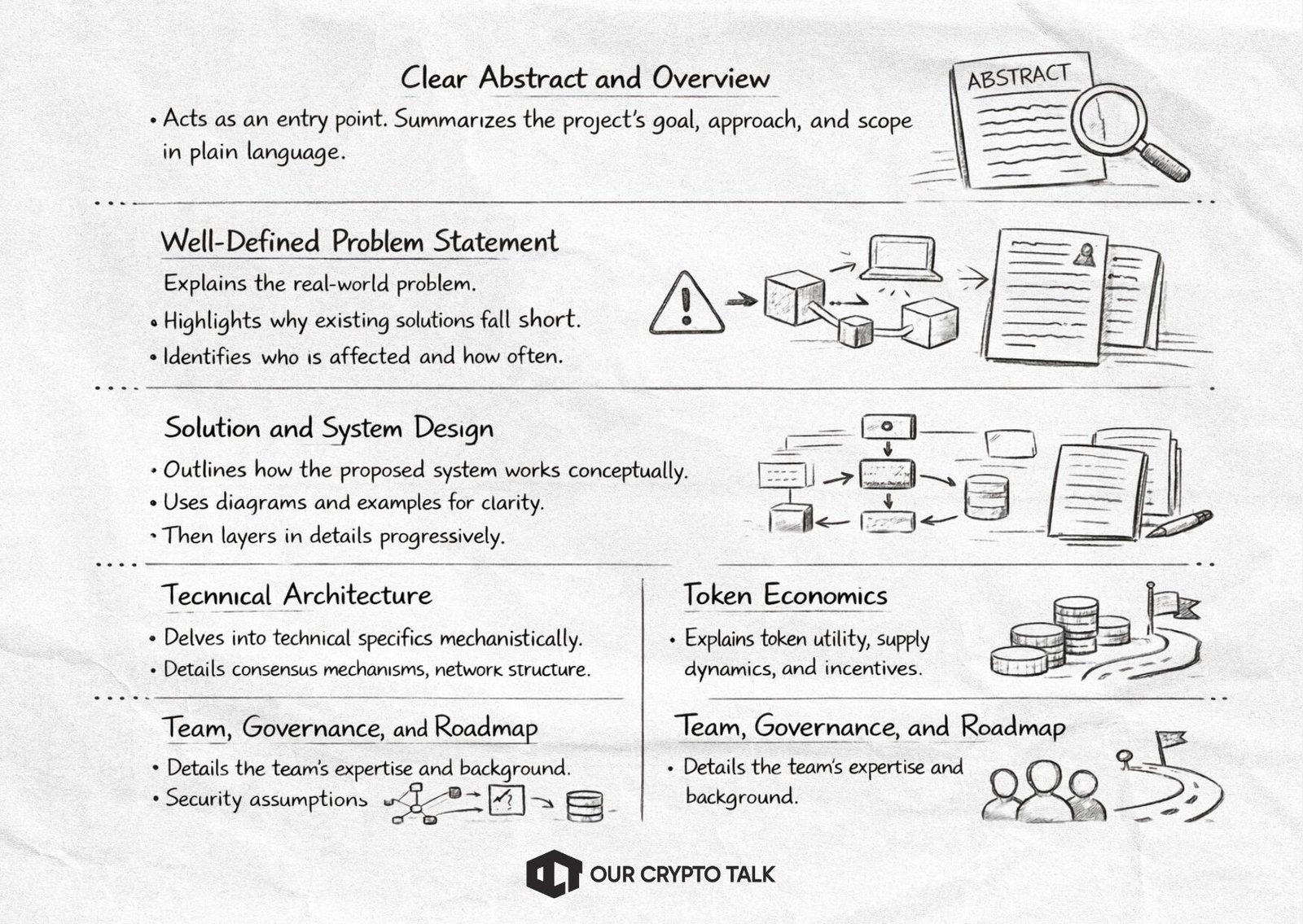
The abstract acts as the entry point. It should summarize the project’s goal, approach, and scope in plain language. Readers should understand the essence of the idea within a few minutes.
A strong abstract avoids buzzwords and focuses on intent. If the opening paragraph feels confusing or exaggerated, that is often an early warning sign.
Every credible Crypto Whitepaper begins with a clear problem. This section explains:
Vague problems usually lead to weak solutions. Precision here reflects depth of understanding.
This is the heart of the whitepaper. It outlines how the proposed system works at a conceptual level before diving into technical detail.
Effective whitepapers often use:
The goal is comprehension, not intimidation. Technical sophistication should enhance clarity, not obscure it.
For technically inclined readers, this section provides insight into:
Pseudocode, flowcharts, or references to repositories help anchor claims in reality. A Crypto Whitepaper does not need to include full code, but it should demonstrate that the design is implementable.
Tokenomics is one of the most scrutinized sections of any Crypto Whitepaper. It explains:
Healthy token models align long-term network growth with participant behavior. Overly complex or opaque models often raise more questions than answers.
Finally, strong whitepapers address execution. This includes:
Ambition is expected, but timelines should reflect technical and organizational reality. Overconfidence here tends to age poorly.
Once you understand the structure of a Crypto Whitepaper, the next step is interpretation. This is where passive reading turns into active analysis. Instead of asking whether the idea sounds exciting, the better question becomes whether it makes sense.
A strong whitepaper leaves very little room for guesswork. It guides the reader through its logic step by step and allows independent verification wherever possible.
Every credible Crypto Whitepaper should demonstrate a tight connection between the problem and the proposed solution.
Look closely at:
Projects that force blockchain into problems already solved efficiently by traditional systems often struggle long term. On the other hand, whitepapers that clearly explain why decentralization matters tend to age better.
Token economics deserve special attention because they directly affect incentives, dilution, and sustainability.
A healthy token model usually shows:
If a Crypto Whitepaper cannot explain why the token is needed, that absence speaks volumes. Utility should emerge naturally from the system design, not appear as an afterthought.
While anonymity is not inherently bad in crypto, transparency still matters.
A strong whitepaper will:
When a project hides behind vague titles or unverifiable achievements, readers should proceed with caution.
Roadmaps reflect how well a team understands execution risk.
Look for:
Whitepapers that promise mainnet launches, mass adoption, and enterprise partnerships within months often underestimate complexity.
Modern Crypto Whitepapers increasingly emphasize governance. This section reveals how power flows through the system.
Key questions include:
Clear governance frameworks often correlate with healthier long-term ecosystems.
Not every Crypto Whitepaper is written in good faith. Learning to identify warning signs early can save both capital and time.
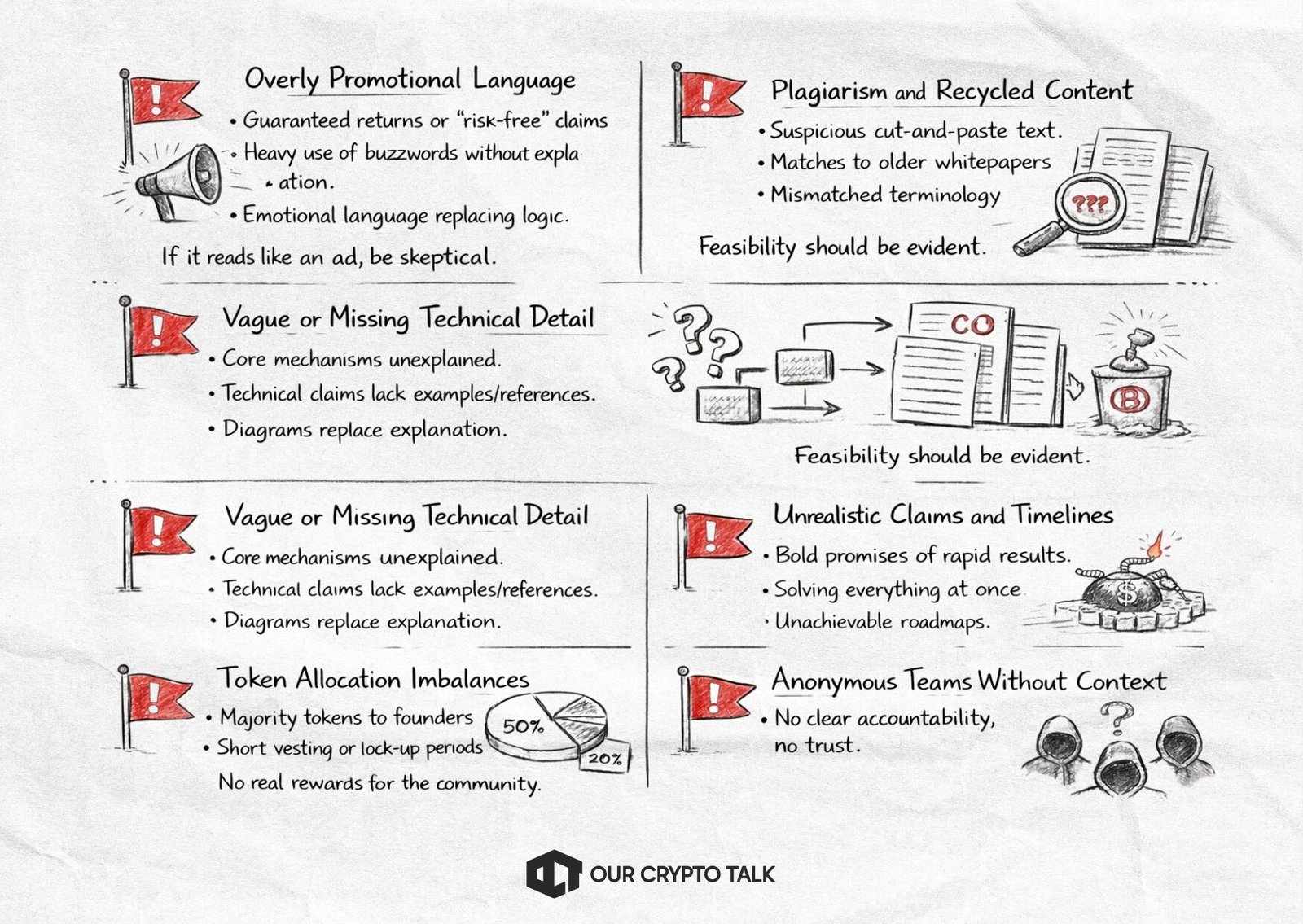
Technical documents should sound technical. Excessive hype usually signals weak foundations.
Red flags include:
If a whitepaper reads more like an advertisement than a proposal, skepticism is warranted.
A Crypto Whitepaper does not need to reveal proprietary secrets, but it must demonstrate feasibility.
Be cautious if:
Opacity often masks unproven ideas.
Plagiarism remains surprisingly common. Entire sections sometimes appear copied from older projects.
Readers can:
Original thinking leaves a consistent fingerprint throughout the document.
Blockchain systems face well-known constraints. Any Crypto Whitepaper claiming to solve scalability, security, and decentralization simultaneously without trade-offs deserves scrutiny.
Similarly, timelines should reflect reality. Complex infrastructure cannot be built overnight, regardless of funding.
Token distribution reveals intent.
Watch for:
When early participants capture most upside, long-term alignment suffers.
Anonymity worked for Satoshi Nakamoto, but that exception does not define the rule.
If anonymity exists, a Crypto Whitepaper should explain why and how trust is maintained despite it.
Understanding where Crypto Whitepapers came from helps explain why standards matter today.
The original Bitcoin Whitepaper was concise, focused, and restrained. It addressed a single problem: trustless digital payments. That simplicity became its strength.
There were no roadmaps, token sales, or marketing sections. The document relied entirely on logic.
During 2017–2018, whitepapers multiplied rapidly. Many expanded in length but not in substance.
This era introduced:
The market eventually punished weak documentation.
With Ethereum Whitepaper, the scope of whitepapers expanded. Smart contracts introduced programmable value, forcing deeper technical explanations.
Later projects began addressing:
Whitepapers became more structured and peer-aware.
Today, many Crypto Whitepapers emphasize audits, compliance, and governance. Regulations such as MiCA have pushed teams toward clearer disclosures and realistic claims.
The lesson is consistent: markets evolve, but fundamentals endure.
One of the best ways to understand what makes a strong Crypto Whitepaper is to study real examples. Over the years, certain documents have shaped the direction of the entire industry, while others have become cautionary tales.
The Bitcoin Whitepaper remains the gold standard for simplicity and focus. It does not attempt to solve every problem in finance. Instead, it clearly defines one objective: enabling peer-to-peer electronic cash without intermediaries.
Key strengths include:
The document avoids marketing language entirely. Its credibility comes from logical consistency rather than persuasion.
The Ethereum Whitepaper introduced a major shift by positioning blockchain as a programmable platform rather than a single-purpose system.
Its impact came from:
Ethereum’s Crypto Whitepaper showed that ambition can coexist with transparency when trade-offs are clearly stated.
The Polkadot Whitepaper focused on a specific structural issue in crypto: fragmented blockchains.
Its whitepaper stood out by:
This document demonstrated how complex ideas can still be communicated without overwhelming readers.
The Solana Whitepaper took a different approach, prioritizing throughput and latency.
Rather than promising universal decentralization, it:
Strong Crypto Whitepapers often gain credibility by being honest about what they prioritize and what they sacrifice.
Not all influential whitepapers succeed for the right reasons. BitConnect became infamous due to exaggerated claims and missing technical substance.
Warning signs included:

Its failure reinforced why careful whitepaper analysis matters.
Reading a Crypto Whitepaper does not mean digesting every equation on the first pass. Like any technical document, it rewards structured reading.
Begin by skimming:
This quick pass helps determine whether deeper analysis is worthwhile.
Every system rests on assumptions. Strong whitepapers make them explicit.
Ask yourself:
Assumptions often matter more than features.
No Crypto Whitepaper exists in isolation.
Readers can:
External validation strengthens internal logic.
Over time, readers benefit from building their own checklist. Common criteria include:
Scoring whitepapers consistently helps remove emotional bias.
Whitepapers are not static. Many evolve as projects mature.
Revisiting documents after major updates or failures often reveals how well original assumptions held up.
Despite faster communication channels and social media narratives, the Crypto Whitepaper remains irreplaceable.
It forces teams to:
For readers, it offers a rare opportunity to evaluate projects on fundamentals rather than momentum.
As regulations increase and markets mature, the quality gap between strong and weak whitepapers will likely widen. Projects that invest in clarity and honesty tend to outlast hype cycles.
A Crypto Whitepaper is not a promise of success. It is a declaration of intent.
Learning how to read one critically transforms how people engage with the crypto space. Instead of reacting to narratives, readers gain the ability to judge ideas on their own terms.
In an industry built on transparency and open systems, that skill remains timeless.