Loading Search...


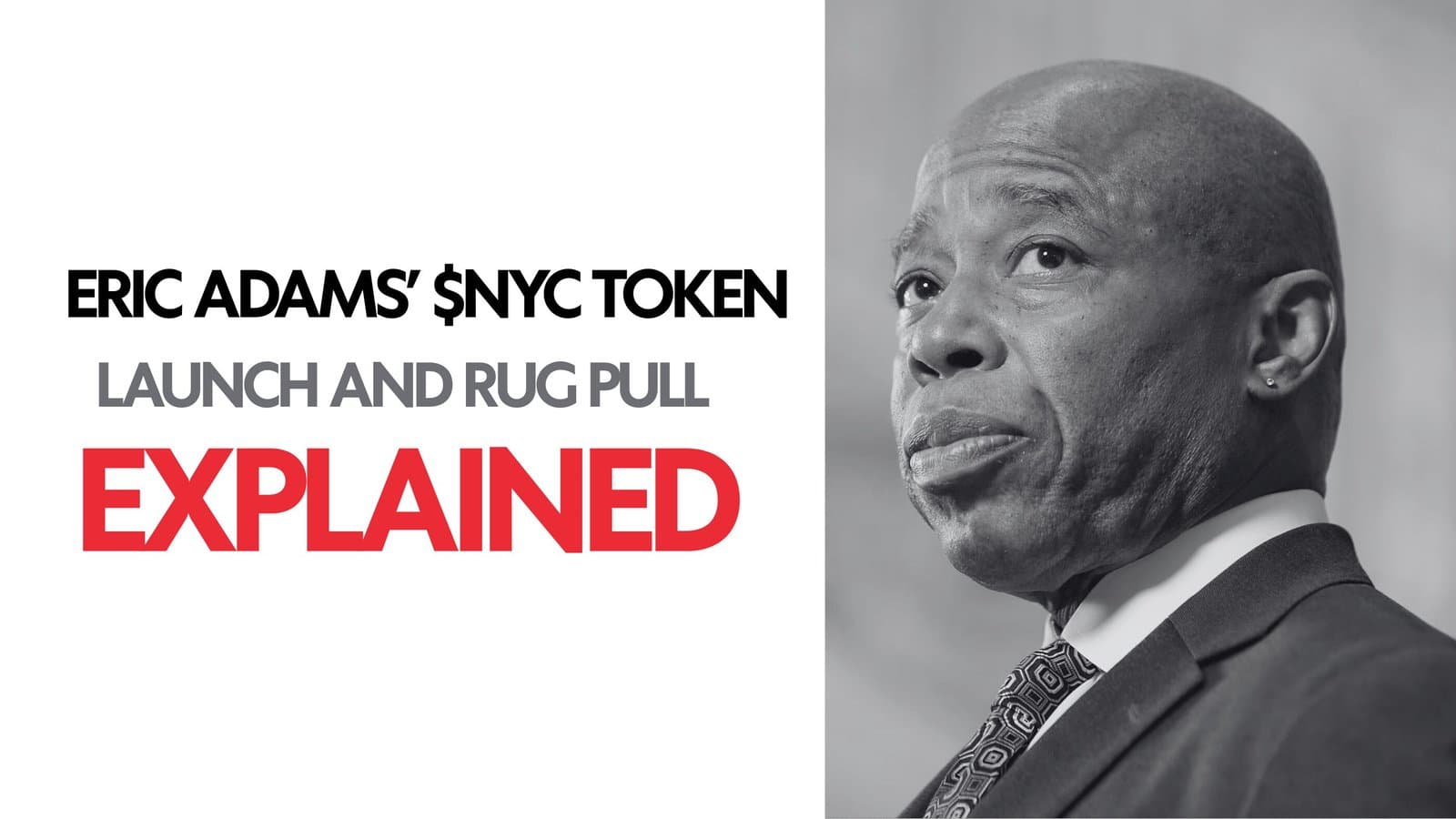
Eric Adams' $NYC Token saw the biggest crash of 2026 yet earlier this week and we explore the entire story behind it.

Author: Sahil Thakur
This week former New York City Mayor Eric Adams helped launch a cryptocurrency called $NYC Token. The project was marketed as a civic-minded crypto asset tied to the “Big Apple.” Its stated goal was to fund social causes. The launch featured a high-profile press event in Times Square. Early investor interest surged quickly.
Soon after, the token’s price spiked. Then it collapsed just as fast. Within hours, millions of dollars in market value vanished. As a result, critics accused the project of a “rug pull.” This term refers to a crypto scam in which insiders drain funds and abandon investors. This account examines what happened next. It covers Adams’s role and public statements. It also traces the timeline, the fallout, and the broader lessons from the collapse.
Eric Adams served as mayor of New York City from 2022 to 2025. He is widely known for his support of cryptocurrency. Many dubbed him the “Bitcoin Mayor.” Early in his term, he converted his first mayoral paychecks into Bitcoin and Ethereum. He also promoted New York City as a future “crypto capital of the world.” Throughout his tenure, he framed blockchain as a pillar of innovation.

Src: ABC News
After leaving office in late 2025, Adams continued to speak publicly about crypto. He presented $NYC Token as a continuation of his agenda. According to Adams, the token would support social causes. He said it would combat hate and expand educational access for young people.
In several statements, Adams tied the project to antisemitism and civic education. He described the token as a way to fight antisemitism and what he called “anti-Americanism.” He also said it would fund blockchain education and scholarships for New York students. In one remark, he pointed to rising tensions on college campuses and in urban communities. He argued that the token could help address those issues.
Adams claimed that proceeds would go to nonprofits and historically Black colleges and universities. He emphasized that this funding would not require higher taxes. Instead, the token would serve as an alternative funding mechanism. In his view, crypto could support public causes without relying on government revenue. These claims framed $NYC Token as both a civic initiative and an educational tool. They also aligned with his long-standing belief that blockchain could benefit society.
The timing of the launch drew attention as well. It occurred just as a new mayoral administration took office. Adams had been succeeded by Zohran Mamdani in January 2026. Shortly after taking office, Mamdani rolled back several of Adams’s policies related to antisemitism. In response, Adams appeared to sharpen his focus on that issue.
On launch day, Adams spoke with Fox Business. During the interview, he suggested the token was part of a broader effort to keep the city from “going backward.” The comment was widely seen as a reference to his successor. As a result, the token took on a political dimension. It was not only a financial product. It was also framed as Adams’s post-mayoral effort to advance his priorities and promote New York as a tech-forward city.
In the months before January 2026, hints of an “NYC token” circulated quietly. Details, however, remained unclear. While in office, Adams had created a Mayor’s Office of Blockchain. He also released a 61-page Blockchain Plan in late 2025. That document outlined how the city might use crypto technology. It did not clearly propose a city-branded token.
Later reporting revealed that similar ideas had already been in circulation. Eddie Cullen, a former mayoral candidate and crypto entrepreneur, said he shared an “NYC Token” proposal with Adams’s team in June 2025. His political action committee issued a press release at the time. It described a trademarked initiative designed to generate city revenue through blockchain. Cullen said he provided a detailed proposal to Adams’s aides.
Despite these earlier discussions, the final launch appeared sudden. Adams’s public announcement surprised Cullen. Cullen said he received no warning. He also said he was shocked that Adams moved forward without involving him. Following the launch, Cullen said he planned to send a cease-and-desist letter. He accused Adams of taking over the concept.

Other signs pointed to limited preparation. The token’s official website was sparse at launch. Several buttons did not work. Questions about the team behind the project went largely unanswered. Adams declined to name partners or backers. He directed inquiries to the website instead.
Further scrutiny raised more concerns. The entity tied to the token, C18 Digital, was newly formed. Records showed it was registered as a Delaware LLC on December 30, 2025. That was only days before the launch. The website also included a disclaimer stating the token was not affiliated with the New York City government.
Eric Adams unveiled the $NYC Token on Monday, January 12, 2026. He did so at a press conference in Times Square. Reporters gathered at the landmark as Adams announced the launch of his digital coin. The location choice was deliberate. Times Square, often called the “Crossroads of the World,” added symbolic weight to the moment.
With bright billboards and heavy foot traffic behind him, Adams framed the project as more than a cryptocurrency. He described it as a movement. Promotional language on the token’s website reinforced that message. It portrayed $NYC Token as a reflection of New York’s energy and ambition. The framing targeted dreamers, innovators, and believers.
During the press conference, Adams repeated the project’s stated goals. Standing beside $NYC Token signage, he said the coin would combat antisemitism and anti-Americanism. He also said it would fund crypto education for young people. He spoke at length about using New York’s financial influence in new ways. According to Adams, the token would teach children about blockchain technology. It would also help pay for scholarships.
He again emphasized that the project would not rely on taxes. Instead, profits from the token would support charities and educational programs. Adams presented this approach as an alternative to traditional public funding. In doing so, he positioned crypto as a tool for social impact.
The press conference was part of a larger media push. Earlier that day, Adams appeared on Fox Business Network. He spoke with anchor Maria Bartiromo about the token. He repeated his claims about fighting hate and supporting nonprofits. During the interview, he addressed critics directly. He argued that blockchain could improve government rather than undermine it.
The Times Square event generated immediate attention. Local news outlets recorded the announcement. The timing also carried symbolism. Just two weeks earlier, Adams had presided over the New Year’s Eve Ball Drop in the same location. That event traditionally represents renewal and optimism. Now, as a former mayor, he returned to launch a different kind of new beginning.

After the morning publicity, $NYC Token began trading on the evening of January 12, 2026. The token launched on the Solana blockchain. It was available on at least one decentralized exchange. Interest surged immediately. The day’s media coverage drove heavy buying within minutes.
The price climbed at a stunning pace. Early buyers rushed in. As a result, the token’s market capitalization ballooned to roughly $580 to $600 million shortly after launch. That valuation was remarkable for a brand-new meme-style token. It reflected the power of a high-profile endorsement. At its peak, the price rose from nearly zero to about $0.58 per token. This happened before any major exchange listings or broad distribution.
Online reaction followed quickly. Traders on forums and social media celebrated what they called the “Big Apple coin.” Excitement dominated the conversation. Many viewed the surge as instant validation of the project.
The momentum did not last. Within 30 to 60 minutes of the peak, the market reversed sharply. The token’s price plunged by roughly 80 percent in less than half an hour. Market capitalization collapsed from nearly $600 million to around $100 to $110 million. Almost $500 million in paper value disappeared in moments.
The price fell just as dramatically. After trading above 50 cents, the token dropped below 10 cents. The entire rise and collapse unfolded in under an hour. The speed of the swing underscored the extreme volatility of the launch.
Panic spread quickly. Many buyers watched their holdings lose value in real time. Those who entered near the peak suffered the most. One trader, known by the alias “Dr6s2o,” reportedly lost about $473,500. That represented roughly 63 percent of their investment in under 20 minutes. The loss occurred after panic-selling during the crash.
Some early participants managed to exit with profits. Many others did not. Latecomers were left holding sharply devalued tokens. On Reddit and X, reactions shifted fast. Early enthusiasm gave way to disbelief and anger. What began as a celebratory launch day ended as a financial shock for many investors.
After the collapse, analysts began examining the blockchain data. The pattern raised immediate concerns. The rapid rise and sudden crash resembled a classic rug pull. In such schemes, insiders promote a token, inflate the price, then remove liquidity or sell large holdings.

In this case, on-chain activity pointed to suspicious behavior. A wallet linked to the token’s deployer removed liquidity at the market’s peak. Analysts soon focused on how the trading pool had been structured.
Instead of a standard two-sided pool, the developers created a one-sided pool. It contained only $NYC Tokens. When public buyers purchased the token, they deposited USDC into the pool. That process created a growing reserve of stablecoins. It also made the pool vulnerable.
At the price peak, a deployer-linked wallet withdrew a large share of that USDC. Reports estimated the amount between $2.4 million and $3.2 million. One analysis placed the figure at roughly $2.43 million. Another, which tracked additional wallets, estimated withdrawals closer to $3.18 million. The timing aligned closely with the market top.
Once the liquidity disappeared, price support vanished. The market collapsed almost instantly. Buyers who entered after the withdrawal had little chance to exit without losses. Later, after public accusations began circulating, roughly $1.5 million in USDC was returned to the pool. The same wallet appeared to be responsible.
By then, the damage was already done. About $932,000 remained unaccounted for. Observers believed that amount represented insider profit. The sequence followed a familiar pattern. Funds were removed at the top. The crash followed. Partial liquidity was restored to limit backlash. The remainder stayed gone.
Analysts and media outlets reacted quickly. Many described the episode as a textbook rug pull. Several estimated that insiders netted close to $1 million. Crypto analytics firms highlighted how concentrated the token supply was among a small number of wallets. They also noted how fast those wallets acted once public money flowed in.
Industry figures were blunt. Nicolas Vaiman, founder of the analytics firm Bubblemaps, called the incident an obvious rug. Others compared it to earlier celebrity-linked token failures. Past examples included a memecoin tied to Argentine President Javier Milei and a 2024 influencer token launch that ended similarly. In each case, hype preceded an insider exit.
Social media amplified the backlash. Users posted transaction screenshots and mocked the project. Memes portraying Adams as “pulling the rug” spread quickly. Within hours, phrases like “NYC Token” and “Eric Adams rug pull” trended in finance-focused discussions. Many pointed out the irony. A token promoted as a tool against injustice had caused financial harm to its own supporters.
From a technical standpoint, experts said the outcome was predictable. Ari Redbord of TRM Labs described the activity as consistent with a memecoin pump-and-dump. In such launches, a small group controls most of the supply and liquidity. Hype drives prices up. Those holders then sell or withdraw funds. A crash follows.
Redbord noted that this pattern does not automatically prove criminal intent. Still, it highlights severe investor risk. Concentrated ownership and fragile liquidity create unstable markets. The involvement of a well-known public figure did not change that reality. In the end, $NYC Token behaved like many speculative meme coins. It surged on hype. Then it collapsed just as quickly.
After the crash, criticism mounted quickly. The team behind $NYC Token came under intense scrutiny. Eric Adams faced pressure as well. At first, Adams said nothing publicly. As the token’s value collapsed on Monday night, January 12, he remained silent.
Early responses came from the project itself. Late Monday and into Tuesday, an official $NYC Token account appeared on X. The account denied any wrongdoing. It claimed the liquidity removal was a technical response to unexpected demand. According to the account, partners needed to “rebalance the liquidity” due to overwhelming interest at launch. The message insisted the team was committed for the long term.
That explanation failed to convince many observers. Online critics quickly pushed back. They argued that legitimate projects do not remove liquidity in a single large transaction. Many also noted that rebalancing should not involve draining the pool at the peak and refilling it only after a crash.
As coverage expanded on Tuesday, January 13, the team attempted further damage control. A public relations firm, People’s Revolution, contacted media outlets. The firm shared an official statement on behalf of the project. In comments sent to Fortune and others, the team flatly denied any withdrawals. The spokesperson claimed no money had been taken from the account.
The statement reframed the launch as a victim of its own popularity. It said the strong response showed public concern about antisemitism and anti-Americanism. It also emphasized transparency and long-term building. However, the message avoided direct discussion of the on-chain transactions. It did not explain the liquidity movements or the rapid collapse. The contradiction between denying withdrawals and earlier claims of rebalancing raised more doubts. By then, blockchain data was already public. Independent analysts had labeled the incident a rug pull. Trust continued to erode.
Adams remained silent as the controversy grew. By Wednesday, January 14, pressure increased for him to respond directly. That day, he issued a statement through his spokesperson and on his own social media accounts. The message strongly denied any personal involvement in moving funds.
In a post attributed to spokesperson Todd Shapiro, Adams rejected the core allegations. The statement said Adams did not move investor funds. It also said he did not profit from the token’s launch. Finally, it claimed that no funds were removed from the project. Adams positioned himself as a promoter, not an operator. He implied that others handled the token’s technical and financial mechanics.

The statement did not identify who controlled the liquidity. It left questions about the project’s partners unanswered. Still, it sought to distance Adams from direct responsibility. That distinction mattered. Online critics had accused him of personally profiting from the crash. His denial aimed to protect his reputation as scrutiny intensified. Major outlets, including Bloomberg, reported on the response.
In the days after the $NYC Token crash, public reaction was swift and hostile. Many people expressed outrage and disbelief. Crypto communities buzzed with claims that a former New York City mayor had promoted a rug pull. New Yorkers voiced embarrassment and anger over the city’s name being tied to an apparent scam.
Social media amplified the backlash. Commenters mocked the speed of the collapse. One widely shared post joked that Eric Adams had completed the entire crypto scam cycle in a single day. Others highlighted the irony. A token marketed as a tool to fight hate had instead fueled distrust in public figures.
Within the crypto world, the incident became a cautionary tale. Influential commentators on X analyzed blockchain data in real time. Their posts helped piece together what happened. This crowdsourced scrutiny added pressure on the token team to respond. Investors who lost money reacted predictably. Many were angry. Some discussed lawsuits or demanded refunds. At that stage, however, no formal class-action cases had been announced.
Mainstream media quickly joined in. Finance and technology outlets labeled the launch a scandal. Several compared it to past crypto ventures linked to politicians. The Washington Post described the collapse as suspicious and consistent with an insider dump. The Jerusalem Post focused on the antisemitism angle. It noted that a token launched as a political statement had unraveled under scrutiny.
Commentators also drew broader comparisons. Some referenced Donald Trump–themed crypto projects and the ethical concerns surrounding them. Others pointed to international examples, including Argentina’s failed Libra coin. Together, these cases framed $NYC Token as part of a wider pattern. Political meme coins often rise on hype and fall just as fast.
As of mid-January 2026, no government agency had announced a formal investigation. Still, speculation grew. New York regulators have taken an aggressive stance on crypto fraud in recent years. Many expected them to review whether securities laws or fraud statutes applied.
Political reactions followed as well. New Mayor Zohran Mamdani dismissed the project outright. When asked if he would buy the token, he simply said no. Members of the public urged city officials to prevent misuse of the “NYC” name. Some raised trademark concerns, noting the city had not authorized the project.
Eddie Cullen also reappeared in the conversation. He repeated his claim that Adams had taken his original idea. He said he intended to hold Adams accountable and explore legal options. Whether that effort will go anywhere remains unclear.
Adams attempted to contain the fallout. He continued to deny profiting from the token. He portrayed himself as a promoter of a cause, not an operator of the project. Still, questions persisted. His level of involvement remained murky. The identities of the developers and beneficiaries were still unknown.
These unanswered questions kept the story alive. By January 15, 2026, the token traded far below its peak. Its community had largely disappeared. Official channels continued to post optimistic messages. Few seemed convinced.
The $NYC Token episode offers several clear lessons.
First, celebrity endorsement does not equal safety. A famous name does not guarantee legitimacy. Even a former mayor cannot reduce the risks of a speculative token. Investors still need to do their own research. Hype can be costly.
Second, early warning signs matter. Highly concentrated token ownership is a red flag. One-sided liquidity pools are another. These structures allow insiders to extract value quickly. Vague project details also deserve scrutiny. A bare website, no named team, and a newly formed company should trigger caution.
Third, rug pulls can happen fast. In this case, hundreds of millions in value vanished within minutes. Liquidity and trust disappeared almost instantly. This reinforces a basic rule of crypto investing. Never risk money you cannot afford to lose.
Fourth, transparency is essential. Public figures who promote crypto projects carry added responsibility. Clear disclosure of token mechanics, liquidity plans, and team members could reduce harm. Using civic branding and social causes as marketing tools, without protecting investors, invites backlash. Even without criminal charges, reputational damage can be severe.
Finally, the case fuels calls for stronger oversight. Celebrity-backed tokens often exist in a legal gray area. Regulators may respond with tighter rules. These could include restrictions on using public names or mandatory disclosures when public figures promote financial products. At minimum, the episode shows that the crypto market remains largely unpoliced.



AI Agent Payments Explained: Circle Nanopayments and the x402 Protocol
Top 7 Projects in the World Liberty Financial (WLFI) Portfolio
Where Crypto Actually Makes Money in 2026?
What If Satoshi Nakamoto Was Here in 2026?
AI Agent Payments Explained: Circle Nanopayments and the x402 Protocol
Top 7 Projects in the World Liberty Financial (WLFI) Portfolio
Where Crypto Actually Makes Money in 2026?
What If Satoshi Nakamoto Was Here in 2026?