Loading Search...


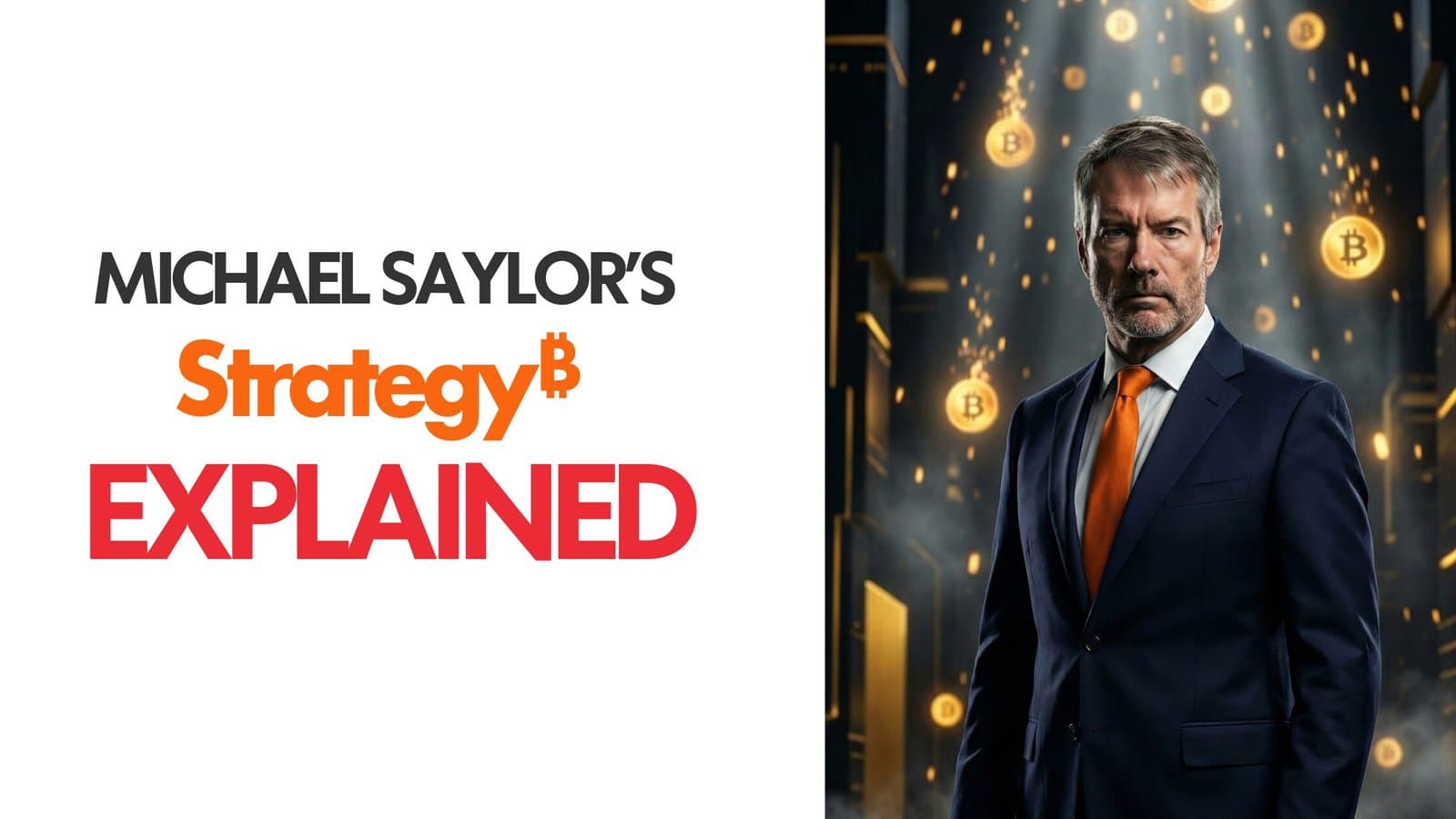
Michael Saylor's Bitcoin accumulation explained: why Strategy keeps buying BTC, how it’s financed, and what it means for corporate treasuries.

Author: Tanishq Bodh
In modern financial history, few corporate strategies are as polarizing or as relentless as Michael Saylor’s Bitcoin accumulation. What began in 2020 as a defensive treasury decision has evolved into one of the largest and most aggressive capital allocation experiments ever attempted by a public company.
As of January 5, 2026, MicroStrategy holds 673,783 Bitcoin, worth approximately $50.5 billion, making it the largest corporate holder of BTC on the planet. This is not passive exposure or short-term speculation. It is a deliberate, compounding strategy that has reshaped both the company’s balance sheet and its market identity.

Source : Strategy
The obvious question is why.
Why does Saylor continue buying Bitcoin through bull markets, bear markets, regulatory pressure, and violent drawdowns? Why has he turned a business intelligence firm into a leveraged Bitcoin vehicle? And what does he understand about money, risk, and time that others either dismiss or underestimate?
This explained article breaks down the logic behind Saylor’s strategy, the mechanics that make it possible, and the broader implications for corporate finance and global monetary systems.
Michael Saylor’s Bitcoin journey did not start with speculation. It started with inflation.
In early 2020, as central banks unleashed unprecedented monetary stimulus, Saylor faced a simple problem. MicroStrategy held hundreds of millions of dollars in cash, and that cash was losing purchasing power every month. Bonds yielded close to zero. Treasuries guaranteed loss after inflation. Holding dollars meant accepting slow erosion.
Saylor responded by studying alternatives. By his own account, he spent hundreds of hours analyzing monetary history, cryptography, game theory, and network effects. His conclusion was blunt: cash was a decaying asset, and Bitcoin was engineered to resist that decay.
On August 10, 2020, MicroStrategy made its first Bitcoin purchase, acquiring 21,454 BTC for $250 million. That decision marked the beginning of a strategy that would eventually redefine the company.
From that moment forward, Saylor framed Bitcoin not as a trade, but as property. In his words, Bitcoin was “engineered monetary energy,” a system designed to store economic value without relying on trust in institutions or governments.
At the core of Michael Saylor’s Bitcoin conviction is a specific view of Bitcoin’s role in the world.
He does not treat Bitcoin as a currency competing with dollars for daily payments. He treats it as digital property, superior to gold and real estate in key dimensions. Bitcoin is scarce by design, capped at 21 million coins. It is portable, verifiable, and immune to physical seizure when properly stored.
Gold, by contrast, is heavy, expensive to transport, and subject to confiscation. Real estate is illiquid, taxed, and politically exposed. Bitcoin, in Saylor’s framework, is the first asset that combines absolute scarcity with global mobility.
Volatility does not invalidate this thesis in his view. Instead, he treats volatility as a byproduct of adoption. Assets that appreciate exponentially do not move in straight lines. They move in violent steps.
This belief explains why MicroStrategy continued buying through the 2022 bear market, when Bitcoin collapsed below $20,000 and critics declared the strategy dead. Saylor viewed that period not as failure, but as accumulation.
Michael Saylor’s Bitcoin accumulation is inseparable from his views on fiat currency.
He sees modern fiat systems as structurally inflationary. Governments expand money supply to manage debt and political pressure. Over time, savers absorb the cost. Even moderate inflation compounds into massive losses over decades.
Bitcoin’s issuance schedule directly counters this dynamic. New supply decreases every four years through halvings. Unlike fiat, Bitcoin does not respond to economic crises with emergency printing. Its rules do not change.
For MicroStrategy, this makes Bitcoin a long-duration hedge. Holding BTC is not about timing cycles. It is about exiting a monetary system Saylor believes is mathematically unstable.
This framework explains why MicroStrategy does not sell Bitcoin to “take profit.” Selling would reintroduce fiat exposure. Accumulation, not rotation, is the goal.
MicroStrategy’s strategy represents a structural break from traditional corporate finance.
Most public companies treat cash as optionality. MicroStrategy treats cash as liability. Excess capital flows directly into Bitcoin. Over time, the company has become less a software firm with Bitcoin exposure and more a Bitcoin treasury with software operations.

Source : Strategy
This model has turned MicroStrategy stock into a proxy for Bitcoin exposure, especially for investors unable or unwilling to hold BTC directly. During Bitcoin bull markets, this leverage amplifies returns. During drawdowns, it magnifies pain.
Saylor accepts this trade-off because he operates on a multi-decade horizon. He is not managing quarterly volatility. He is positioning for what he believes is a monetary transition.
The mechanics behind the accumulation are as important as the philosophy.
MicroStrategy funds purchases through a mix of equity issuance and convertible debt. When its stock rallies alongside Bitcoin, the company issues shares or low-interest convertible notes. Those proceeds buy more Bitcoin. As Bitcoin appreciates, the balance sheet strengthens, enabling further capital raises.
This cycle effectively converts fiat yield into Bitcoin exposure. It is aggressive. It is controversial. But it has worked during periods of rising Bitcoin prices and favorable capital markets.
Importantly, Saylor does not view this as reckless leverage. He argues that borrowing depreciating currency to buy appreciating property is rational when time is on your side.
Saylor’s Bitcoin accumulation is not limited to corporate optimization. It is also geopolitical.
He believes Bitcoin will become a strategic reserve asset for nations, similar to gold in the twentieth century. Countries that adopt early will gain monetary advantage. Those that resist will be forced to adapt later at higher cost.
This belief informs his public advocacy. Saylor has urged governments to consider Bitcoin reserves and has positioned MicroStrategy as an early mover in this emerging order.
In this context, MicroStrategy’s holdings are not just assets. They are strategic positioning in what Saylor views as an inevitable shift in how value is stored globally.

Critics point to Bitcoin’s volatility, regulatory uncertainty, and energy usage. Saylor does not ignore these issues but rather reframes them.
He argues that Bitcoin mining increasingly stabilizes energy grids by monetizing excess supply and he points to regulatory clarity improving through ETFs and institutional adoption. Also, he acknowledges volatility but views it as declining over time as liquidity deepens.
Most importantly, he rejects short-term framing. Risk, in his view, lies not in volatility but in holding assets guaranteed to lose value over long horizons.
This mindset explains why Saylor continues buying even during periods when both Bitcoin and MicroStrategy stock decline. His strategy is not reactive. It is structural.
Michael Saylor keeps buying Bitcoin because he believes most of the world remains underexposed.
From his perspective, institutions, corporations, and governments are still early in understanding Bitcoin’s role. As adoption expands, scarcity will assert itself. Prices will adjust accordingly.
Whether or not this vision fully materializes, one fact is already clear. Saylor has permanently altered the conversation around corporate treasuries and digital assets. He demonstrated that Bitcoin is no longer just a retail experiment. It is a balance-sheet strategy at scale.
Michael Saylor’s relentless Bitcoin accumulation is not a bet on price. It is a bet on time, mathematics, and monetary history.
He buys Bitcoin
because he believes it is the most durable form of property ever created. He buys because inflation is structural, not temporary. He buys because volatility does not scare long-term thinkers. And he buys because, in his view, the world has not yet caught up.
Whether history proves him visionary or reckless remains to be seen. But one thing is certain.
If Bitcoin succeeds as Saylor expects, he will not be remembered for buying too early.
He will be remembered for buying when others hesitated.