Loading Search...



Learn how OTC trading in crypto works, why institutions use OTC desks for transactions, and the benefits, risks, and real-world examples.

Author: Chirag Sharma
When people imagine cryptocurrency trading, they usually picture charts flashing on centralized exchanges like Binance or Coinbase. Retail traders click buy or sell, the order hits a public order book, and the market moves accordingly. But this is not how large institutions trade.When a hedge fund wants to buy $50 million worth of Bitcoin, placing that order directly on an exchange would immediately move the market. The order would consume available liquidity and push prices upward as it fills. To avoid that disruption, large participants rely on OTC trading crypto desks. Over-the-counter (OTC) trading in crypto refers to the direct buying and selling of digital assets between two parties outside public exchange order books. Instead of interacting with an automated matching engine, the buyer and seller negotiate the trade privately through an intermediary called an OTC desk. These desks act as liquidity providers or brokers that connect large buyers and sellers without exposing their transactions to the broader market.
A typical OTC trading crypto deal works like this:
Because the trade never touches the public order book, it does not influence visible market prices.
This mechanism allows institutions to move enormous positions without triggering volatility.
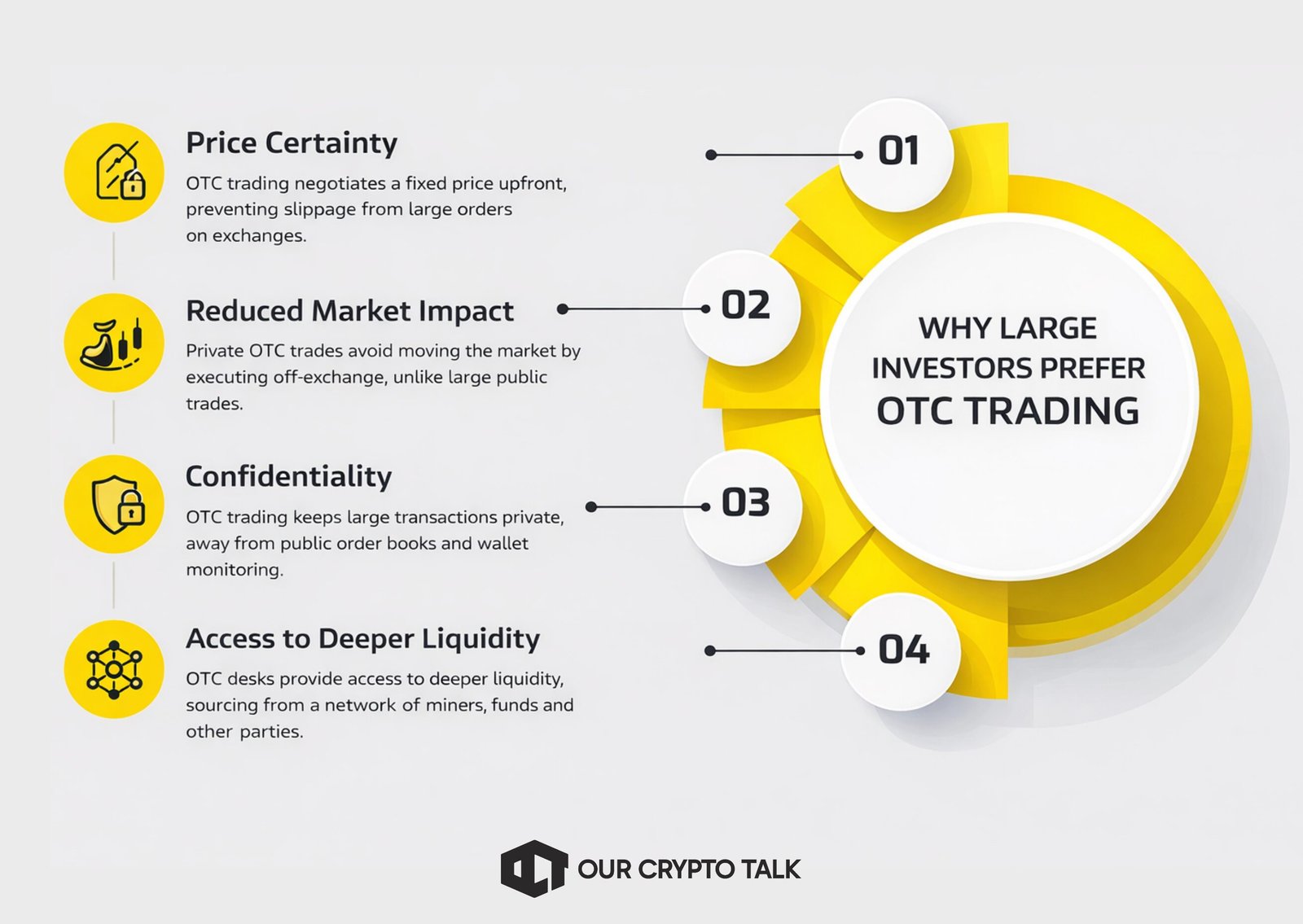
OTC trading exists in traditional financial markets as well. Forex, bonds, and commodities frequently trade over the counter. In crypto, the need for OTC execution is even stronger because liquidity on public exchanges can be fragmented. Large investors choose OTC desks for several reasons.
Executing a large order on an exchange can cause slippage. Slippage happens when an order consumes available liquidity at progressively worse prices. For example, buying 500 BTC might start at one price but finish at a much higher one. OTC trading crypto avoids this by locking a single negotiated price before execution. The buyer knows the final cost upfront.
Large trades can move the market. If a whale begins accumulating Bitcoin on exchanges, algorithmic traders detect the activity and front-run the order flow. Prices move rapidly before the buyer finishes accumulating. OTC desks eliminate this dynamic because the transaction occurs privatel The market only reflects the trade once participants voluntarily move the assets afterward.
Institutions care deeply about discretion. A visible large trade can signal strategy, portfolio allocation, or sentiment. Competitors, traders, and analysts monitor exchange flows constantly. OTC trading crypto keeps these moves confidential. Many institutional desks even structure settlement so that blockchain transfers occur through custody providers rather than immediately visible exchange wallets.
Public exchanges show only a portion of available liquidity. OTC desks maintain relationships with a network of counterparties, including:
This network creates hidden liquidity that often exceeds visible exchange depth for large transactions.
To understand OTC trading crypto fully, it helps to compare it directly with traditional exchange trading. On centralized exchanges, transactions occur through a public order book. Every bid and ask is visible to the market. When a trader submits a market order, the system automatically fills it against available orders in the book. If liquidity is thin, the order walks the book and causes price movement.
OTC trading operates differently. Instead of interacting with an automated matching engine, participants negotiate privately with a liquidity provider.
Trading vs Exchange Trading (OCT Style) HTML + CSS (drop-in) ========================= –>Exchange trading is standardized. Orders follow predefined formats and settlement rules. OTC desks can structure trades more flexibly.
For example, some desks offer:
This flexibility is one reason institutions prefer OTC execution for large allocations.
OTC desks quietly power a significant portion of global crypto liquidity. When large players move capital, the trades rarely appear on public exchanges immediately. Instead, they flow through institutional liquidity networks. Major crypto OTC desks often maintain billions in daily trading volume. Some operate similarly to traditional market makers, providing continuous quotes to institutional clients. These desks also serve an important stabilizing role in markets. By matching large buyers and sellers privately, OTC trading crypto reduces volatility that would otherwise occur on public exchanges.
For example:
When the trade happens OTC, the two sides meet privately at a negotiated price. The broader market remains stable. This mechanism helps maintain smoother price discovery across the ecosystem.
The rise of OTC trading crypto desks did not happen by accident. As cryptocurrency markets matured, large investors quickly realized that traditional exchange infrastructure was not designed for institutional-sized trades. OTC desks filled that gap by offering execution designed specifically for large transactions.
Slippage is one of the biggest challenges when executing large orders on exchanges. Imagine a trader attempting to purchase $50 million worth of Bitcoin through a public order book. The system fills the order against available sell orders at progressively higher prices. The result is that the final average purchase price may be significantly worse than the initial quote.
OTC trading solves this problem by locking in a price before the trade executes. The OTC desk typically calculates a fair price based on the weighted average across multiple exchanges and liquidity sources. Once the client agrees to the quote, the desk commits to executing the entire trade at that price.
This creates certainty and protects the client from unexpected price movement during execution.
Large trades often reveal strategic intent.
If a hedge fund begins accumulating Bitcoin on an exchange, other market participants may interpret that activity as bullish sentiment. Algorithmic traders may start buying ahead of the order flow, pushing the price higher before the buyer finishes. OTC trading crypto eliminates this issue because the trade never appears on the public order book. The execution remains private between the buyer, seller, and intermediary desk.
This confidentiality is extremely valuable for institutions managing large portfolios.
Public exchanges represent only a portion of available crypto liquidity.
OTC desks maintain deep networks that include:
By connecting these participants, OTC desks create liquidity pools that are often far deeper than exchange order books.
For transactions exceeding several million dollars, this hidden liquidity becomes essential.
Executing large trades across multiple exchanges requires significant operational coordination.
Institutions would need to:
OTC desks simplify this entire process.
A single request to the desk can handle the entire trade, often settling within minutes.
For institutions managing billions in assets, this efficiency saves both time and operational risk.
Despite its advantages, OTC trading crypto is not without risk.
Understanding these risks is essential for anyone considering large transactions through OTC desks.
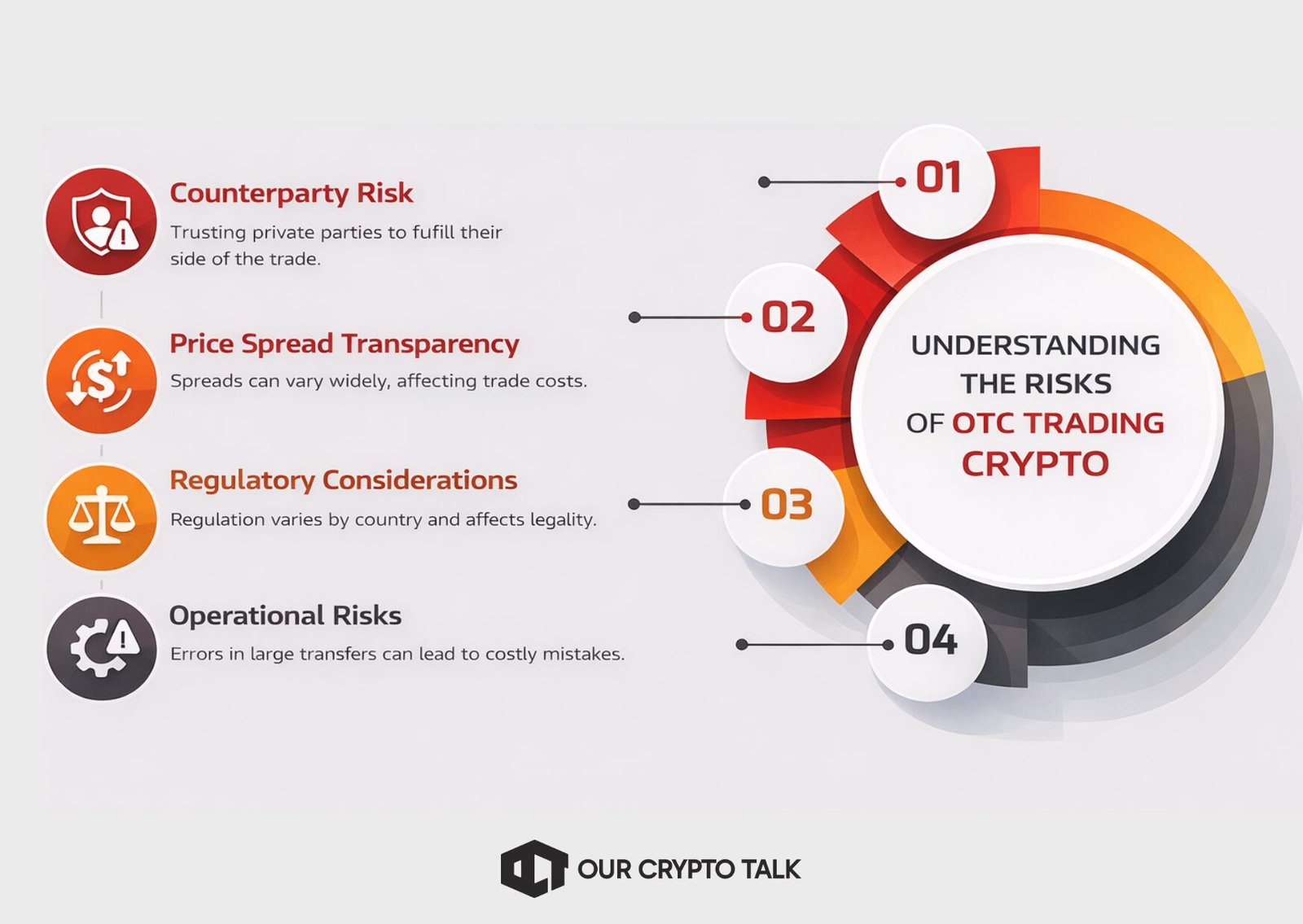
The most significant risk in OTC trading is counterparty failure.
Since the trade occurs privately between two parties, the buyer must trust that the seller will deliver the agreed crypto or fiat.
Reputable desks mitigate this risk through several mechanisms:
Institutional desks often partner with custody providers such as Coinbase Custody or Fireblocks to ensure secure asset movement. Still, due diligence is essential before working with any OTC provider.
OTC desks make money through spreads. Instead of charging explicit trading fees like exchanges, desks quote prices slightly above or below the prevailing market rate.
The spread typically ranges from:
While this structure is normal in financial markets, investors should still compare quotes from multiple desks to ensure fair pricing.
Crypto regulation varies significantly across jurisdictions. Some countries require OTC desks to operate under financial licensing frameworks, while others maintain lighter oversight. Before executing large trades, clients should confirm that their OTC provider complies with applicable regulations and anti-money-laundering standards. Institutional desks typically conduct KYC and AML checks during onboarding to meet regulatory obligations.
Large crypto transfers involve technical complexity. Mistakes in wallet addresses, settlement instructions, or banking details can delay trades or create financial risk. Professional OTC desks mitigate these risks through structured procedures such as:
These safeguards reduce the likelihood of operational errors during high-value trades.
Although OTC trading crypto may sound complex, the actual process is straightforward.
Most trades follow a clear sequence designed to ensure speed and security.
Step 1: Client Onboarding
Before trading, clients complete identity verification and sign a master services agreement. Institutional desks usually complete onboarding within 24–48 hours.
Step 2: Requesting a Quote
The client contacts the OTC desk through a trading portal, encrypted messaging platform, or relationship manager. The request typically includes:
Step 3: Receiving a Price Quote
The desk responds with a firm two-way quote. This quote includes a bid and ask price with a short validity window, often between 10 and 30 seconds. The price reflects market conditions plus the desk’s spread.
Step 4: Trade Confirmation
If the client accepts the quote, the trade becomes locked. At this point, the desk reserves liquidity and prepares settlement instructions.
Step 5: Settlement
Settlement occurs through direct wallet transfers and bank wires. Many desks use delivery-versus-payment structures to ensure both parties fulfill obligations simultaneously. Once settlement completes, the desk provides documentation including transaction IDs and trade confirmations. For most liquid assets, the entire process from quote to settlement can take less than ten minutes.
As the cryptocurrency market matured, a number of professional trading firms began offering institutional-grade OTC services. These desks combine deep liquidity, regulatory compliance, and sophisticated infrastructure to handle large transactions. Some of the most well-known OTC trading crypto providers include market makers, exchange-affiliated desks, and specialized liquidity firms.
Large trading firms such as Cumberland, Galaxy Digital, and Jane Street operate some of the deepest crypto liquidity desks in the market. These institutions trade billions of dollars worth of digital assets daily and often serve hedge funds, family offices, and corporate treasury departments.
Exchange-linked desks have also become dominant players in the OTC trading crypto ecosystem. Platforms such as Coinbase Prime, Kraken, and Binance provide private execution channels alongside their public exchanges.
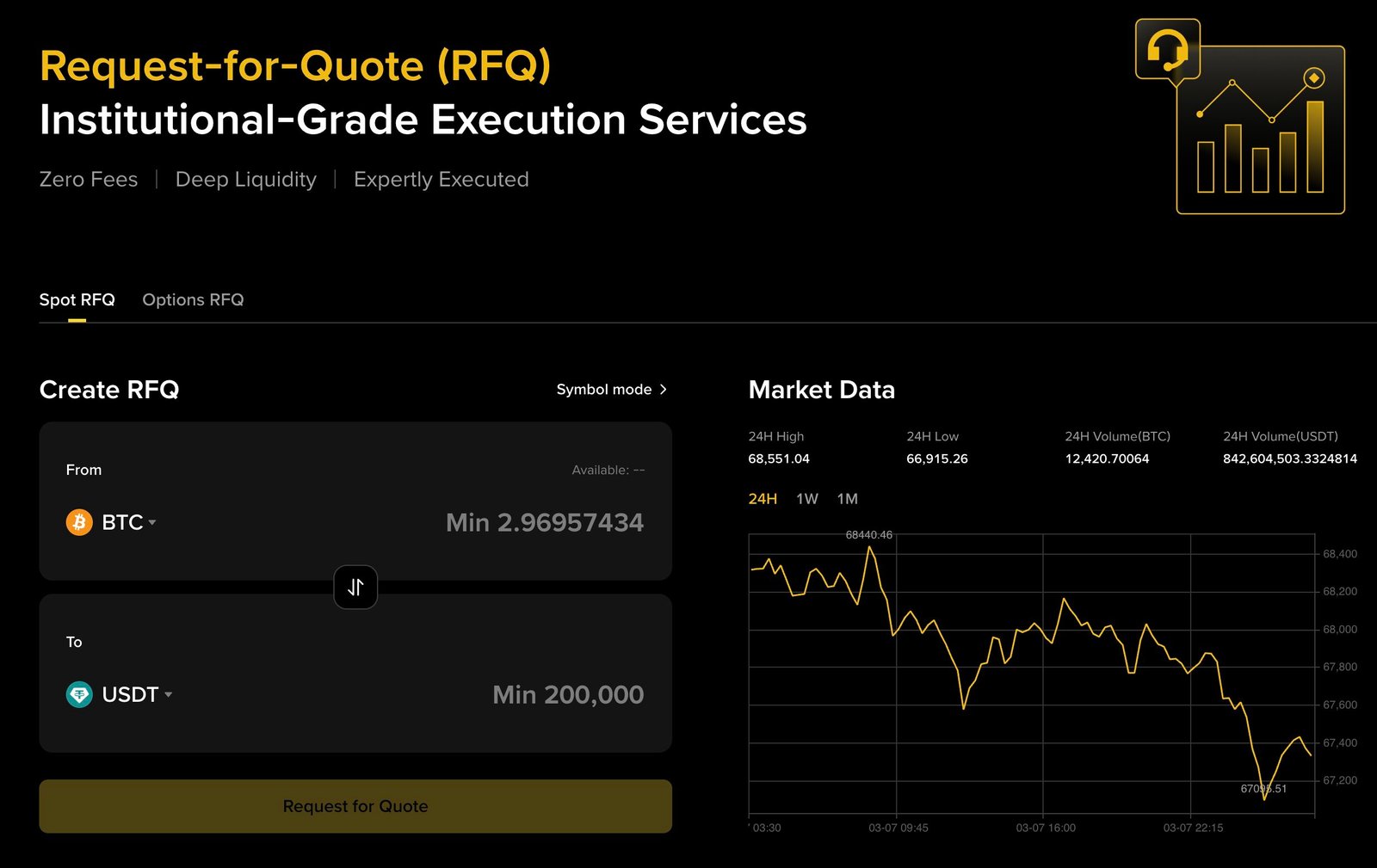
These desks combine the liquidity of exchange markets with the privacy and efficiency of OTC execution.
There are also specialized algorithmic market makers such as Wintermute, B2C2, and Flow Traders. These firms focus heavily on OTC trading crypto and liquidity provisioning across dozens of digital asset markets.
What these providers have in common is strong capitalization, secure custody partnerships, and a global client network capable of supporting multi-million-dollar trades.
OTC trading crypto is not theoretical. It is used daily by institutions to move enormous positions efficiently. Consider a hedge fund that decides to allocate $120 million into Bitcoin. If the fund attempted to purchase that amount on a public exchange, the order could easily push the price upward by several percentage points.
Instead, the fund contacts an OTC desk. The desk aggregates liquidity from multiple sources such as miners, long-term holders, and institutional sellers. Within minutes, the entire order is executed privately at a negotiated price very close to the market index. The trade settles quickly and leaves no immediate footprint on exchange order books.
Another common use case involves mining companies. Many large Bitcoin mining operations regularly sell hundreds of BTC each month to cover operational costs. Selling these coins on exchanges could depress prices and hurt profitability.
Mining companies therefore frequently establish long-term relationships with OTC trading crypto desks. These desks connect miners with institutional buyers who want steady Bitcoin supply.
Both sides benefit:
A third example involves corporate treasury allocations.
Several publicly listed companies that added crypto to their balance sheets used OTC desks. Large corporate trades often require strict compliance procedures, insurance coverage, and custody integration. OTC desks provide these services while ensuring the purchase does not create market volatility.

These examples highlight why OTC trading crypto has become a preferred execution method for large capital flows.
Although OTC trading is typically associated with institutions, high-net-worth individuals and sophisticated investors can also benefit from using OTC desks. However, careful preparation is essential. One of the most important recommendations is to start with smaller test trades. Executing a modest transaction first allows investors to evaluate the desk’s responsiveness, pricing transparency, and settlement speed before committing large capital.
Another valuable practice is comparing quotes across multiple desks. OTC desks make money through spreads, which means prices may vary slightly between providers. Requesting quotes from two or three desks for the same trade can reveal meaningful price differences. Even a small spread difference becomes significant for large trades. A 10-basis-point difference on a $10 million transaction equals $10,000.
Building relationships with trading desks also matters. OTC trading crypto often operates on relationship-driven networks. Dedicated relationship managers can provide market insights, alert clients to liquidity opportunities, and sometimes secure better pricing for repeat traders. Investors should also evaluate total transaction costs beyond the quoted spread. Custody fees, bank transfer charges, and compliance requirements can all influence the overall cost of executing large trades.
Finally, security practices should never be overlooked. Always verify wallet addresses, use secure communication channels, and confirm settlement instructions carefully. High-value crypto transfers require the same operational discipline as traditional financial transactions.
OTC trading crypto has become one of the most important mechanisms behind large digital asset transactions. While retail traders interact primarily with exchanges, institutions rely heavily on OTC desks to execute block trades efficiently and privately. By allowing direct negotiation between buyers and sellers, OTC trading removes the market impact and slippage associated with public order books. It also provides access to deeper liquidity pools and more flexible settlement structures.
At the same time, OTC trading requires careful counterparty selection and proper due diligence. Choosing reputable desks, verifying regulatory compliance, and following strong operational procedures help mitigate risks. For investors moving substantial capital, OTC desks provide a powerful execution channel that complements exchange trading rather than replacing it entirely. In a market that operates around the clock and across global jurisdictions, OTC trading crypto remains the quiet infrastructure behind some of the largest and most strategic transactions in the digital asset ecosystem.