Loading Search...


In this article, we explore the long standing one sided rivalry between Peter Schiff, the investor and Bitcoin, the asset.

Author: Sahil Thakur
Peter Schiff is an American stockbroker, financial commentator, and author. He is known for his libertarian economic views and strong support for gold. He gained widespread attention after warning about the housing bubble and excessive debt before the 2008 financial crisis. That prediction brought him significant recognition in financial circles.
Over time, Schiff built a prominent career in finance. He founded Euro Pacific Asset Management, formerly Euro Pacific Capital, where he serves as chief economist. He also chairs SchiffGold, a precious metals dealer. In addition, he has written several books on economics, including Crash Proof and The Real Crash. He also hosted The Peter Schiff Show, a long-running radio program.
Because of his consistently bearish outlook, many refer to Schiff as “Dr. Doom.” He frequently argues that sound money, especially gold, is superior to fiat currency. As a result, he often warns about inflation, currency debasement, and future economic crises.
At the same time, Schiff has become just as well known for his hostility toward Bitcoin. Over the past decade, he has positioned himself as one of its most vocal critics. He continues to question Bitcoin’s fundamentals while predicting its collapse, even as it grows in popularity. This tension between his gold-centered philosophy and Bitcoin’s rise as “digital gold” has become a recurring theme in financial media. The following sections explore why Schiff strongly opposes Bitcoin, what he has said over the years, and why he continues to promote gold and silver instead.
From the beginning, Peter Schiff has rejected Bitcoin. He views it as a speculative bubble rather than a meaningful monetary innovation. As early as 2013, when Bitcoin traded in the low hundreds, he dismissed it as “tulip mania 2.0.” He compared it to the Dutch tulip bubble rather than to digital gold. This view has shaped his commentary ever since.
At the core of Schiff’s argument is the belief that Bitcoin has no intrinsic value. He argues that it is not backed by a physical asset. It also does not generate cash flow. In his view, it serves no essential economic function. Because of this, he often compares Bitcoin to fool’s gold or a Ponzi-style scheme driven by speculation.
Schiff frequently claims that Bitcoin’s demand comes from the hope of reselling it at a higher price. He frames this as the “greater fool” theory. In interviews, he has said that Bitcoin is backed by nothing and offers no real utility beyond simple transfer. In a November 2023 appearance, he went further. He labeled Bitcoin a “pure Ponzi” and a pyramid scheme fueled by investor expectations of future buyers.
In addition, Schiff rejects the idea that Bitcoin can function as real money. During the 2017 bull market, he argued that cryptocurrencies would never become true currencies. He described the enthusiasm as speculation based on unrealistic expectations. To reinforce his point, he often compares crypto to the dot-com bubble. Just as many internet stocks collapsed, he believes cryptocurrencies will follow the same path.
Schiff also challenges Bitcoin’s scarcity argument. While Bitcoin has a fixed supply cap, he argues that new cryptocurrencies can be created endlessly. In his view, this unlimited creation dilutes the idea of digital scarcity. As more coins enter the market, he believes supply will overwhelm demand and push values lower.
Another major criticism centers on Bitcoin’s behavior during market stress. Schiff argues that Bitcoin is not a safe haven. He points to its tendency to rise during speculative booms and fall sharply during risk-off periods. In contrast, he sees gold as a proven store of value. When Bitcoin dropped sharply in 2020 and again in 2022, Schiff said those moves confirmed his position.
He often refers to Bitcoin as “digital fool’s gold.” According to Schiff, gold has value because of its physical properties, industrial uses, and long history as money. Bitcoin, by contrast, relies entirely on confidence. If that confidence fades, he argues, its value could disappear quickly.
Finally, Schiff insists that Bitcoin’s long-term value is zero. He dismisses rising prices as hype rather than proof of legitimacy. In 2019, he publicly stated that Bitcoin would never reach $100,000. Even after prices moved higher, he did not change his stance. In 2023, he reiterated that Bitcoin was headed to zero, just on a longer timeline. In his view, every rally is only a prelude to an eventual collapse.
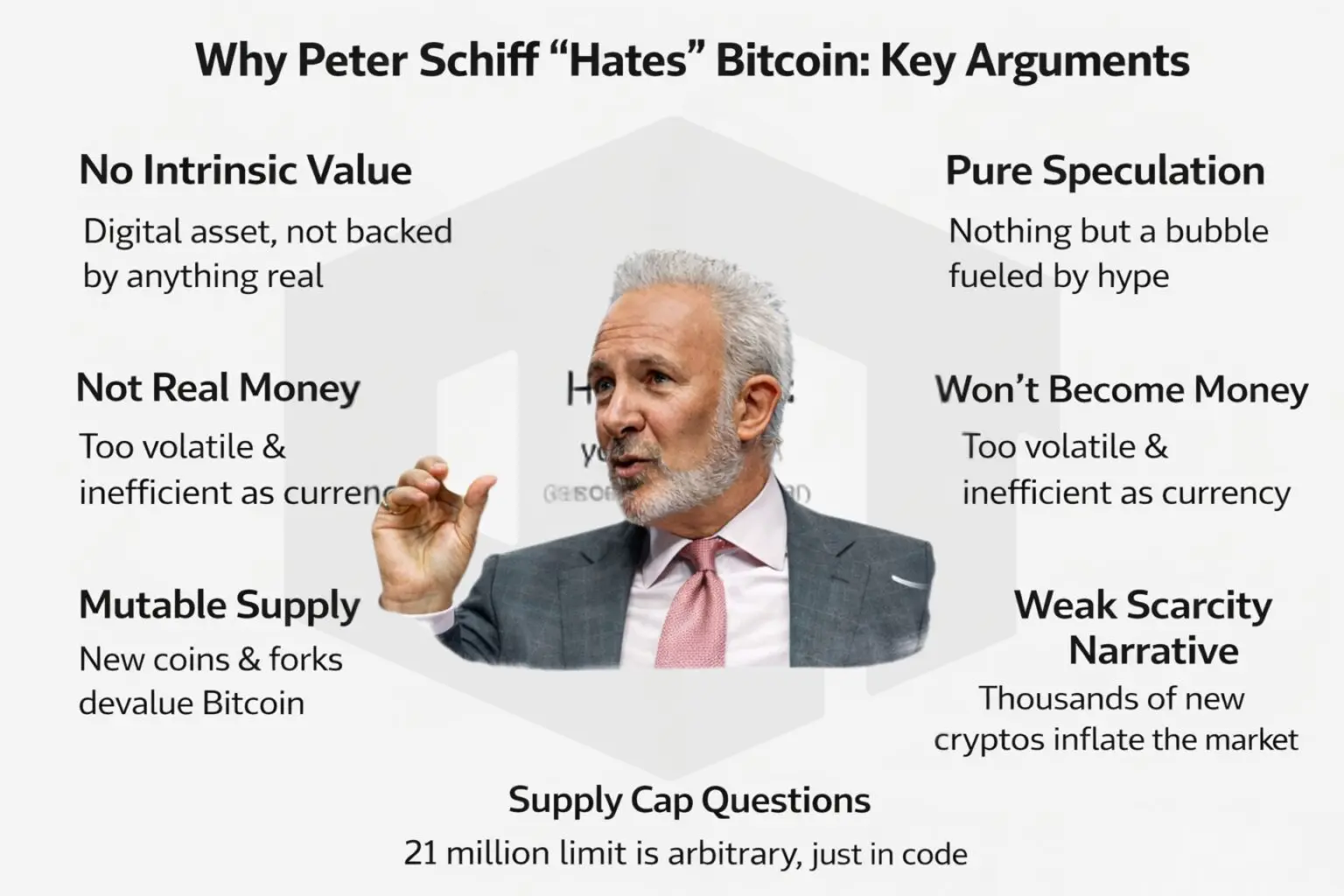
Peter Schiff’s opposition to Bitcoin rests on a set of arguments he repeats often. Together, they explain why he remains one of its harshest critics.
First, Schiff argues that Bitcoin has no intrinsic value. Because it is digital, it has no physical use or tangible backing. He contrasts this with gold, which is used in jewelry, electronics, and industry. Gold’s supply is also naturally limited. By comparison, Schiff says Bitcoin is not backed by anything real. Like fiat money, it depends entirely on trust. In his view, Bitcoin’s value exists only as long as people believe in it. If that belief disappears, nothing remains.
Next, Schiff describes Bitcoin as a purely speculative bubble. He believes people buy it only because they expect the price to rise. They do not buy it for inherent value or real utility. For this reason, he compares Bitcoin to tulip mania and the dot-com bubble. He argues that the same pattern is playing out again. According to Schiff, investors are speculating on a future that will never arrive, namely Bitcoin becoming a dominant global currency.
Schiff also insists that Bitcoin will never function as real money. He points to extreme price volatility and limited acceptance for everyday purchases. He also argues that Bitcoin is inefficient compared to cash systems or gold-backed frameworks. During the 2017 bull market, he stated clearly that cryptocurrencies would never become money. Since then, his position has not changed. He does not believe Bitcoin can replace fiat currency or operate as a stable medium of exchange.
Another major criticism involves supply. While Bitcoin has a fixed cap, Schiff focuses on the broader crypto market. He notes that thousands of alternative coins exist and more appear regularly. In his view, this creates inflation across the crypto asset class. As new coins keep launching, he believes supply will eventually overwhelm demand. Because of this, he argues that Bitcoin’s scarcity narrative is weak. If enthusiasm fades, investors can always move to a different coin.
Schiff also raises concerns about security and custody. He often points out that losing a wallet password means losing Bitcoin forever. This risk became personal for him in 2020. He contrasts this with gold, which does not disappear if someone forgets a code. Gold can be lost or stolen, but the metal itself retains value. For Schiff, digital wallets and private keys are too complex for most people. As a result, he sees Bitcoin as impractical for widespread use.
Finally, Schiff questions Bitcoin’s supply cap itself. He has called the 21 million limit arbitrary and meaningless. Unlike gold, whose scarcity comes from nature and mining costs, Bitcoin’s limit exists only in code. In his view, that code can be changed or easily replicated by other cryptocurrencies. Without underlying utility, he does not believe programmed scarcity guarantees value.
Peter Schiff has commented on Bitcoin for more than a decade. Over time, his remarks have followed a consistent pattern of skepticism. The timeline below highlights some of his most notable statements and predictions.
In 2013, Bitcoin crossed the $600 mark for the first time. At that point, Schiff dismissed it on CNBC as “tulip mania 2.0.” He argued that Bitcoin was not “gold 2.0” and described it as a speculative fad rather than a true store of value. This comment set the foundation for his long-term stance.
By 2017, Bitcoin entered a major bull run and traded around $4,000. During that period, Schiff warned that the market was a gigantic bubble waiting to explode. Speaking to TheStreet, he said Bitcoin would never become real money. He compared the crypto frenzy to the dot-com bubble and predicted a collapse. He also emphasized that new cryptocurrencies kept being created, which he believed would eventually overwhelm demand.
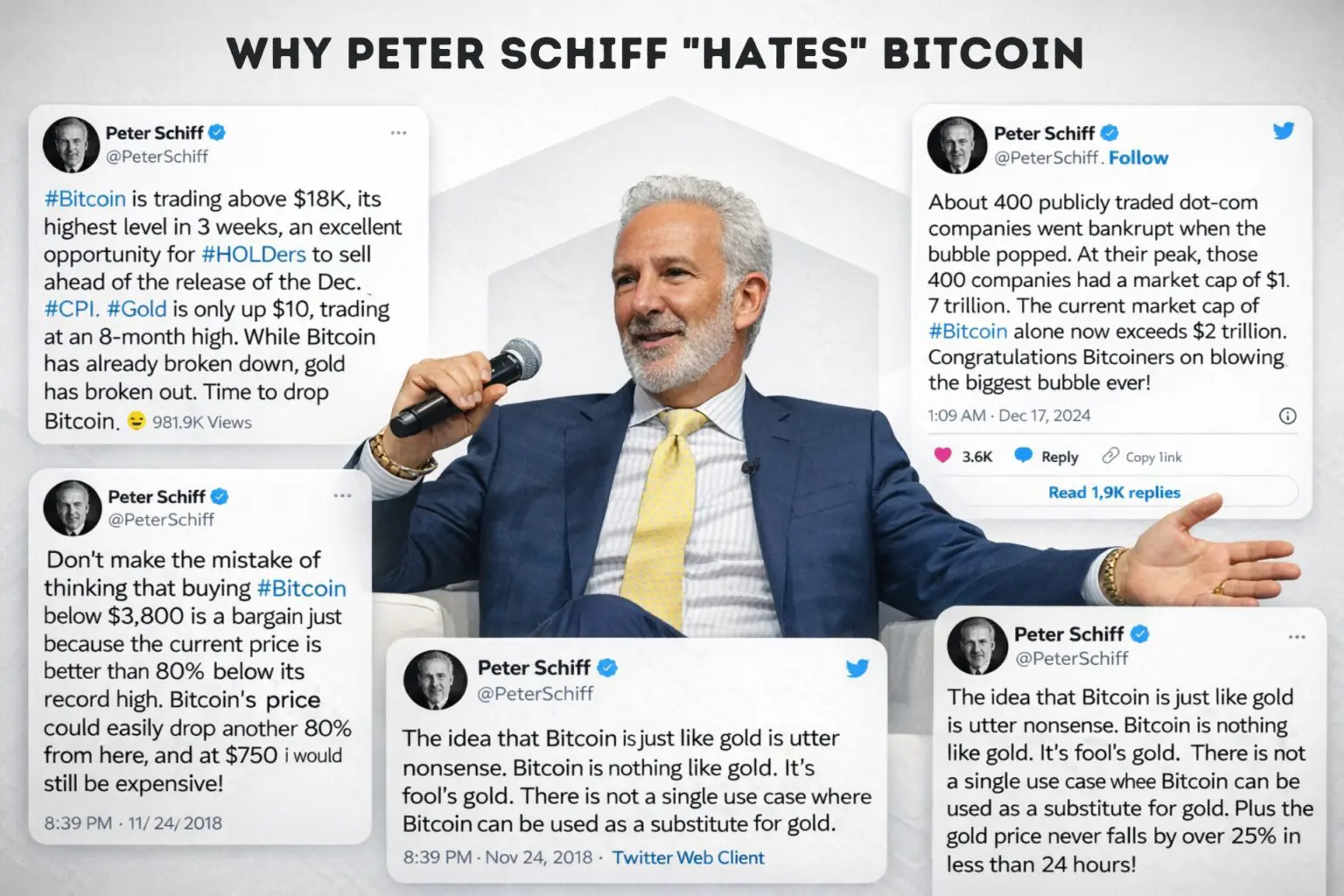
In 2019, Schiff mocked optimistic price targets. As Bitcoin hovered in the five-figure range, he tweeted, “Keep dreaming. Bitcoin is never going to hit $100,000!” That statement later became widely circulated as a meme. Bitcoin eventually reached nearly $69,000 in 2021 and surpassed $100,000 by late 2025.
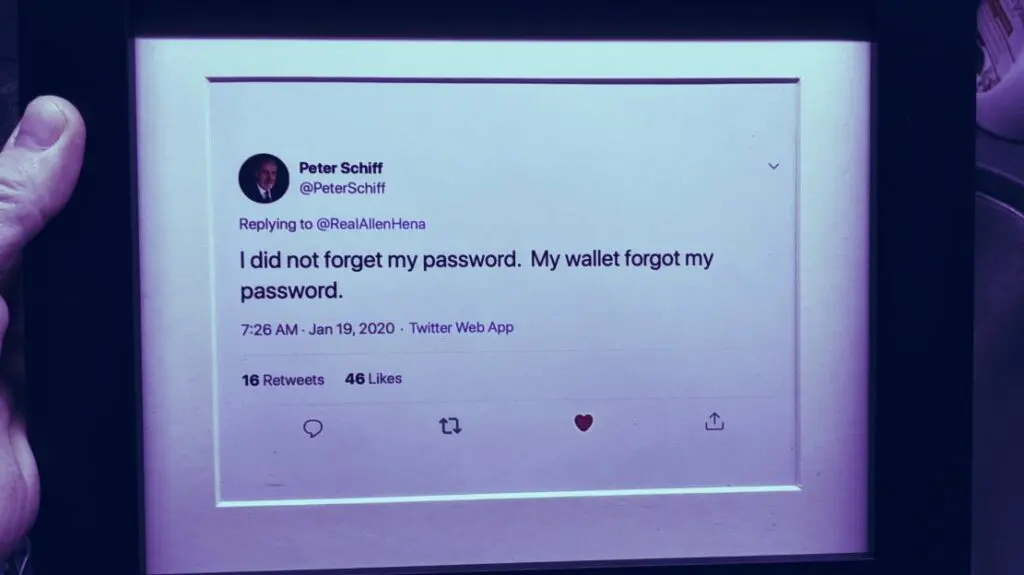
Early 2020 brought one of Schiff’s most infamous moments. In January, he announced that he had lost all the Bitcoin he ever owned after his wallet stopped accepting his password. He vented publicly, saying Bitcoin was not only intrinsically worthless but also had no market value to him anymore. The situation escalated when members of the crypto community suggested user error. Erik Voorhees later revealed that Schiff had forgotten his password and failed to save the recovery phrase. Schiff pushed back and blamed the wallet software. Despite the embarrassment, the episode reinforced his belief that Bitcoin was impractical. He remarked that the lost Bitcoin was “easy come, easy go” and joked that his ship had sunk before Bitcoin itself.
During the 2020 and 2021 bull market, Schiff stayed firmly bearish. As Bitcoin surged, he repeatedly warned that the rally was driven by hype. When Bitcoin reached $50,000 in 2021, he urged investors to sell before the bubble burst. Around the same time, his son Spencer publicly revealed that he had invested his entire portfolio in Bitcoin. Schiff criticized the decision and joked that his son had been brainwashed. This father-son disagreement became a recurring anecdote in the gold versus Bitcoin debate.
In 2023, Schiff showed no sign of softening his view. As Bitcoin rebounded from a bear market, he reiterated that it was still headed toward zero. He argued that the timeline did not matter. In his words, Bitcoin was “just taking longer to get there.” He added that only a complete replacement of fiat money would prove him wrong, a scenario he dismissed as unrealistic.
Later in 2023, Schiff briefly acknowledged a hypothetical regret. Speaking in early 2024 about past decisions, he admitted that he wished he had invested a small amount in Bitcoin in 2010. He noted that even a modest investment could have produced massive gains. However, he quickly added that he would have sold early. He explained that any purchase would have been a bet on others paying a higher price, not on Bitcoin’s real value. He again described Bitcoin as a speculative, Ponzi-like asset.
Toward the end of 2024, irony entered the picture. Disclosure filings revealed that a bond fund managed by Schiff’s firm had indirect exposure to Bitcoin through a Bitcoin-backed bond. The news surfaced publicly in April 2025. Crypto commentators quickly highlighted the contradiction. While it was unclear whether Schiff personally approved the investment, the episode underscored how deeply Bitcoin had penetrated traditional finance.
That same year, Schiff delivered one of his harshest warnings. In December 2025, Bitcoin traded sideways while gold, silver, and tech stocks rallied. Schiff declared that the Bitcoin trade was over. He argued that if Bitcoin could not rise during favorable conditions, it never would. He warned that holders should hope for a quick exit rather than a slow decline. Schiff also pointed out that Bitcoin had fallen sharply when measured against gold, which he said undermined the digital gold narrative.
As of early 2026, Schiff remains unmoved. He continues to predict Bitcoin’s collapse in media appearances and online commentary. He describes its valuation as a bubble sustained by belief alone. Over time, his repeated predictions have turned him into a meme within the crypto community. Traders often joke that his pessimism acts as a contrarian signal. Even so, Schiff remains confident that history will eventually prove him right, with gold rising and Bitcoin falling.
If Peter Schiff rejects Bitcoin, he strongly supports gold. In fact, gold sits at the center of his entire investment philosophy. For decades, Schiff has promoted precious metals as the best store of value. He believes they offer protection when fiat currencies weaken.
As a result, Schiff is often labeled a “gold bug.” He accepts the term. He argues that gold, and to a lesser extent silver, represents sound money. In his view, these assets preserve wealth when paper currencies fail.
Below are the main pillars of Schiff’s pro-gold and anti-fiat worldview.
First, Schiff sees gold as true money. He argues that gold has intrinsic value, a naturally limited supply, and global recognition. Unlike paper currency, gold cannot be printed at will. Its supply grows slowly through mining. Because of this, Schiff believes gold cannot be easily debased. He often points out that gold preserved purchasing power for centuries, including during the gold standard era. By contrast, modern fiat currencies have lost most of their value over time. He predicts that when trust in fiat collapses, gold-backed systems will return.
Second, Schiff views gold and silver as essential inflation hedges. He repeatedly warns that central bank money creation and rising government debt will trigger inflation or currency crises. In those conditions, he expects precious metals to surge. He interprets recent gold rallies as warning signs. To him, rising gold prices signal declining trust in the U.S. dollar. He has even claimed that the next financial crisis could dwarf 2008, urging people to pay attention to what gold prices are signaling.
Next, Schiff criticizes traditional stocks and bonds. He believes U.S. markets are overvalued and artificially supported by central bank policy. Because of this, he prefers hard assets and foreign equities. He often recommends commodities, mining stocks, and investments outside the United States. Still, for most investors, he places gold and silver at the top of the list. Notably, when Bitcoin hit record highs in late 2025, Schiff did not suggest buying tech stocks or real estate. Instead, he advised selling Bitcoin and buying silver, which he viewed as undervalued and ready to rise.
Despite rejecting cryptocurrencies, Schiff has embraced tokenized gold. Between 2023 and 2025, he launched TGold, a project that issues digital tokens backed by physical gold stored in vaults. His goal was to combine gold’s intrinsic value with the convenience of blockchain technology. Schiff explains that each token represents direct ownership of gold. The token itself is not the gold, but it proves ownership and can be redeemed. He compares this model to historical gold certificates. In his view, tokenized gold solves issues like transport and divisibility while preserving trust, as long as the gold is fully reserved and audited. This stance highlights a key distinction. Schiff rejects Bitcoin, but he accepts blockchain tools when they support assets he already trusts.
Beyond gold, Schiff frequently promotes silver. He calls it “poor man’s gold” and highlights both its monetary and industrial demand. He often notes that silver can outperform gold during inflationary periods. In 2025, he predicted a major silver rally, pointing to its explosive upside potential. He also occasionally supports real estate, though he remains cautious about bubbles. Across all asset classes, his preference is consistent. He favors tangible assets with clear use and scarcity.
One of the most highly-publicized clashes of Schiff’s anti-Bitcoin crusade came in December 2025, when he debated Binance founder Changpeng “CZ” Zhao live on stage at Binance Blockchain Week in Dubai. This event encapsulated the Bitcoin vs. gold argument in dramatic fashion – even featuring a live gold bar authenticity test that quickly went viral .
The debate was framed as “Bitcoin vs. Tokenized Gold”, since Schiff was promoting his TGold platform and CZ, as a major crypto exchange CEO, was defending Bitcoin. Despite their opposing views, both agreed on some basics at the start: tokenization can make gold more usable, and historically gold’s monetary value partly comes from collective belief (not purely industrial use) . But the discussion soon turned to “what gives money value in the digital age?”, and here the fun began.
Partway through, CZ surprised Schiff by bringing out a 1-kilogram gold bar on stage. He handed the bar to Peter Schiff and simply asked: “Is it real?” . Schiff examined the gold bar, looked for a mint stamp, and compared its color to his own gold bracelet. In front of the live audience, Schiff hesitated and admitted, “I don’t know.” . The crowd chuckled at the irony – the world’s most famous gold cheerleader couldn’t verify if the shiny bar in his hand was genuine gold or a fake. Schiff explained that because it was from an unfamiliar source (the bar had markings from Kyrgyzstan), he “would probably need to assay it to be certain” and noted the color looked slightly off . He stressed that usually one trusts reputed mints, otherwise testing is needed .
CZ’s point was brilliantly made: verifying physical gold in real time is hard. He highlighted that with Bitcoin, no such problem exists – “if I send you one Bitcoin right now, we can verify instantly that you received it,” CZ said . Bitcoin’s blockchain provides immediate, trustless verification of transactions and total supply, whereas gold relies on assays, certifications, and trusting vaults. The audience’s laughter and applause during this segment underscored how CZ turned Schiff’s own turf (gold’s trustworthiness) into a pain point. As one summary noted, this “gold-bar test fail made the case for Bitcoin as ‘better gold’”, at least in terms of verifiability . Even the London Bullion Market Association acknowledges that only a destructive test (melting the bar, i.e. fire assay) can 100% confirm a gold bar’s purity, which isn’t practical on the spot .
The debate ended amicably with a polite stalemate reflective of their views. CZ predicted that Bitcoin would continue to outperform gold in the long run, citing its historical ROI and growing adoption, whereas Schiff remained adamant that precious metals would ultimately outshine digital assets as people realize Bitcoin’s flaws . Neither man convinced the other (as expected), but the audience gained a clear view of the contrasting philosophies. The “gold bar question” moment, however, clearly favored CZ’s narrative by illustrating a real problem with gold in a lighthearted way.
This event also generated buzz on social media. Clips of Schiff holding the gold bar and saying “I don’t know” if it’s real were widely shared , much to Bitcoiners’ amusement. Binance’s own account and others noted how “Peter Schiff failed the gold test” and how “CZ argues Bitcoin is superior” because you can’t fake or confuse a Bitcoin transfer . Even SchiffGold’s website spun the debate afterwards, with Schiff insisting that tokenized gold beats Bitcoin when considering intrinsic value, despite the verifiability issue . In any case, the Schiff vs. CZ debate has become a landmark anecdote symbolizing the clash between old-world gold and new-age Bitcoin.
Peter Schiff’s relationship with Bitcoin reflects consistent opposition. For more than a decade, he has remained one of its most vocal critics among prominent investors. He rarely misses a chance to call Bitcoin worthless or destined to fail. Over the years, he has labeled it a bubble, a Ponzi scheme, and a trade headed for a slow collapse. He has held this view even as Bitcoin continued to grow and reach new highs.
At the same time, Schiff’s conviction comes from a long-held belief system. He places deep trust in gold and other hard assets. That framework leaves little room for Bitcoin. As a result, he has struggled to acknowledge Bitcoin’s successes. When he does, it is usually limited to admitting he could have profited by trading it early, not by believing in it.
To Schiff, the comparison is simple. Gold represents ancient money with tangible value. Bitcoin, in his view, represents a temporary craze with no intrinsic worth. He has maintained this position despite growing institutional adoption and repeated recoveries after major crashes. Meanwhile, the crypto community often highlights his missed calls. Many Bitcoin holders who ignored his advice have outperformed gold by a wide margin over the past decade. Bitcoin’s market value has even surpassed major traditional assets at times, including silver. That reality directly challenges Schiff’s narrative.
Still, Schiff argues that the story is unfinished. He believes the final outcome will favor gold. If fiat currencies collapse and inflation accelerates, he expects gold to endure. He expects Bitcoin to fade away. As of February 2026, he continues to warn of economic turmoil and urges investors to choose gold over what he calls digital fantasy money.
Whether one agrees with him or not, Schiff plays an important role in the broader debate. His skepticism forces Bitcoin supporters to confront questions about value, utility, and trust. It also keeps the discussion grounded in economic fundamentals. Even clashes between gold advocates and crypto supporters have produced new ideas, such as tokenized gold and deeper conversations about what money truly is.
Ultimately, Peter Schiff has become part of Bitcoin’s story. He is not a pioneer or a believer. Instead, he stands as its most persistent antagonist. His long-running feud with Bitcoin highlights a familiar pattern. Every disruptive innovation faces resistance from defenders of the old system. Whether Schiff will ever soften his stance, or whether Bitcoin will fail as he predicts, remains uncertain. For now, the Schiff versus Bitcoin saga continues, fueled by sharp criticism, bold forecasts, and ongoing controversy.