Loading Search...


What happens when all 21 million Bitcoins are mined? Discover Bitcoin’s supply limit, mining, halving and the final coin.

Author: Arushi Garg
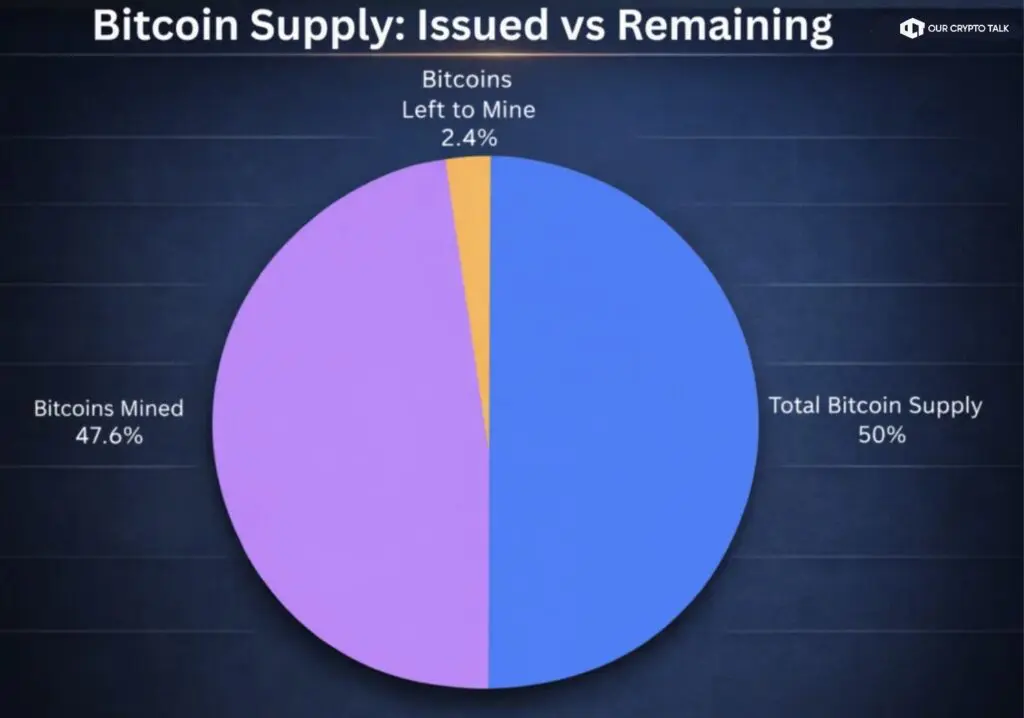
More than 95 percent of all bitcoin that will ever exist has already been mined. Bitcoins recently crossed a major milestone. More than 20 million bitcoins have now been mined, meaning over 95 percent of the total supply already exists. That leaves fewer than 1 million coins still to be created.
For people new to crypto, this milestone raises a simple but important question: what happens when all 21 million bitcoins are mined?
The short answer is that Bitcoin was designed to keep running long after the final coin is created. But understanding why requires a closer look at how Bitcoin’s supply system works and how miners are rewarded.
This guide explains the key ideas in plain language.
One of Bitcoin’s defining features is its fixed supply. Unlike traditional currencies, there will never be more than 21 million bitcoins in existence. Bitcoin’s creator, Satoshi Nakamoto, wrote this rule into the system in the 2008 Bitcoin whitepaper.
Satoshi Nakamoto, in the 2008 Bitcoin whitepaper, which outlines the network’s fixed supply and decentralized design. The supply cap follows a simple economic principle. Traditional fiat currencies, such as the US dollar or euro, can be printed by central banks. When governments increase the money supply, each unit of currency can lose purchasing power over time. This process, called inflation, can gradually erode the value of savings and incomes. In extreme cases, uncontrolled inflation can lead to hyperinflation, as seen historically in countries like Zimbabwe or Venezuela, where everyday goods became unaffordable because the currency lost value rapidly.
Satoshi Nakamoto designed Bitcoin to solve this problem by creating a form of digital money with predictable scarcity. Instead of relying on a central authority to control supply, Bitcoin uses a mathematical cap which is exactly 21 million coins. This limit is enforced by the network’s software and cannot be altered by anyone. No government, company, or individual can simply create more bitcoins beyond the total number of Bitcoins mined allowed by the protocol. The cap is built into the code itself, which is publicly visible and auditable by anyone using the blockchain.
New bitcoins enter circulation through a process called mining. Mining involves specialized computers called miners, which compete to solve complex cryptographic puzzles. While all miners are nodes, not all nodes mine, many simply validate and relay transactions to help maintain decentralization. These puzzles are not arbitrary. They validate transactions and secure the network against fraud.
When a miner successfully solves a puzzle and adds a block of transactions to the blockchain, they are rewarded with newly created bitcoins, called the block reward. This reward is how new bitcoins are introduced into circulation.
Mining is intentionally resource-intensive. The computing power and electricity required make it extremely difficult to add fraudulent transactions or rewrite history. This is one of the reasons Bitcoin is considered secure and decentralized.
Bitcoin recently passed an important milestone. More than 20 million Bitcoins have now been mined, meaning the vast majority of the total supply already exists. Since the maximum supply is 21 million coins, fewer than one million bitcoins remain to be created. At first glance, that might make it sound like the remaining supply will be mined quickly. But Bitcoin’s reward system slows production dramatically over time.
When Bitcoin first launched in 2009, miners earned 50 BTC for every block they added to the blockchain. Since then, several halving events have reduced that reward step by step.
The reward history looks like this:
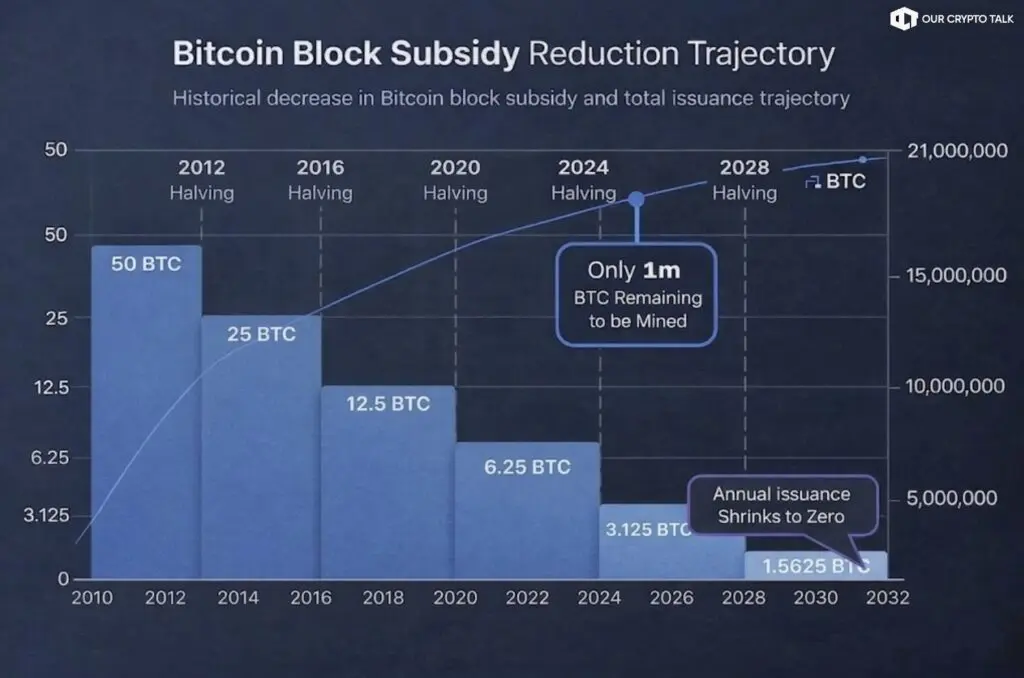
Each halving cuts the reward in half, and the process repeats roughly every four years. Because of this system, new bitcoins are released at a slower and slower rate over time. Even though more than 20 million Bitcoins have already been mined, the remaining supply will take over a century to mine. The final bitcoin is expected to be created around the year 2140. In other words, the 20 million milestone is significant, but Bitcoin’s issuance process is designed to stretch far into the future.
Not every bitcoin that has been mined is still accessible today. Over the years, some coins have been permanently lost because people misplaced private keys, forgot passwords, or discarded old hard drives containing wallets.
According to a report by Chainalysis, roughly 3.7 million BTC may already be permanently inaccessible due to lost private keys, forgotten passwords, or discarded storage devices.
For beginners, this highlights an important point: Bitcoin’s supply is not just limited. In practice, the usable supply may be even smaller over time, which could make the remaining coins more valuable if demand grows.
Will Bitcoin run out? No. The 21 million coin cap only limits new issuance. Even after the last bitcoin is mined, miners will continue to secure the network using transaction fees, ensuring Bitcoin keeps running indefinitely. To understand why, it helps to look at how miners earn money today. Miners currently receive two forms of compensation:
Right now, block rewards represent the largest share of miner income. But transaction fees are already an important part of the system. Whenever someone sends bitcoin, they usually attach a small fee to the transaction. That fee goes to the miner who includes the transaction in a block. As the block reward decreases over time, transaction fees are expected to make up a larger portion of miner revenue.
Eventually, when the last bitcoin is mined, transaction fees will become the only reward miners receive. Some in the mining community debate whether high fees could discourage small miners, but most analysts believe the network will remain secure as adoption grows. The transition will not happen suddenly. Over the next century, block rewards will shrink gradually, giving the network time to adjust. By the time the final bitcoin is mined, miners will rely solely on transaction fees. While some debate whether fees alone will always fully incentivize miners, most analysts believe growing adoption and higher fee volume will keep the network secure.
This long timeline is an important part of Bitcoin’s design.
Bitcoin’s limited supply is often cited as one of the main reasons people see it as a scarce digital asset. The concept is fairly straightforward: when something is difficult to produce and limited in quantity, it can hold value over time. Gold is a classic example. Gold has been used as a store of value for centuries, partly because it is rare and expensive to mine. While new gold can still be discovered, its total supply grows very slowly, making it a reliable asset over the long term. Similarly, the number of Bitcoins mined is limited, reinforcing its scarcity as a digital asset.
Unlike gold or other natural resources, Bitcoin’s total supply is fixed at 21 million coins. The rules governing issuance are hard-coded into the software and verified by the network itself. This ensures that no one, whether a government, corporation, or individual, can arbitrarily create more bitcoins. Because of this, many supporters describe Bitcoin as deflationary money. In plain terms, this means the supply cannot expand to meet demand. If more people want to own bitcoin while the supply remains fixed, economic principles suggest that the price could rise over time.
However, supply alone does not determine value. Demand is equally important, and it can fluctuate for a variety of reasons.
To put this into perspective for beginners, imagine Bitcoin like a limited-edition collectible. If only 1,000 rare figurines exist and more people want them each year, their value tends to increase. But if fewer people care about collecting them, scarcity alone doesn’t make them valuable. The same principle applies to Bitcoin: scarcity is necessary but not sufficient for long-term price growth.
Ultimately, while Bitcoin’s fixed supply and the fact that Bitcoins mined will never exceed 21 million create a foundation for potential long-term value, it does not guarantee price increases. Beginners should understand that scarcity provides a framework, but actual value depends on a complex mix of utility, adoption, and market dynamics. Thinking of Bitcoin simply as “digital gold” is helpful, but it is also a unique asset with characteristics unlike any other. By understanding both its fixed supply and the factors influencing demand, newcomers can get a clearer picture of why Bitcoin’s price behaves the way it does.
For newcomers, the 20 million milestone is an interesting moment in Bitcoin’s history. It shows how far the network has progressed since its launch in 2009. But it should not be treated as a signal to rush into buying Bitcoin or to make investment decisions based on a single statistic. The most useful takeaway is understanding how Bitcoin’s supply system works.
Unlike traditional currencies, Bitcoin operates on a transparent and predictable schedule. Anyone can see how many coins exist today and how many will be created in the future. Even though fewer than one million bitcoins remain to be mined, the final coin will not appear for more than a century. That means the supply cap is a long-term structural feature, not a short-term event. For beginners, it is far more valuable to focus on learning the fundamentals of the Bitcoin network, including:
As Bitcoin moves toward its supply cap, the bigger story is how the technology, users, and financial systems around it evolve. The 21 million limit forms the foundation, and what gets built on top of it is still unfolding.
This article is for educational purposes only and should not be considered financial advice.



What Happens When All 21 Million Bitcoins Are Mined? A Beginner’s Guide
Why Does The Ethereum Foundation Keep Selling ETH?
The CLARITY Act Explained: What It Means for Your Crypto
Meta To Onboard 3.6 Billion Users Onto Web3
What Happens When All 21 Million Bitcoins Are Mined? A Beginner’s Guide
Why Does The Ethereum Foundation Keep Selling ETH?
The CLARITY Act Explained: What It Means for Your Crypto
Meta To Onboard 3.6 Billion Users Onto Web3