Loading Search...



Two years after approval, the spot Bitcoin ETFs market holds over $120B in assets, driving institutional adoption, and market maturity.

Author: Kritika Gupta
The U.S. Securities and Exchange Commission approved the first spot Bitcoin ETFs, ending a decade of regulatory resistance and reshaping how investors access Bitcoin on January 11, 2024. Unlike earlier futures-based products, these hold actual Bitcoin. As a result, they track price movements more accurately, reduce structural costs, and fit seamlessly into traditional portfolios.
Two years later, spot Bitcoin ETFs rank among the most successful ETF launches in modern financial history. They have attracted tens of billions in net inflows, surpassed $120 billion in assets under management, and generated more than $2 trillion in cumulative trading volume.
More importantly, these products changed Bitcoin’s role in global markets. Bitcoin no longer sits only at the edges of finance. Through spot Bitcoin ETFs, it now appears inside pension funds, registered investment advisors, hedge funds, and corporate balance sheets.
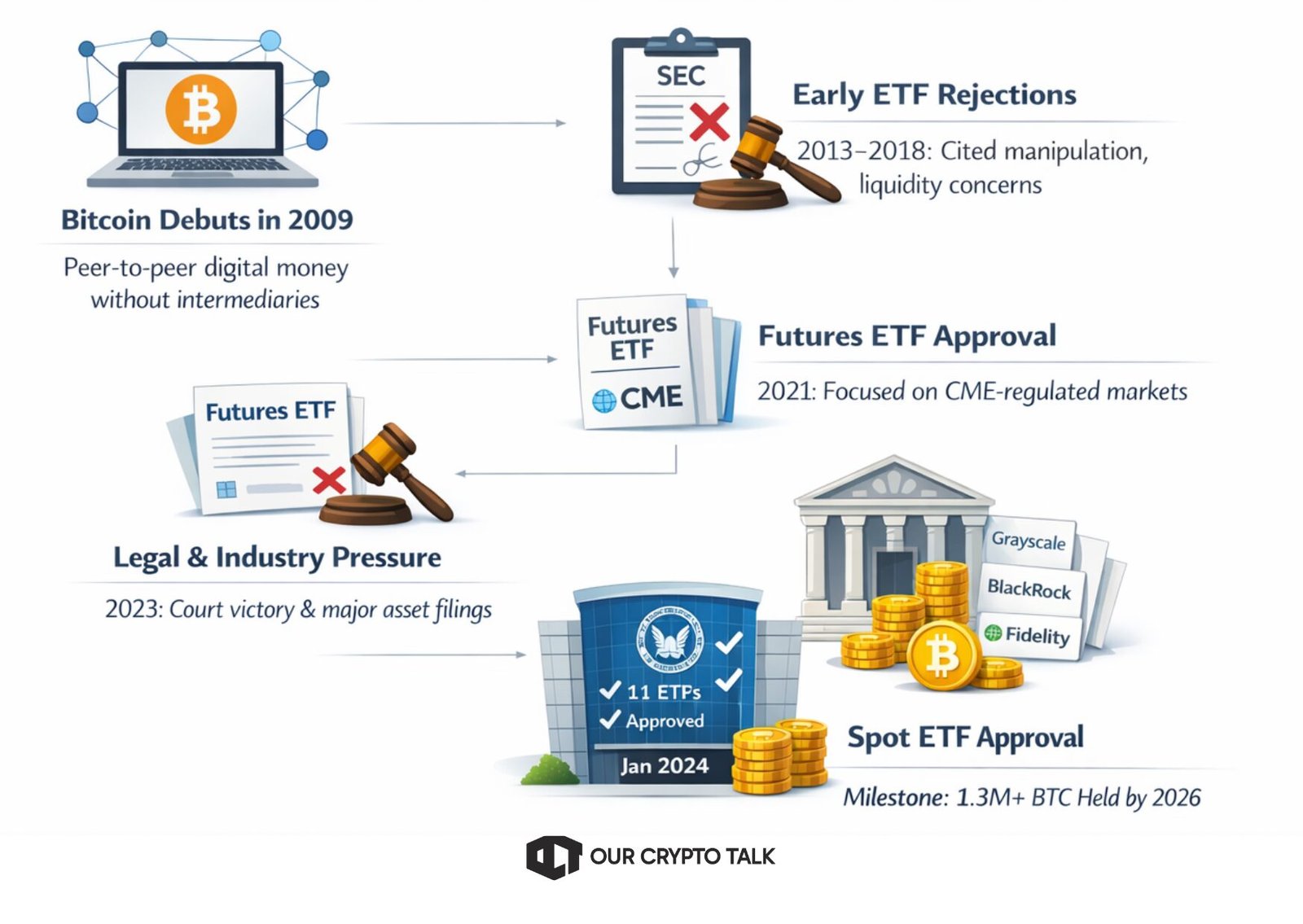
Bitcoin launched in 2009 as a peer-to-peer monetary system without intermediaries. However, institutional adoption faced immediate regulatory and structural barriers.
Early spot ETF proposals, including the Winklevoss Bitcoin Trust in 2013, failed repeatedly. At the time, the SEC cited market manipulation risks, fragmented liquidity, and weak surveillance mechanisms.
Over time, the agency softened its stance slightly. In 2021, regulators approved futures-based Bitcoin ETFs because those products relied on CME-regulated markets. Still, futures ETFs introduced meaningful drawbacks.
Because futures often traded above spot prices, investors absorbed losses through contango. Consequently, these products struggled to deliver long-term efficiency.
By 2023, pressure intensified. Grayscale won a court ruling that labeled the SEC’s rejection of its spot ETF conversion as arbitrary. Meanwhile, BlackRock, Fidelity, and other asset managers filed new applications supported by improved custody, surveillance-sharing agreements, and compliance controls.
Ultimately, in January 2024, the SEC approved 11 spot Bitcoin ETFs simultaneously. The decision reflected legal constraints and a market infrastructure that regulators could no longer ignore.
Two years later, spot Bitcoin ETFs hold more than 1.3 million BTC, representing over 6 percent of total supply. In hindsight, these products validated years of unmet institutional demand.
When spot Bitcoin ETFs launched on January 11, 2024, they immediately rewrote ETF history. On the first day alone, the 11 approved funds generated $4.6 billion in trading volume. BlackRock’s IBIT, Fidelity’s FBTC, and Grayscale’s converted GBTC led activity across major U.S. exchanges.
Soon afterward, inflows accelerated sharply. By March 2024, spot Bitcoin ETFs attracted more than $10 billion in net inflows, moving in step with Bitcoin’s rally toward $73,000.
Several factors supported this rapid momentum. Asset managers introduced aggressively low fees, brokerage platforms integrated the products seamlessly, and investors gained exposure without facing custody, security, or operational hurdles.
By mid-2024, ETF holdings surpassed 800,000 BTC. As a result, liquidity deepened, bid-ask spreads tightened, and overall market efficiency improved. Momentum continued into 2025. By May, cumulative trading volume crossed $1 trillion. By January 2026, total volume doubled to more than $2 trillion in less than eight months.
Early 2026 delivered mixed signals. January opened with $1.2 billion in inflows, led by IBIT’s $372 million on January 5. A subsequent three-day streak added $1.7 billion and pushed Bitcoin above $97,000.
However, volatility returned later in the month. Over three days, ETFs recorded $1.1 billion in outflows. Even so, a record $753.8 million inflow on January 13 confirmed that institutional demand remained resilient.
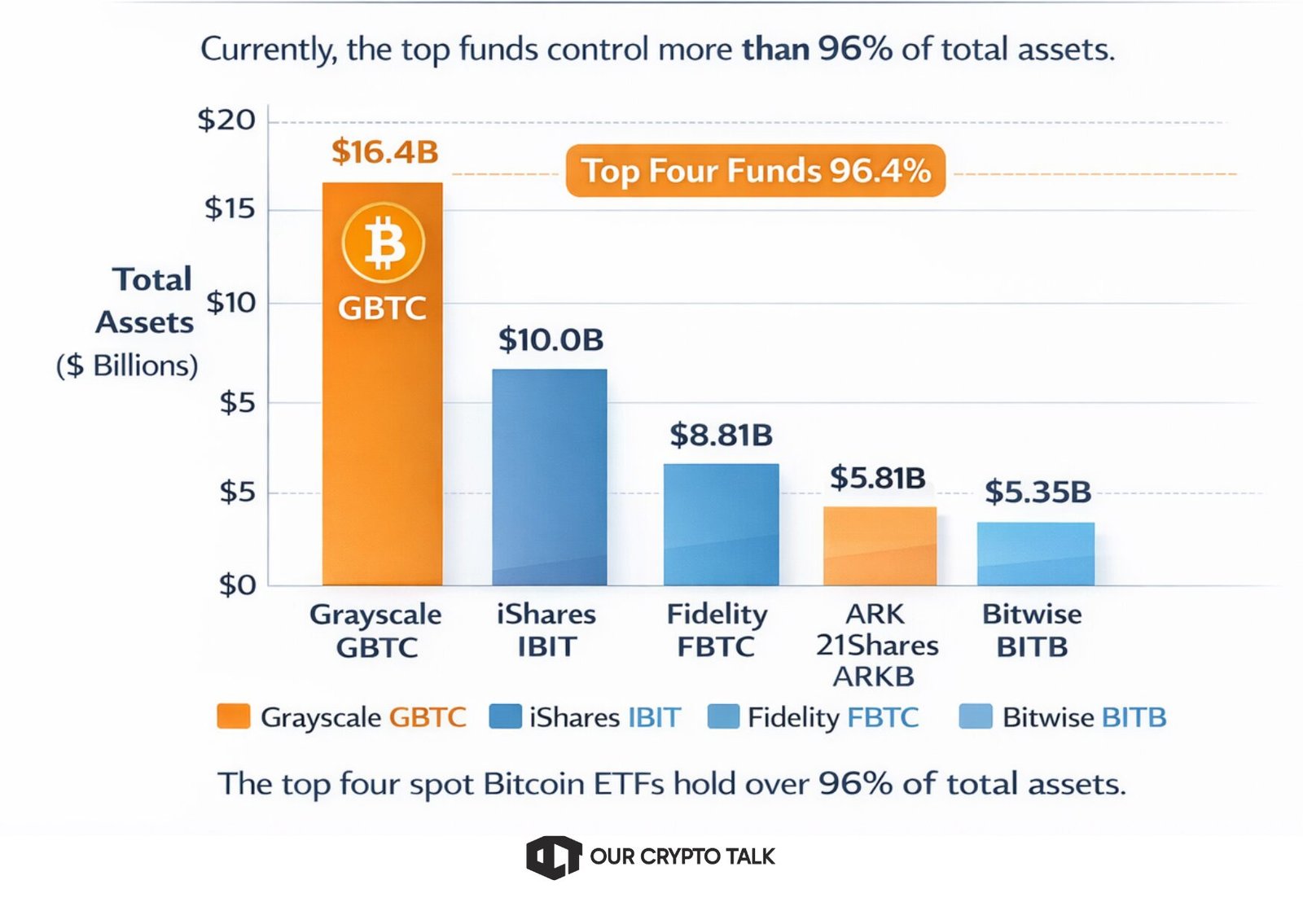
Currently, the top funds control more than 96 percent of total assets. This outcome closely mirrors traditional ETF markets, where liquidity, scale, and brand trust naturally attract capital.
BlackRock’s IBIT leads the market with approximately $74.11 billion in assets under management. Fidelity’s FBTC follows at around $18.89 billion, benefiting from competitive fees and broad advisor adoption.
Grayscale’s GBTC still holds roughly $16.4 billion in assets, even after experiencing heavy outflows following its conversion to an ETF. ARK 21Shares’ ARKB and Bitwise’s BITB trail behind, with assets of about $5.81 billion and $5.35 billion respectively.
Fee structures explain much of this divergence. GBTC’s 1.5 percent management fee pushed investors toward lower-cost alternatives, while funds charging below 0.3 percent steadily captured incremental inflows.
Although this concentration improves liquidity and execution quality, it also introduces systemic exposure. As a result, large redemptions from a dominant fund can amplify short-term volatility and shift market sentiment quickly.
Despite their strong adoption, spot BTC ETF still carry meaningful risks that investors must consider.
Bitcoin’s price volatility remains the most significant concern. Sharp market swings have triggered rapid inflows and outflows, particularly during late 2025 and early 2026. During several correction periods, ETFs recorded multi-day outflows without an immediate recovery in price, highlighting sensitivity to short-term sentiment.
Concentration risk also plays a central role. A small number of issuers control the majority of assets, which increases the market’s exposure to fund-specific events. As a result, large redemptions from a dominant ETF can quickly influence liquidity conditions and broader market sentiment.
In addition, management fees reduce long-term returns over time. While some funds charge as little as 0.12 percent, others remain significantly more expensive. These costs compound, especially for investors using ETFs as long-term holdings rather than tactical instruments.
Two years after approval, spot Bitcoin ETFs have permanently reshaped Bitcoin’s relationship with traditional finance.
By offering regulated, liquid, and operationally simple exposure, they moved Bitcoin into mainstream portfolios and institutional allocation models. With more than $120 billion in assets and consistent inflows, spot Bitcoin ETFs now influence liquidity, volatility, and market structure.
Looking ahead, adoption appears far from complete. As regulatory clarity improves and global ETF access expands, these products may attract tens of billions more in capital.
Ultimately, spot Bitcoin ETFs proved that digital assets can integrate into established financial systems while retaining relevance. For investors seeking measured exposure, they now represent a durable cornerstone rather than a temporary experiment.



AI Agent Payments Explained: Circle Nanopayments and the x402 Protocol
Top 7 Projects in the World Liberty Financial (WLFI) Portfolio
Where Crypto Actually Makes Money in 2026?
What If Satoshi Nakamoto Was Here in 2026?
AI Agent Payments Explained: Circle Nanopayments and the x402 Protocol
Top 7 Projects in the World Liberty Financial (WLFI) Portfolio
Where Crypto Actually Makes Money in 2026?
What If Satoshi Nakamoto Was Here in 2026?