Loading Search...


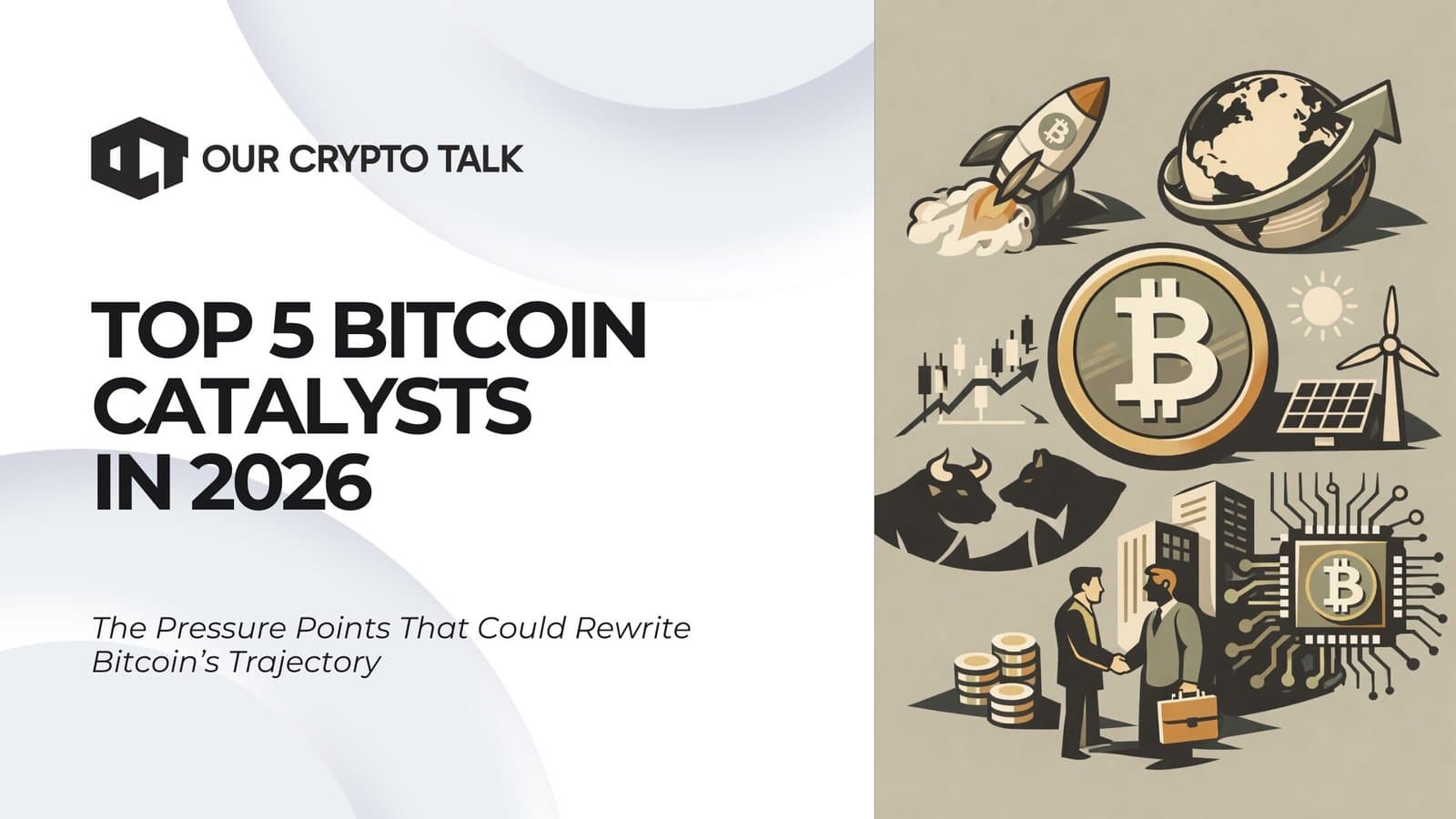
The top 5 Bitcoin catalysts in 2026, from regulation and institutional flows to liquidity cycles and global economic shifts.

Author: Kritika Gupta
Bitcoin catalysts are coming into focus as we move deeper into 2026. Bitcoin now sits at a critical inflection point. After a volatile 2025, prices surged above $126,000 before correcting sharply. Today, Bitcoin trades near $92,000 as markets absorb macro uncertainty, regulatory signals, and shifting liquidity conditions. However, this consolidation does not signal weakness. Instead, it marks a necessary pause as structural forces realign ahead of the next major move.
Against this backdrop, the top bitcoin catalysts in 2026 matter far beyond short-term price narratives. Rather than relying on speculation, they show how Bitcoin continues to integrate into global finance. For example, regulation is becoming clearer, institutional capital is expanding, sovereign interest is growing, and technology adoption is accelerating. Meanwhile, ETF inflows continue to rise, global liquidity remains near historic highs, and political momentum shifts toward crypto-friendly frameworks. As a result, 2026 increasingly appears set to mark Bitcoin’s transition from cyclical speculation to sustained, demand-driven growth.
Daily issuance has fallen to roughly 450 BTC, tightening supply in a world still grappling with debt expansion, fiscal deficits, and persistent currency debasement. As a result, scarcity now interacts directly with institutional demand rather than retail speculation alone.
At the same time, the volatility of 2025 exposed Bitcoin’s sensitivity to macro conditions. However, stabilization in the $90,000 to $95,000 range now signals a growing base of long-term holders supported by structured inflows. Spot Bitcoin ETFs alone have attracted more than $87 billion since launch, absorbing a meaningful portion of new supply and reinforcing price stability.
More importantly, the reason catalysts matter has become increasingly clear. Bitcoin is shifting away from four-year boom-bust cycles and toward liquidity-driven price discovery. In this environment, global M2 expansion, central bank policy, and regulatory clarity exert far more influence than social media momentum or retail leverage. With less than 0.5 percent of advised U.S. wealth currently exposed to crypto, the runway for allocation shifts remains substantial.
Without catalysts, Bitcoin risks extended range-bound trading. However, with them, sustained inflows can overwhelm limited supply. For this reason, identifying the top 5 biggest Bitcoin catalysts in 2026 remains essential for understanding where the market may head next.

The anticipated progress of U.S. market structure legislation, including the Clarity for Payment Stablecoins Act, could finally resolve long-standing jurisdictional uncertainty between the SEC and CFTC.
Once regulators clearly classify Bitcoin as a commodity, enforcement risk declines sharply. In turn, this clarity opens the door for broader institutional participation. Banks, asset managers, and custodians have waited years for this moment. When it arrives, products such as direct custody, managed allocations, and retirement account exposure become viable at scale.
Meanwhile, regulatory normalization continues globally. Europe’s MiCA framework moves steadily from theory into execution, while emerging markets increasingly explore Bitcoin reserves as inflation hedges. Simultaneously, political incentives align. Pro-growth fiscal policies, tax adjustments, and easing capital constraints continue to favor risk assets.
The mechanism remains straightforward. Reduced regulatory uncertainty lowers compliance costs and reputational risk. As a result, capital that once remained sidelined can finally enter the market. Even partial legislative progress sends a legitimacy signal to institutions managing trillions in assets.

Building on regulatory progress, institutional integration remains one of the most powerful forces among the top 5 biggest Bitcoin catalysts in 2026. Spot Bitcoin ETFs have already reshaped market structure by offering regulated, liquid exposure without custody complexity.
As regulatory risk declines, major asset managers continue expanding crypto offerings. Pension funds, endowments, and family offices now increasingly view Bitcoin as a macro hedge rather than a speculative trade. This shift in perception drives longer holding periods and more stable capital flows.
At the same time, a critical dynamic continues to unfold. ETFs regularly purchase more Bitcoin than miners produce. Consequently, this imbalance creates structural upward pressure during periods of steady inflows. Corporations reinforce this effect as well. MicroStrategy’s continued accumulation strategy has inspired similar treasury approaches across the corporate landscape.
Importantly, institutional demand also stabilizes volatility. Longer time horizons reduce panic selling and amplify price trends driven by liquidity rather than leverage. This shift supports smoother market behavior even during periods of macro stress.

Markets increasingly anticipate multiple rate cuts as inflation moderates and economic growth slows. Lower rates reduce the opportunity cost of holding non-yielding assets like Bitcoin. At the same time, fiscal stimulus and large-scale debt refinancing inject additional liquidity into the financial system.
Historically, Bitcoin has tracked global M2 growth closely. When liquidity expands, capital consistently seeks scarce assets. Bitcoin benefits from this dynamic more than most assets due to its fixed supply and global accessibility.
Additionally, a weaker dollar further supports risk assets. While inflation risks remain present, current consensus favors easing over tightening. In this environment, institutional inflows and ETF demand exert an even stronger influence.
Macroeconomic tailwinds do not act in isolation. Instead, they magnify other drivers, making liquidity one of the most important contributors among the top 5 biggest Bitcoin catalysts in 2026.

Alongside macro forces, technology adoption adds depth to Bitcoin’s narrative in 2026. Tokenization of real-world assets, stablecoin growth, and fintech integration continue expanding blockchain utility beyond speculation.
Increasingly, tokenized bonds, equities, and payment rails rely on public blockchains for settlement and transparency. While Bitcoin remains primarily a store of value, its role as base collateral strengthens as on-chain finance scales.
At the same time, miners diversify into high-performance computing and AI infrastructure. This shift stabilizes revenue while reinforcing network security. Payment platforms also integrate crypto rails, steadily improving usability for non-technical users.
Together, this technological backdrop attracts both capital and users, indirectly supporting Bitcoin’s valuation. As utility-driven adoption grows, reliance on hype cycles diminishes.

Countries facing currency instability or heightened geopolitical risk increasingly explore Bitcoin as a reserve asset. Even modest allocations reduce circulating supply meaningfully. Strategic reserves, sovereign funds, and state-backed entities amplify scarcity effects over time.
Beyond volume, the signaling effect carries equal importance. When governments treat Bitcoin as strategic infrastructure, institutional confidence follows quickly.
Although this catalyst remains unpredictable, it remains powerful. It interacts with every other driver by removing supply permanently from the market.
Given these dynamics, investors approaching Bitcoin in 2026 have multiple ways to express conviction, depending on risk tolerance and access.
Despite strong structural tailwinds, Bitcoin in 2026 still faces meaningful risks. Volatility remains elevated, and sharp drawdowns remain possible if liquidity tightens or ETF flows reverse. Regulatory progress could also stall due to political delays, extending uncertainty for institutions still on the sidelines.
Macroeconomic risks persist as well. Inflation surprises or policy missteps could force tighter financial conditions, pressuring risk assets broadly. In addition, competition from other digital assets may dilute capital inflows during speculative phases. Investors should size positions conservatively and monitor indicators such as CPI trends, rate expectations, and ETF net flows to manage downside risk effectively.
The top 5 biggest Bitcoin catalysts in 2026 reflect a market transitioning from speculative cycles to structural integration. Regulatory progress, institutional inflows, supportive macro conditions, expanding utility, and sovereign interest collectively reshape Bitcoin’s role in global finance.
While volatility and uncertainty remain unavoidable, the broader trajectory points toward deeper legitimacy and sustained demand. Ultimately, understanding these forces matters more than predicting short-term price moves. The catalysts are active, the framework continues to form, and 2026 may prove to be the year Bitcoin firmly steps into its next phase.



AI Agent Payments Explained: Circle Nanopayments and the x402 Protocol
Top 7 Projects in the World Liberty Financial (WLFI) Portfolio
Where Crypto Actually Makes Money in 2026?
What If Satoshi Nakamoto Was Here in 2026?
AI Agent Payments Explained: Circle Nanopayments and the x402 Protocol
Top 7 Projects in the World Liberty Financial (WLFI) Portfolio
Where Crypto Actually Makes Money in 2026?
What If Satoshi Nakamoto Was Here in 2026?