Loading Search...


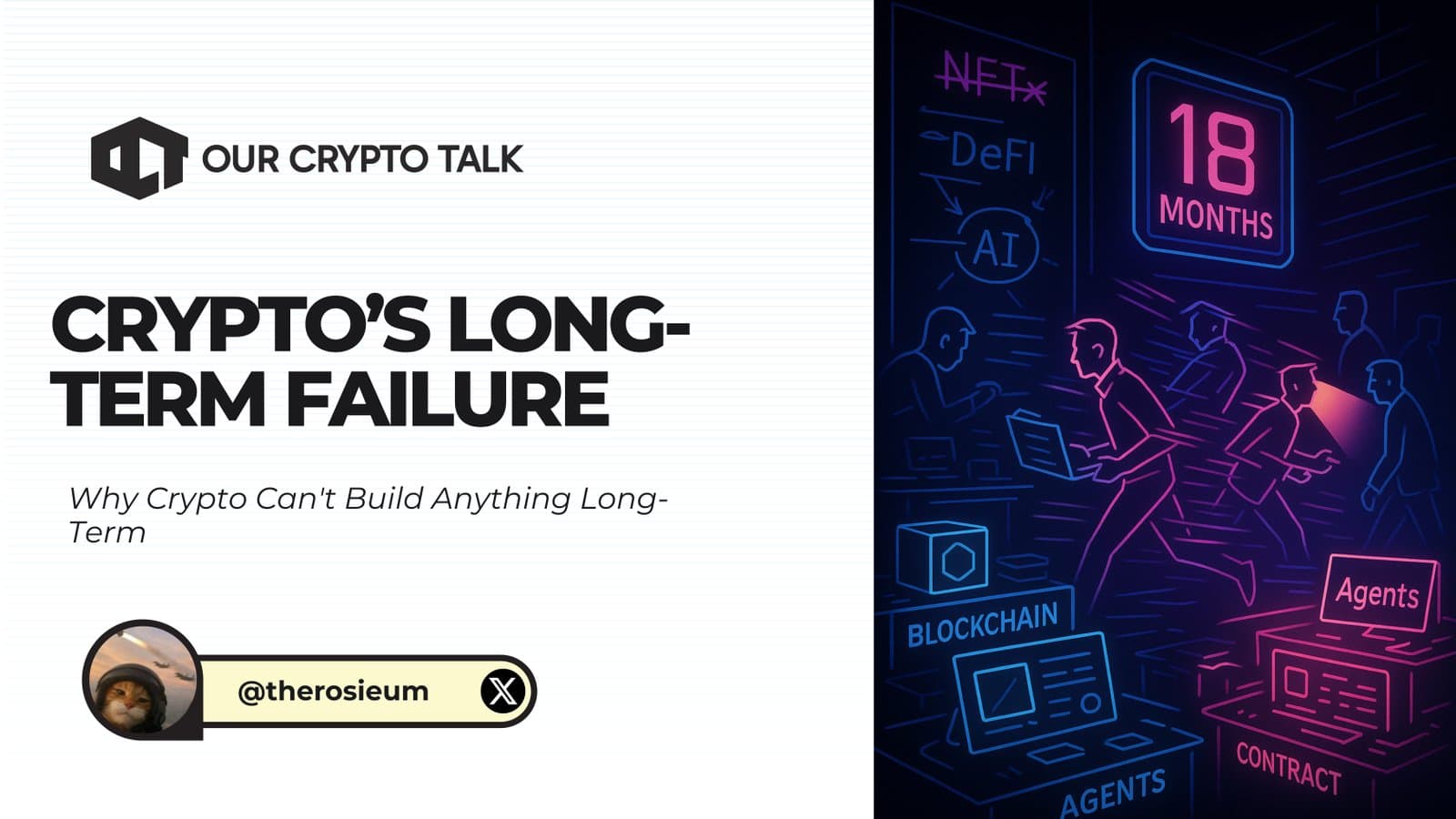
Crypto’s long-term failure comes from rapid narratives, constant pivots, misaligned incentives, and users who vanish the moment trends shift.
Crypto’s long-term failure is rooted in the reality that most founders are now on their third pivot, and no one even pretends otherwise.
Many of the same people who built NFT platforms in 2021 moved to DeFi yields in 2022, then to AI agents in 2023/24, and now naturally they’re working on prediction markets or whatever trend the current quarter demands.
And honestly? They’re not wrong to pivot. In many ways, they’re simply playing the game correctly. The problem is the game itself makes long-term building structurally impossible.
Narrative appears -> capital floods in -> every founder pivots -> they build for 6–9 months -> narrative dies -> pivot again.
This cycle used to last 3–4 years (ICO era). Then it shortened to 2 years.
Now? It’s 18 months, if you’re lucky.
Crypto venture funding dropped nearly 60% in a single quarter (Q2 2025), squeezing founders’ runway and accelerating the pivot cycle.
But here’s the core issue:
You can’t build real infrastructure in 18 months. You can’t achieve real product-market fit in 18 months. Meaningful products demand 3–5 years, not one market cycle.
Yet if you’re still building last year’s narrative, you’re considered “dead money.” Investors ghost you. Users disappear. Some VCs even demand you pivot.
Even your team quietly interviews at whichever project raised on this quarter’s hot storyline.
This is how Crypto’s long-term failure compounds itself the system punishes commitment and rewards perpetual reinvention.

Traditional business advice says: don’t fall for the sunk cost fallacy; pivot if it’s not working. Crypto mutated that into something far more extreme: Sunk-cost-maxxing.
Now nobody sticks with anything long enough to know if it works.



Every founder runs the same internal calculation:
Option A: Keep building your current product. It might start working in 2–3 years. There’s a chance you can raise again. And with some luck, people will still care by then.
Option B: Pivot to the hot narrative. Raise instantly. Show paper gains. Exit while sentiment is high.
Option B wins almost every time. And this is one of the clearest expressions of Crypto’s long-term failure, the rational move is the short-term move.
Very few crypto projects ever truly finish what they’re building. Most are stuck in a permanent “almost there” mode.
One more feature. Another upgrade. A fresh version you hope will finally unlock PMF. But halfway through, the narrative shifts, and suddenly your DeFi protocol once everything feels irrelevant. The market has moved on, and all anyone wants to talk about now is AI agents.
In crypto:
So the market punishes completion and rewards perpetual possibility. This dynamic reinforces Crypto’s long-term failure, the system is allergic to finality.
Which projects actually get funded?
VCs aren’t funding products they’re funding attention. And attention sticks to new stories, not finished systems. Most teams today are narrative-maxxing optimizing for the storyline that raises capital rather than the product that solves problems.
Finishing a product is a constraint. Not finishing keeps the narrative open-ended.
This is how Crypto’s long-term failure becomes inevitable: The market rewards momentum, not maturity.
Even if you want to finish what you’re building, your team won’t make it easy.
You can’t compete because you’re building something “boring” the thing you started last cycle.
Nobody wants to work at the stable, steady project. They want to work at the chaotic, over-funded, possibly soon-to-implode project that has a chance to 10×.
Good luck building a 5-year roadmap when your team is rotating every 6 months.
Crypto users aren’t stable either. They use your product because:
The moment the narrative moves, they leave. Doesn’t matter if your product improved. Doesn’t matter if you added everything they asked for.
You cannot build sustainable products for unsustainable users.
Many founders have pivoted so many times they don’t even remember what their original idea was:
Decentralized social -> NFT marketplace -> DeFi aggregator -> Gaming infra -> AI agents -> Prediction markets.
Pivoting stopped being strategy. It became the product. This is the purest behavior of Crypto’s long-term failure.
The things that last in crypto Bitcoin, Ethereum were built before crypto was flooded with attention, VC capital, and speculative liquidity.
Most things built during hype cycles die with those cycles. Things built between cycles have a better shot.
But here’s the paradox:
Nobody builds between cycles because there is no funding, no attention, and no exit liquidity.
The crypto system structurally avoids long-term construction. Another pillar of Crypto’s long-term failure.
Crypto’s speed is both its superpower and its fatal flaw.
Crypto promises velocity. Long-term building requires patience. These two values cannot coexist.
Crypto struggles to build anything long-term because its structure pushes participants away from long-term thinking. Yes, you can be the principled founder who refuses to pivot, who commits to a multi-year roadmap, who ignores narratives and focuses on fundamentals.
But be prepared:
The market doesn’t reward finishing. It rewards starting something new repeatedly, endlessly.
Maybe crypto’s true innovation isn’t the technology. Maybe it’s the ability to extract maximum value from minimum completion.
In the end…
Perhaps the product isn’t what you build. Perhaps the product is the pivot.

AI Agent Payments Explained: Circle Nanopayments and the x402 Protocol
Top 7 Projects in the World Liberty Financial (WLFI) Portfolio
Where Crypto Actually Makes Money in 2026?
What If Satoshi Nakamoto Was Here in 2026?
AI Agent Payments Explained: Circle Nanopayments and the x402 Protocol
Top 7 Projects in the World Liberty Financial (WLFI) Portfolio
Where Crypto Actually Makes Money in 2026?
What If Satoshi Nakamoto Was Here in 2026?